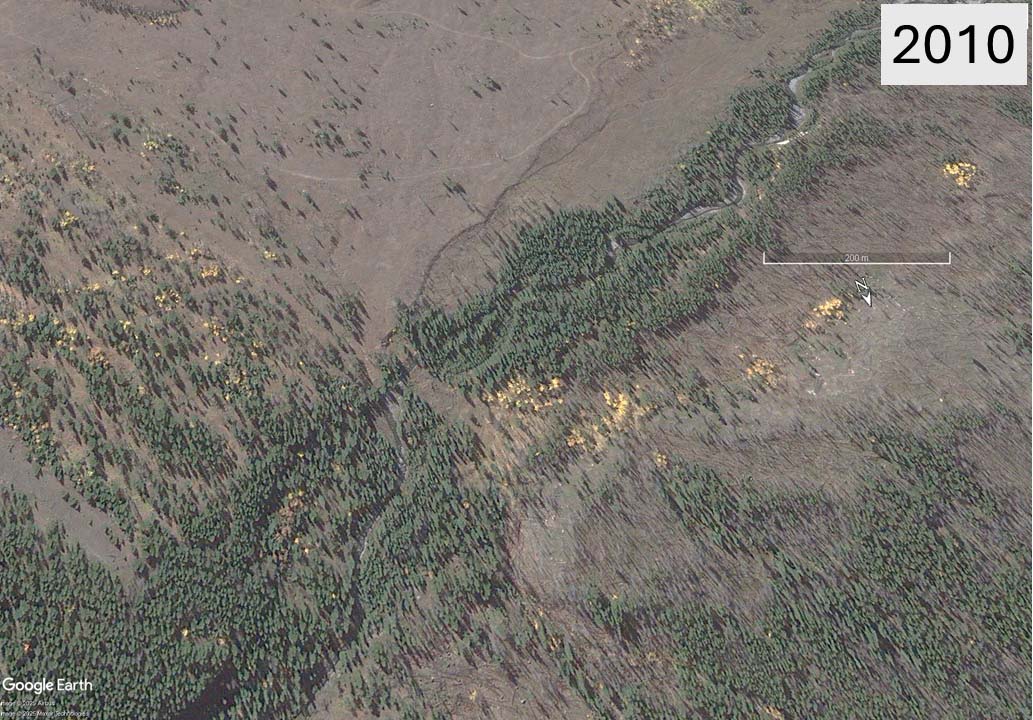
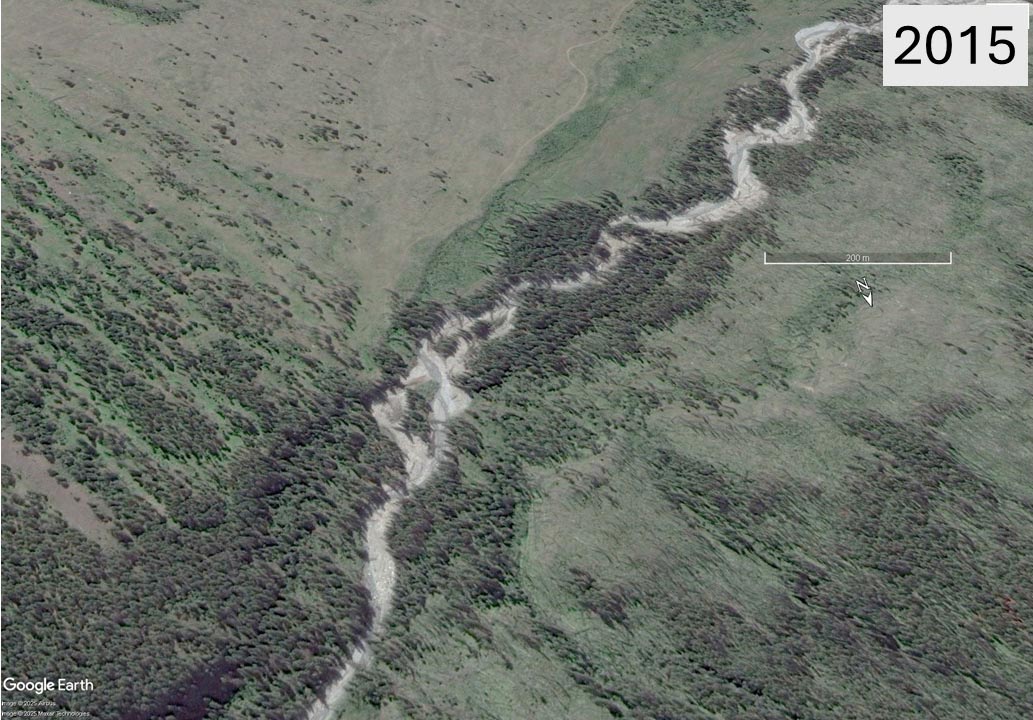
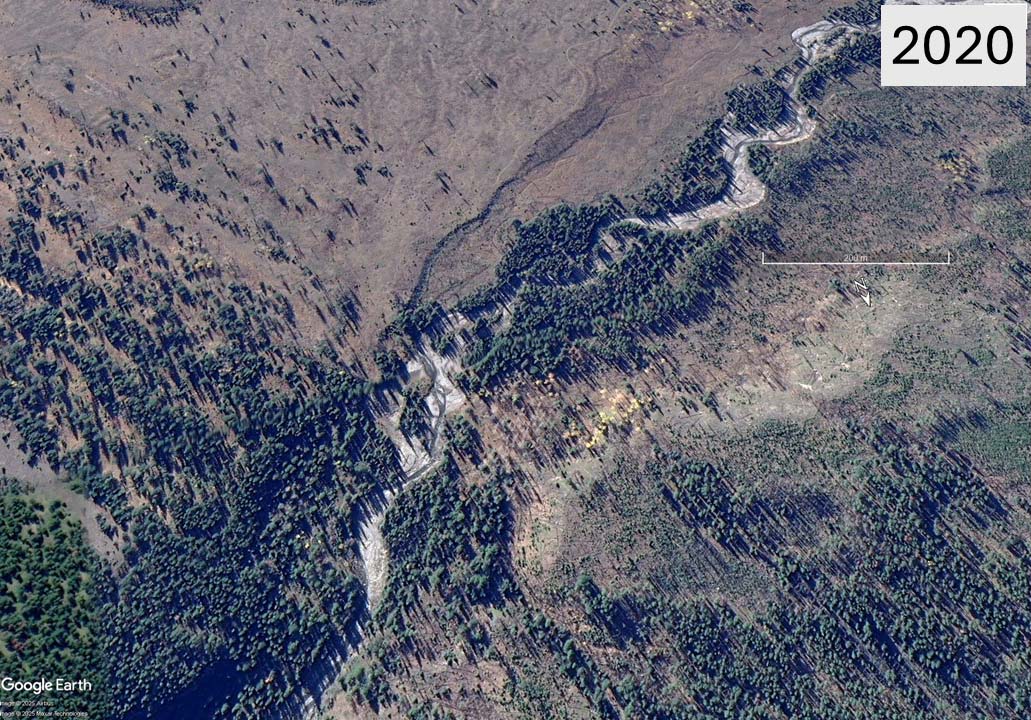
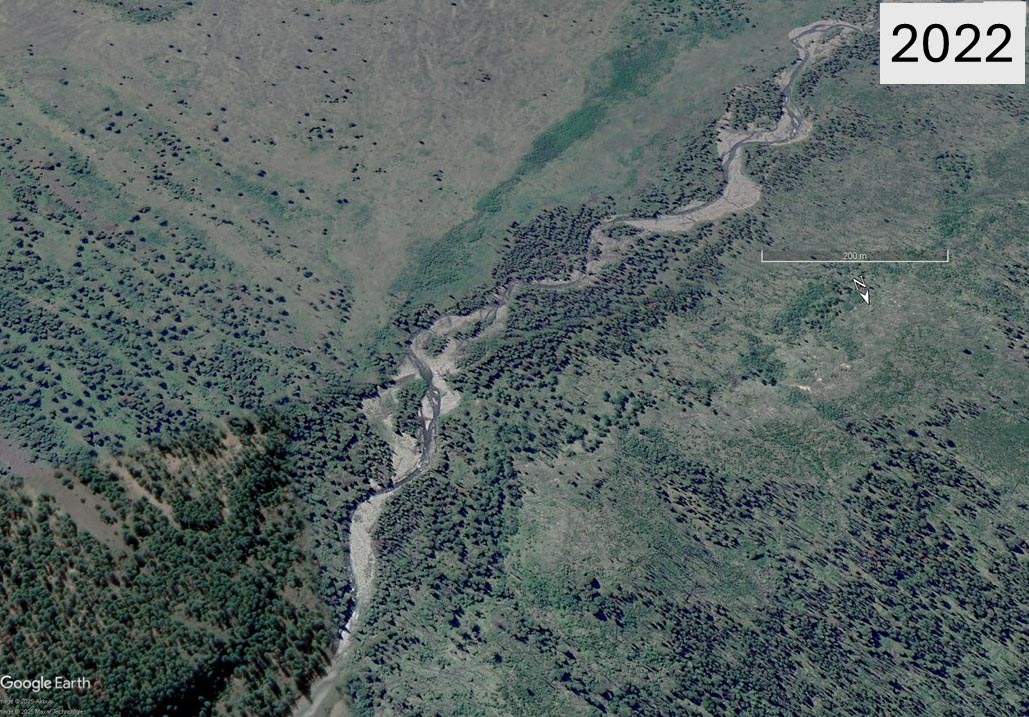
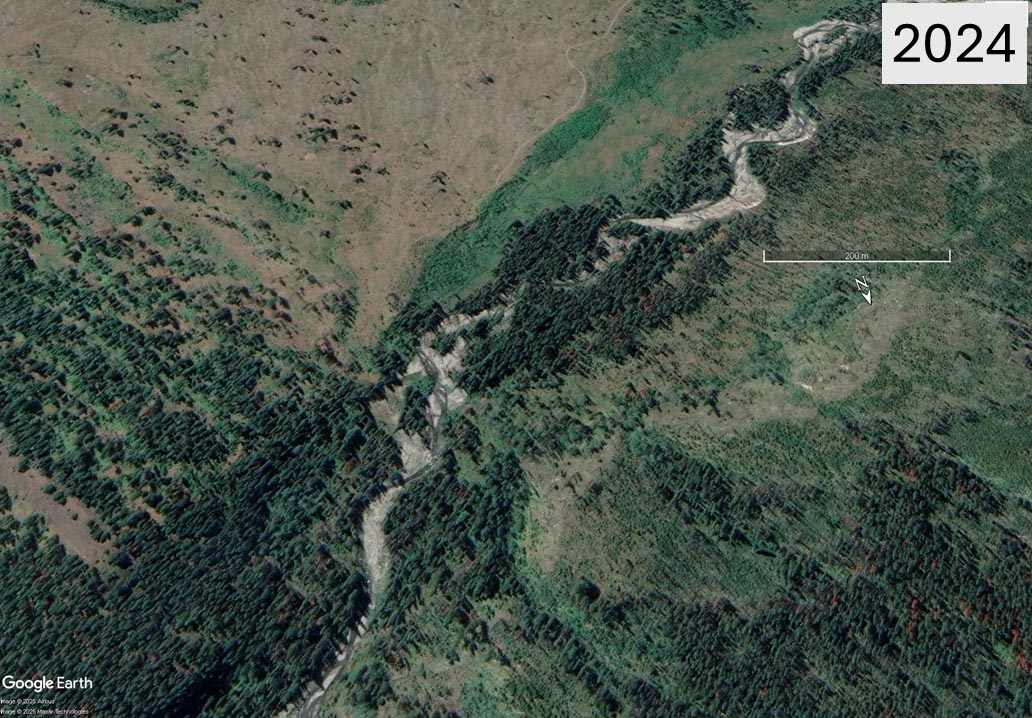
Google Earth satellite image views over time of the Carrot Creek fuelbreak (on left) and the Fairholme 2003 burn (right). Between the 2010 and 2015 views the massive June 19-20, 2013 rainfall and flood event occurred which greatly altered Carrot Creek.
On September 27, 2025 Mark Heathcott and CW toured the Carrot Creek Fuelbreak, and then crossed the creek into the dense fuels of the nearby 2003 Fairholme burn. Mark was Banff’s initial attack crew leader in the early 1980s, did a stint in Wood Buffalo National Park, and then went on to being the Parks Canada National Fire Management Coordinator in Ottawa before returning to Calgary. During the period 2000-2003 he had worked with Ian Pengelly, Banff’s Vegetation and Fire Manager to do a national review of the plans and obtain the funding and staffing that led to what was a the time a successful operation–although I am sure some participants can recount some “unsuccessful” moments in this large fuel break and prescribed burning operation (>50 square km).
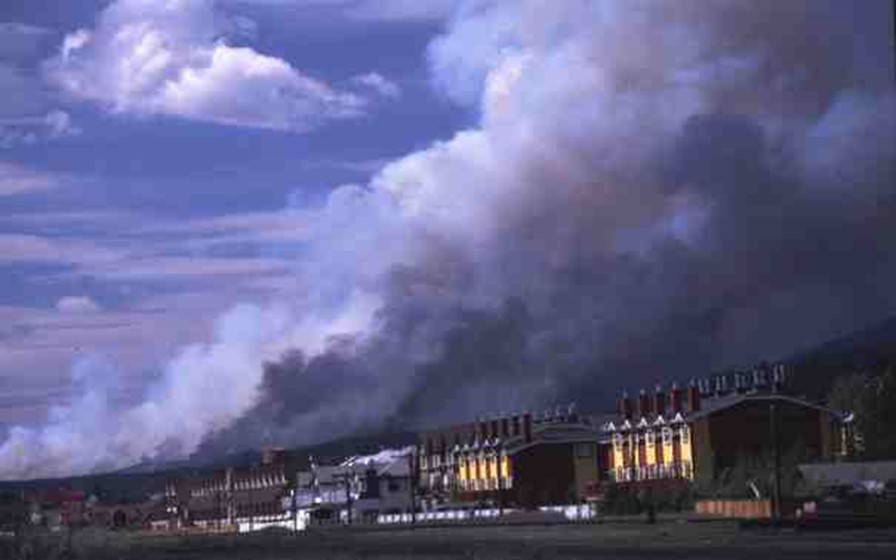
View from the Town of Canmore of ignition along the downwind edge of the Fairholme Burn Unit adjacent to Carrot Creek on May 28, 2003. Although the smoke looks ominous, the fuels were still wet, and the fire was largely out by sunset. For Canmorans, fuelbreak operations and maintenance will always present a classic dilemma: “How do you like your smoke? In small white puffs in the spring or one large black puff in the summer?”
After the initial fuel break construction and burning operations all was well, but Mother Nature doesn’t stand still, and some areas of the fuelbreak and burned forest have rapidly changed.
Mark hadn’t been into the treatment area for over 10 years, and from the hillside we could see the new large fuelbreaks being cut across the valley near the Canmore Nordic Center. Obviously concerned, and never being one to sugarcoat his observations, he sent me a written report the following morning. To summarize his view, cutting fuelbreaks and doing prescribed fires without a maintenance and operations program can lead to tragic consequences.
The image series above well-illustrates the vegetation and fuel changes that in some cases are beneficial, but in others are increasingly dangerous. I have keyed these to 5 zones in the 2024 view (click image to expand).
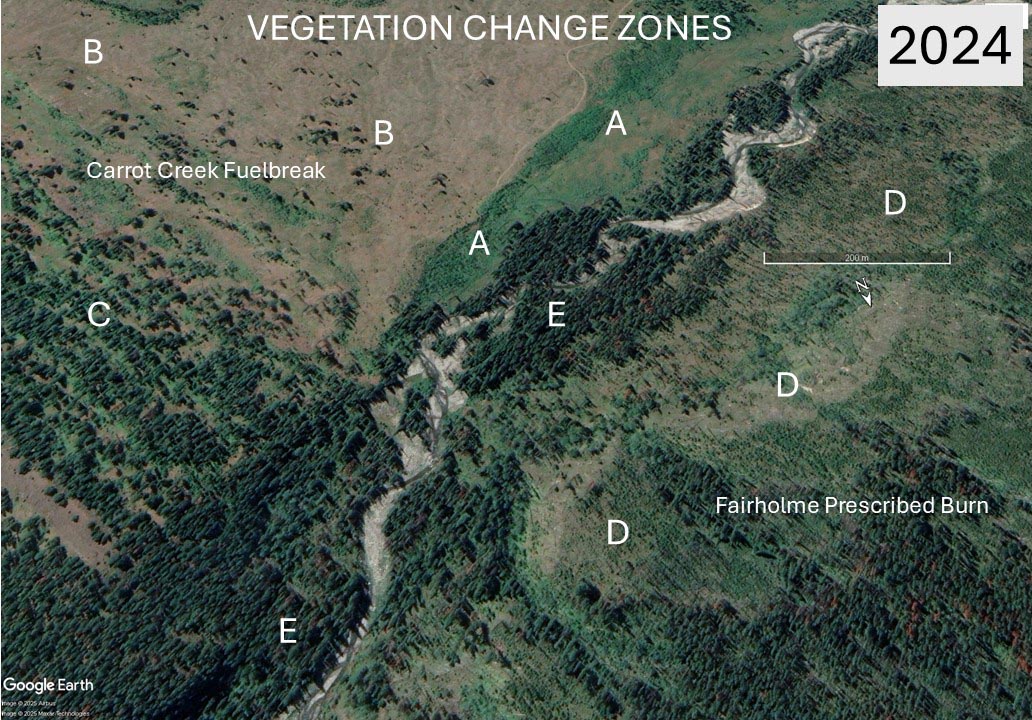
- A: Densely regenerating aspen clones along Carrot Creek. During the mid-summer these are unlikely to burn.
- B: Clear-cut lodgepole pine with that was burned 2-3 times after harvest to remove pine seedlings and create a relatively stable grassland and old Douglas-firs. Fire rate of spread could be rapid here, but these meadows are easily burned out or water-bombed to hold wildfires.
- C: Selectively cut lodgepole pine and Douglas fir with dense pine regeneration- Where no maintenance burning has occurred after harvest, an abundant seed source for lodgepole pine is allowing a crop of young pines to grow into meadows. In many areas these young trees are now greater than 3M in height, and have high danger due to a grass understory, and dense conifer foliage.
- D: Fairhome Prescribed Burn where lodgepole pine that was burned by prescribed fire and where young lodgepole pine are densely regenerating due to no reburning. Moreover, the previous overstory of charred mature pine have fallen into the understory creating potential for extreme fire behavior.
- E: Unburned or unthinned forests- If a mid-summer fire spreads into these areas they will burn hot.
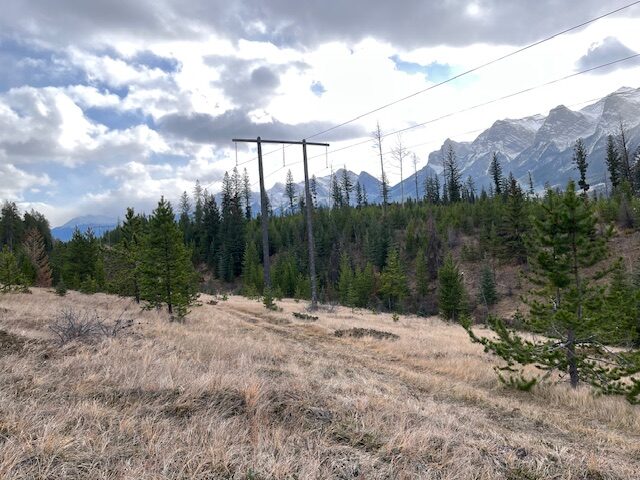
Carrot Creek Fuelbreak: Fire maintained grassland in foreground (Type B) and unmaintained dense lodgepole regeneration in background (Type C). The glading along the powerline reduces the linear visual impact, protects the power poles it from high intensity fire, and minimizes the risk of fire ignition from trees falling on the line on windy days.