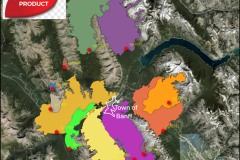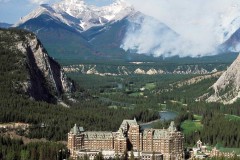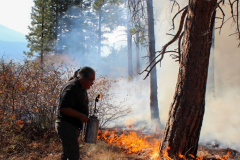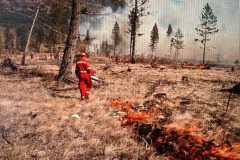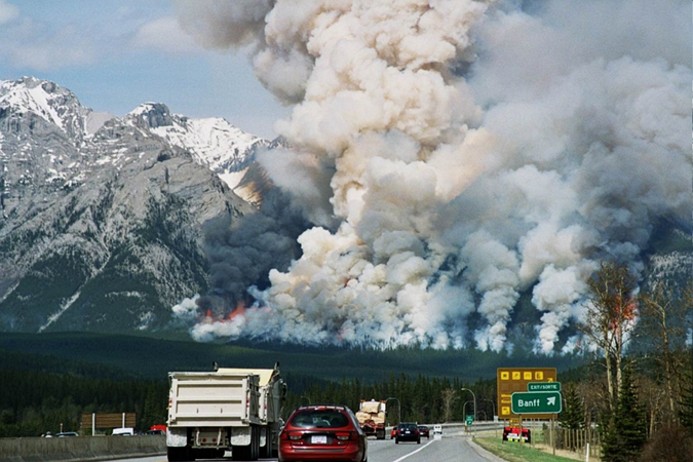
Fairholme Prescribed Fire, May 2003 (Randy Komar photo, Rocky Mountain Outlook).
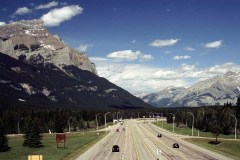
In this theme a group of long-time participants from Parks Canada’s Banff National Park fire management teams and other concerned folks can contribute to help describe the trials and tribulations of our current culture coming to grips with the Canadian Rockies fire regime. As forest biomass, human infrastructure, and visitation increase across the landscape, the Bow Valley is now in a crisis– a wicked problem with no easy solutions.
The lower Bow Valley must take immediate action to avoid the recent tragic conflagrations of Waterton, Jasper, Fort McMurray, Summerland, Lahaina, and many other communities:
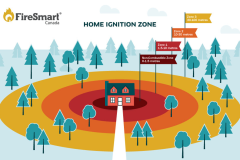
- Within a decade all buildings should meet FireSmart landscaping and structural guidelines;
- Forests within ~10km of infrastructure need managed intensively, immediately increasing thinning or prescribed burning to >10 times the rates of the last few decades;
- Evacuation or “shelter-in-place” plans for residents and visitors must be prepared, known, and easily accessible.
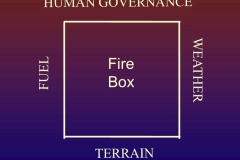
- Governance and organizational structures must be in place to deliver these targets.
To achieve these objectives in the Bow Valley will require roughly an order of magnitude (TEN TIMES!!) increase in capacity to reduce extreme wildfire risk to people, infrastructure, and long-term ecosystems. As suggestions on achieving this target, we will add webpages to this album using this draft outline as folks contribute some of their old photos, fading memories, and sometimes still sharp expertise. Many of these reminiscences may be fairly well “burned in”.
One option for future use Banff’s hard-earned institutional and eco-cultural knowledge (and sadly also from Waterton, Jasper, Fort Mac etc.) could be as background reference for the preparation of a “Community Forest Wildfire Protection Handbook for Parks and Protected Areas”. Establishing a Bow Valley Community Forest is one of the most promising approaches to reach the existential objective of reducing wildfire risk. Documenting the organization’s progress would be significant reference for certification courses specializing in saving from incineration communities like Banff and Canmore surrounded by the wildlands with high economic, ecological and cultural value. Canada’s federal and provincial governments could train and graduate dozens of specialists in this endeavor for the price of purchasing and operating a single new waterbomber. I think most of us would agree that a community forest organization working with various levels of government, land owners and leasees to creatively manage a broad zone between houses and wildland or working forests is a wise investment to better protect both our homes, economy and outdoor life style.