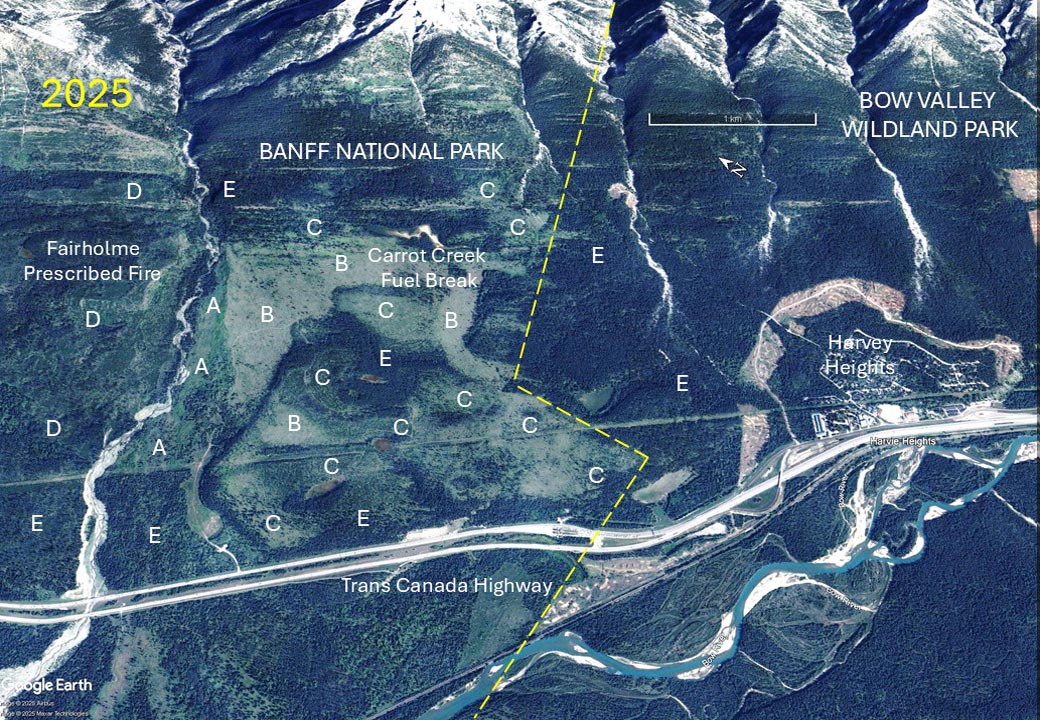
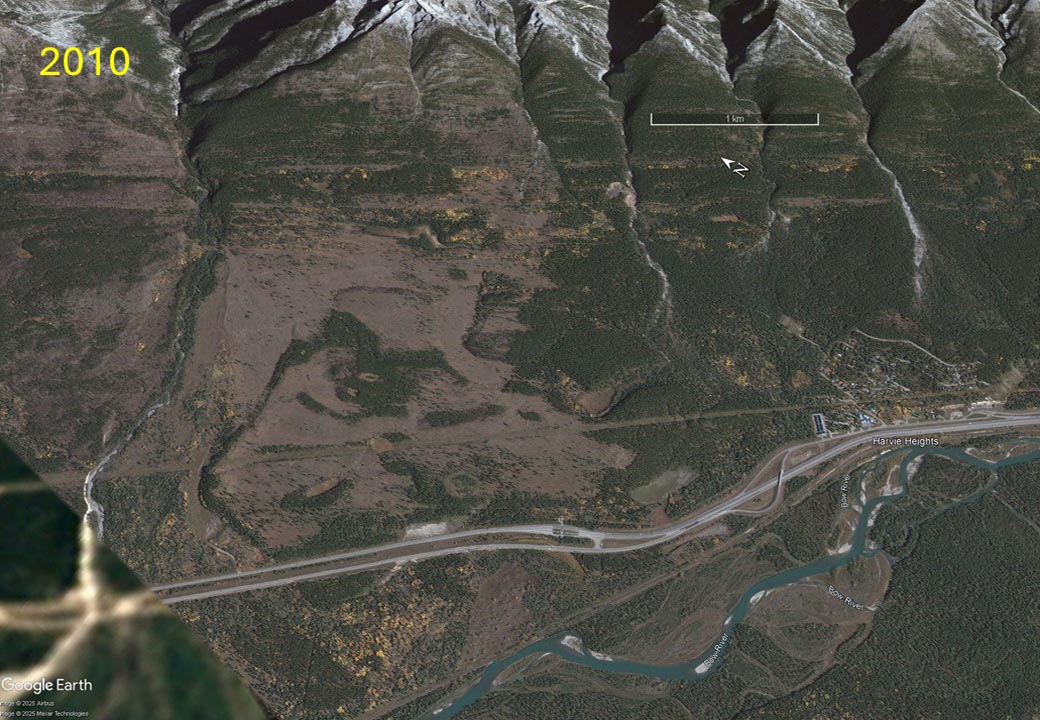
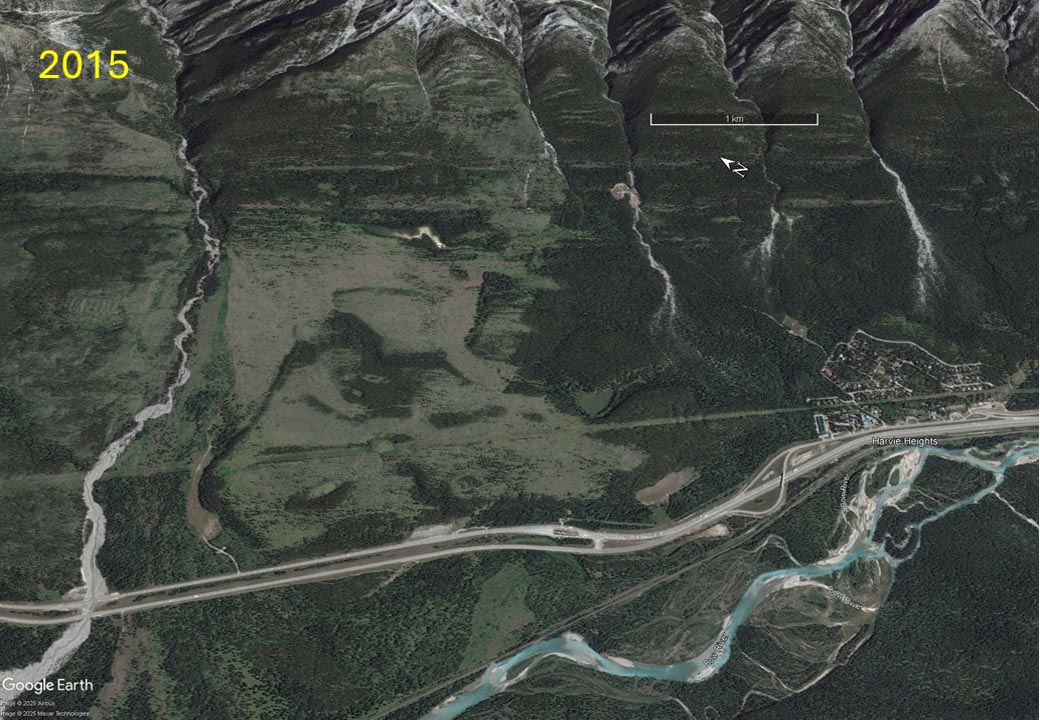
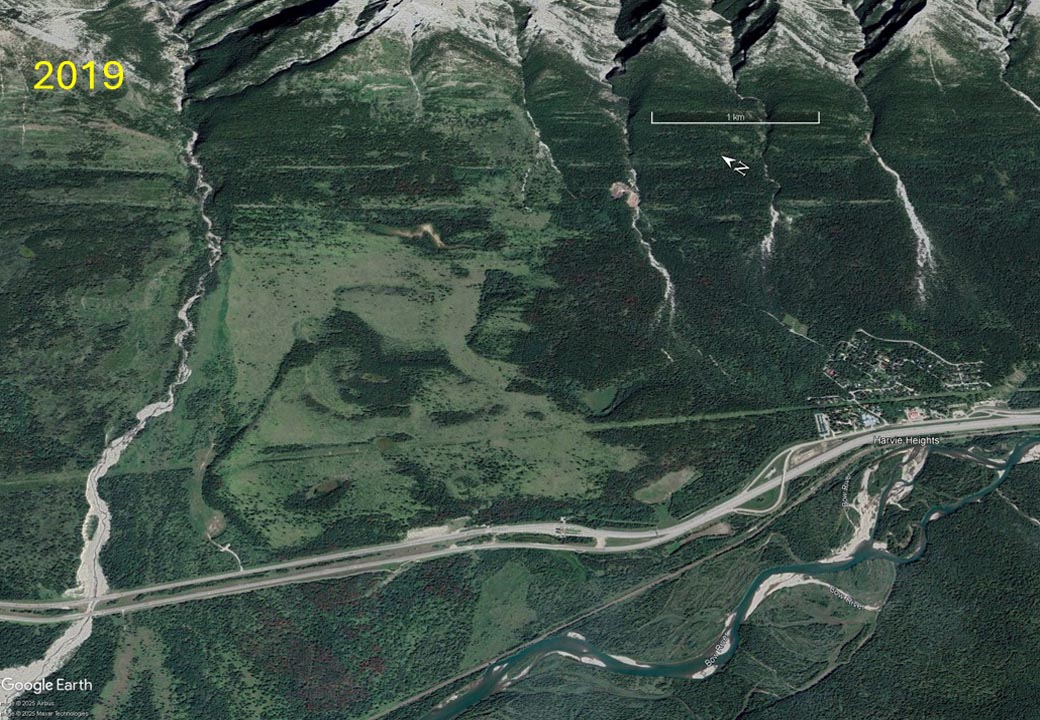
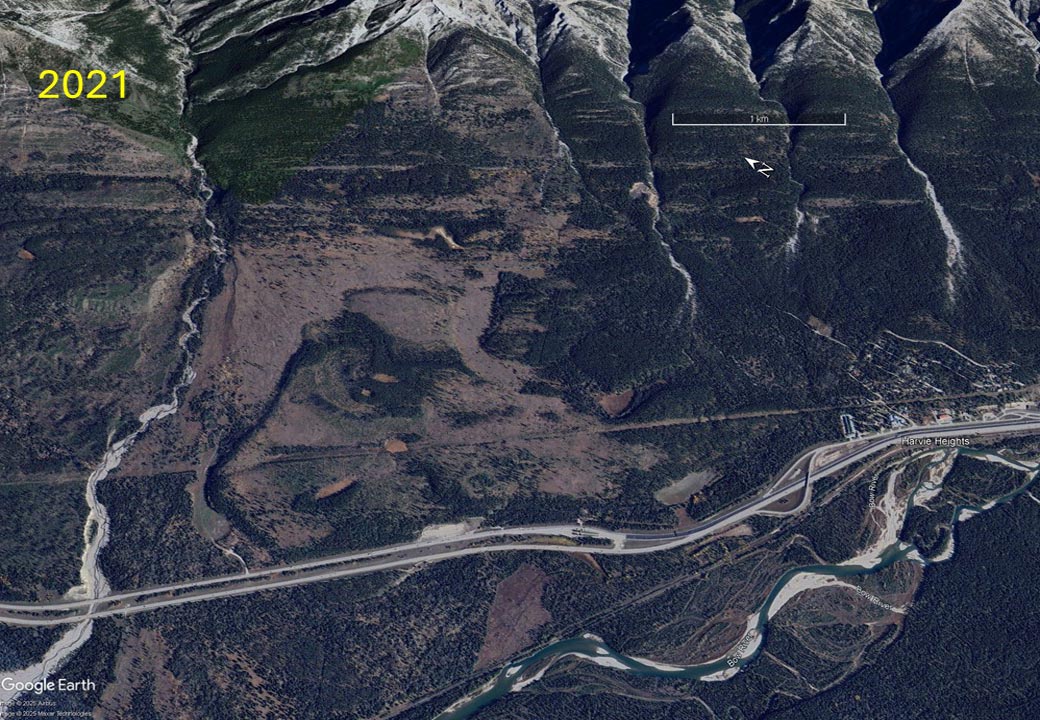
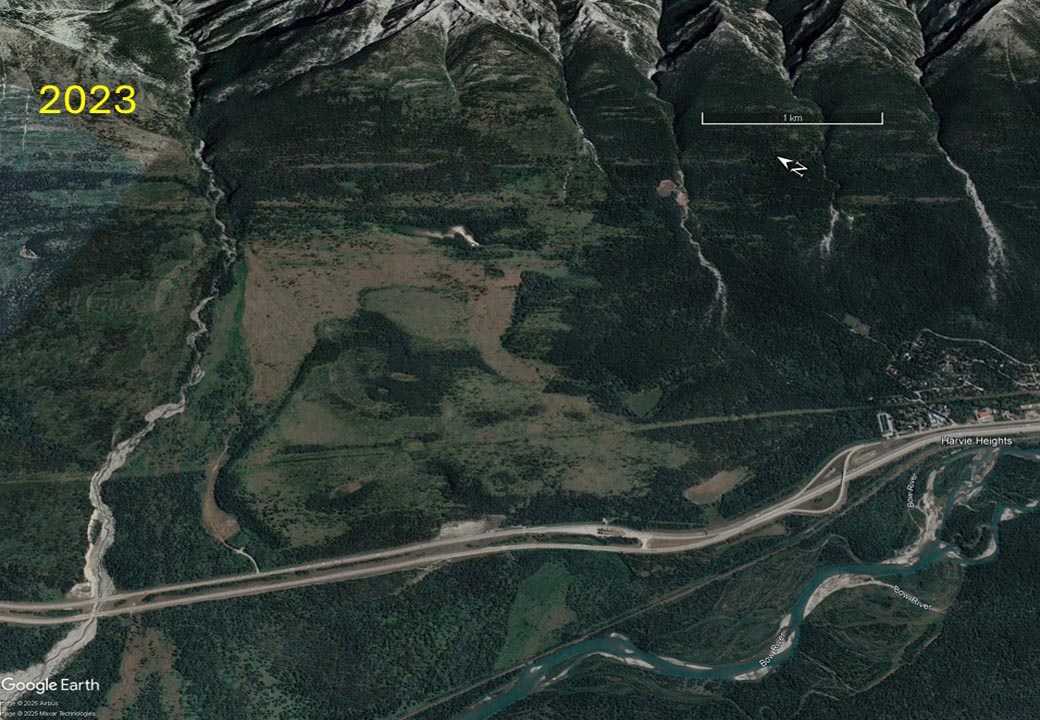
Carrot Creek Fuelbreak after the 2003 Fairholme Prescribed Fire showing the maintenance and forest regrowth pattern between the years 2010 and 2025. After over 10 years of no maintenance the risk of wildfire is increasing rapidly from conifer regeneration in the both the prescribed burn area and in the fuelbreak. Recognizing this existential danger to communities downwind, in 2025 the Alberta Provincial Parks expanded fuelbreaks around Harvey Heights and Canmore. The code letters for vegetation patterns in the fuel break are described in the figures and text below.
In the 1990s as an outbreak of mountain pine beetle (MPB) reached the Bow Valley near Banff, Parks Canada worked with the Alberta government to dampen the impact. The provincial agencies established an annual program to remove MPB infected trees (~$50K/year near Canmore). Because Banff National Park also had objectives for maintaining young forests for natural habitat, Parks Canada built the Carrot Creek fuelbreak (netting >$500K in saw logs), then used these funds for a large prescribed fire (>30 sq km) on the Fairholme Bench contained by the break.
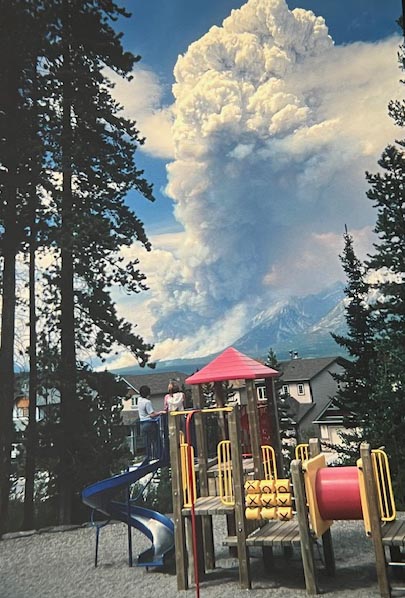
View from Canmore’s Peaks of Grassi subdivison of prescribed burning on the Fairholme Bench in May, 2003. As with most spring burns in the Rockies, the smoke is largely water vapour, and by late evening, the fire is 95% out due to moist soils.
For several years after the prescribed fire, Parks Canada worked with local community Fire Departments to maintain Carrot Creek Fuelbreak with small burns in the spring. The pattern of the work and natural vegetation response is illustrated with a 2025 satellite image.
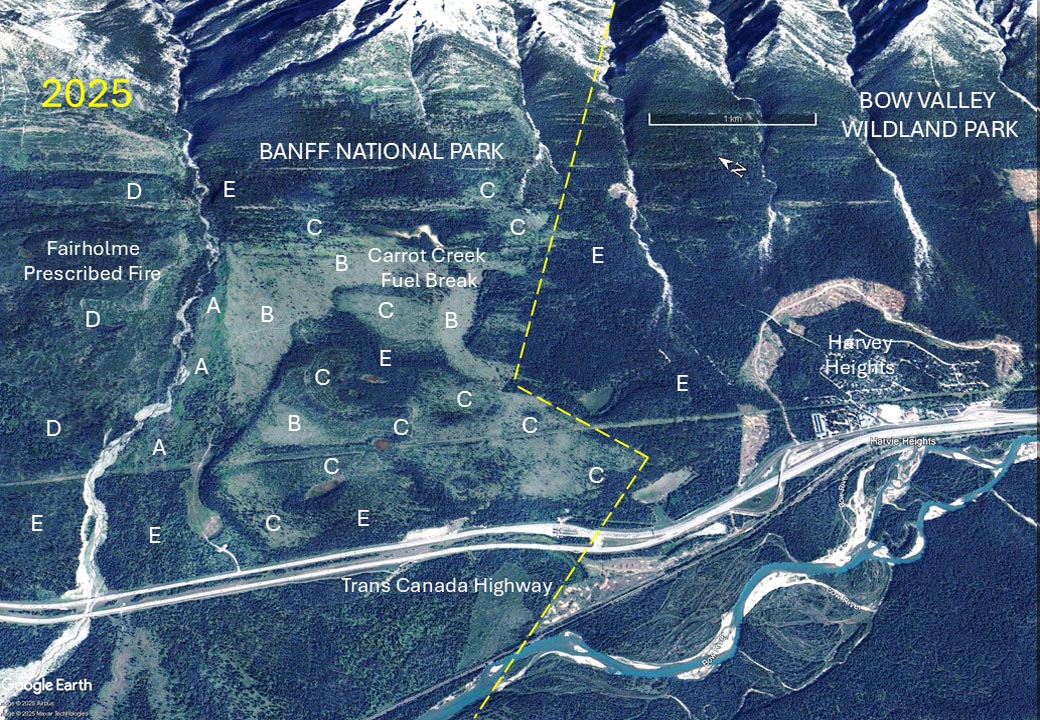
Current vegetation conditions in the Carrot Creek Fuel Break (click image to expand) showing several general patterns:
- A: Densely regenerating aspen clones along Carrot Creek. During the mid-summer these are unlikely to burn.
- B: Clear-cut lodgepole pine with that was burned 2-3 times after harvest to remove pine seedlings and create a relatively stable grassland and old Douglas-firs. Fire rate of spread could be rapid here, but these meadows are easily burned out or water-bombed to hold wildfires.
- C: Selectively cut lodgepole pine and Douglas fir with dense pine regeneration- Where no maintenance burning has occurred after harvest, an abundant seed source for lodgepole pine is allowing a crop of young pines to grow into meadows. In many areas these young trees are now greater than 3M in height, and have high danger due to a grass understory, and dense conifer foliage.
- D: Fairhome Prescribed Burn where lodgepole pine that was burned by prescribed fire and where young lodgepole pine are densely regenerating due to no reburning. Moreover, the previous overstory of charred mature pine have fallen into the understory creating potential for extreme fire behavior.
- E: Unburned or unthinned forests- If a mid-summer fire spreads into these areas they will burn hot.
The pattern of regrowth since maintenance ended is worrying. A broad band of dense 3-5 meter high pine has extended along the power line across the fuelbreak to the national park boundary near Harvey Heights. Given that Fairholme Burn has now regrown to reaching explosive summer fire behavior, any fire beginning east of Banff in a dry summer would likely quickly cross the Fairholme Bench, the fuelbreak, and overwhelm the narrow fuelbreak near Harvey Heights. It is now critically important the Parks Canada re-implement spring maintenance burning (or even manual clearing) in the Carrot Creek Fuel Break, and do a series of early spring burns to reduce fuels on the Fairholme Bench. Not only would this work protect communities downwind, it will also protect the single powerline that services Banff National Park.