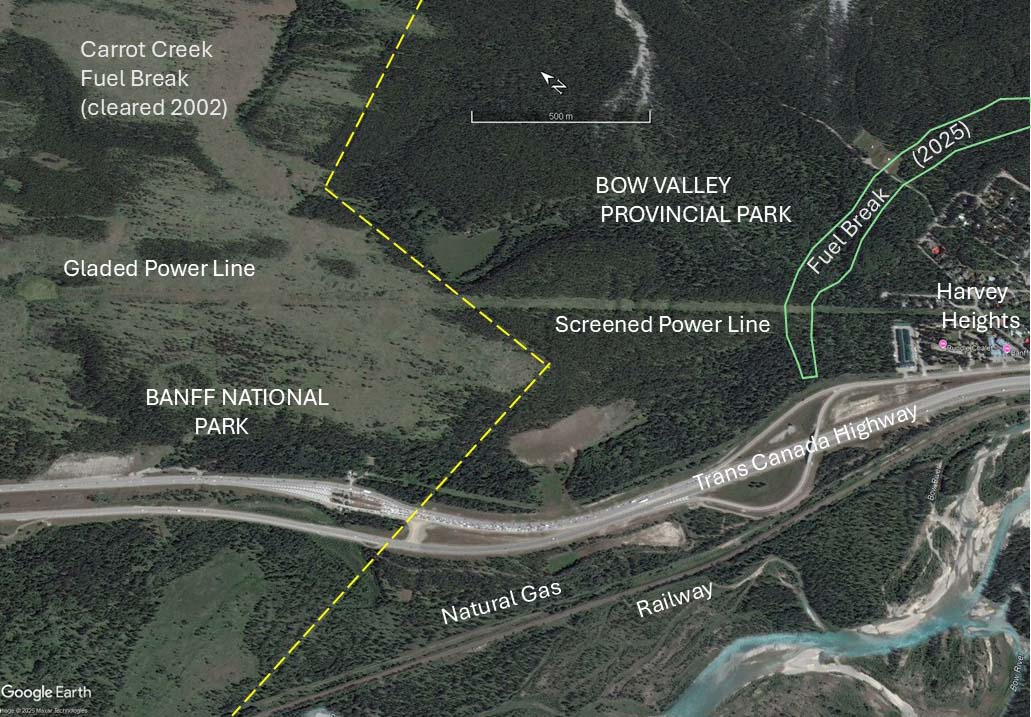
Innovative vegetation management on the eastern boundary of Banff National Park to protect important infrastructure. Ecologists logged, thinned or gladed the forest to remove trees susceptible to mountain pine beetle. They then used prescribed fire to restore and maintain historic vegetation cover. The restoration project provides a win/win for both ecology and human infrastructure. In this satellite view, hundreds of cars are lined up to enter Banff’s east gate.
Visitors come to parks to see a natural landscapes, so a traditional goal for park managers has been to “tuck-away” the necessary infrastructures that provides food, water, and heat, and remove garbage and sewage. Moreover, the Rocky Mountain parks straddle Canada’s national highways and railways—creating additional needs for 24-7 protection and service of rails, roads, power lines and oil pipelines. In the late 1990s a surge of mountain pine beetles in nearby British Columbia threatened to cross the onto the Rockies eastern slopes. The province of Alberta chose to annually remove individual trees as they were colonized by beetles. In contrast, Parks Canada began an aggressive program to remove larger areas of mature lodgepole pine both by prescribed fire, but using logging or thinning in high-risk areas such as along the Banff park boundary near the community of Harvey Heights, then maintain the clearings with prescribed fire.
Restoring open vegetation cover near the power line connecting Banff to the Alberta grid is a special challenge. For many years fires had been suppressed along the right-of-way to screen visibility from homes and the highway. After 1995, working with Alta-Link, the power providers, Parks Canada crews and contractors felled trees along 18 km of the line, in some cases leaving them to be burned by the subsequent fires, or in accessible areas, trucking them to the mill. Over several years the powerline eventually was surrounded by open glades and is difficult to see due to scalloped forest edges with no straight clearing lines. Moreover, regenerating trees could easily be removed with routine use of understory fires. In contrast, the powerline surrounded by dense forest east of the park boundary requires routine cutting, and in the case of wildfire would be at high risk from serious damage.
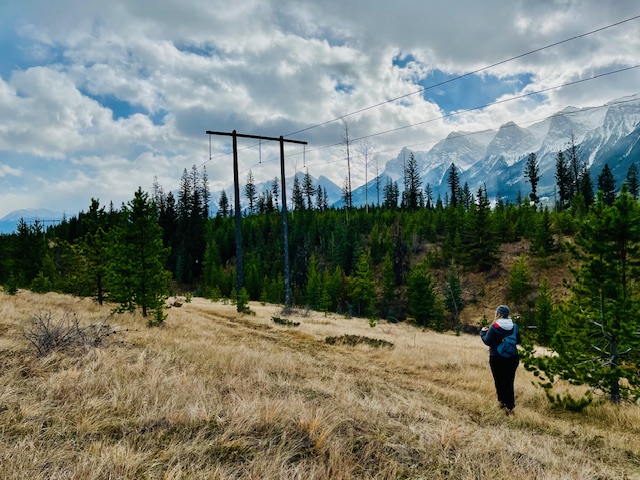
AltaLink power line near Carrot Creek in Banff National Park passing through glades with grasslands and variable ages of lodgepole pine. These clearings reduce the visible intrusion of the power line and exposure to high intensity fire. The glades in the background are being overgrown by lodgepole pine and require maintenance. Up until ~2010 when maintenance ceased Bow Valley community fire departments assisted Parks Canada in this work with low intensity prescribed fire.
Return to Power Line Managemen Section