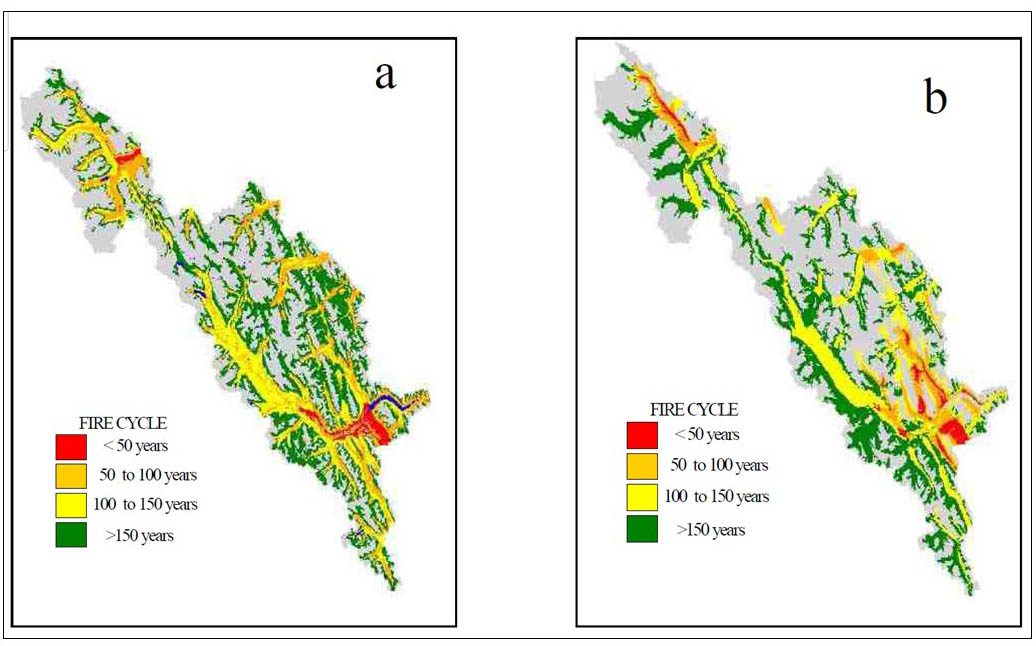
Banff long-term fire frequency calculated by two methods: a. fire history plots grouped by Ecological Land Classification (ELC) ecosites, and ecosites aggregated into “Fire Groups” of similar fire history and biomass characteristics, and b. stand origin mapping for the whole park with pixels grouped by elevation and valley orientation into similar areas of stand age.
The first method captures individual site characteristics (e.g. soil moisture), whereas the second method is based upon fire behaviour patterns across larger landscapes. Regardless, they both yield similar results of oldgrowth in fire-sheltered valleys, and frequent fires in the lower elevations of main valleys. The ELC based model is based upon parent material and soil types that may give higher resolution to map spring-burning conditions regulated by soil moisture.
Return to Fire History section lead in
References
Rogeau, M. P., I. R. Pengelly, and M. J. Fortin. 2004. “Using a Topography Model to Predict and Monitor Fire Cycles in Banff National Park.” In Proceedings of the 22nd Tall Timbers Fire Ecology Conference: Fire in Temperate, Boreal, and Montane Ecosystems, edited by R. T. Engstrom, K. E. M. Galley and W. J. de Groot. Tall Timbers Research Station.
White, C. A., I. R. Pengelly, D. Zell, and M. P. Rogeau. 2005. “Restoring Heterogeneous Fire Regimes in Banff National Park.” In Mixed Severity Fire Regimes: Ecology and Management, edited by J. Zelnik Taylor, S. Cadwallader, and B. Hughes. Washington State University Extension.