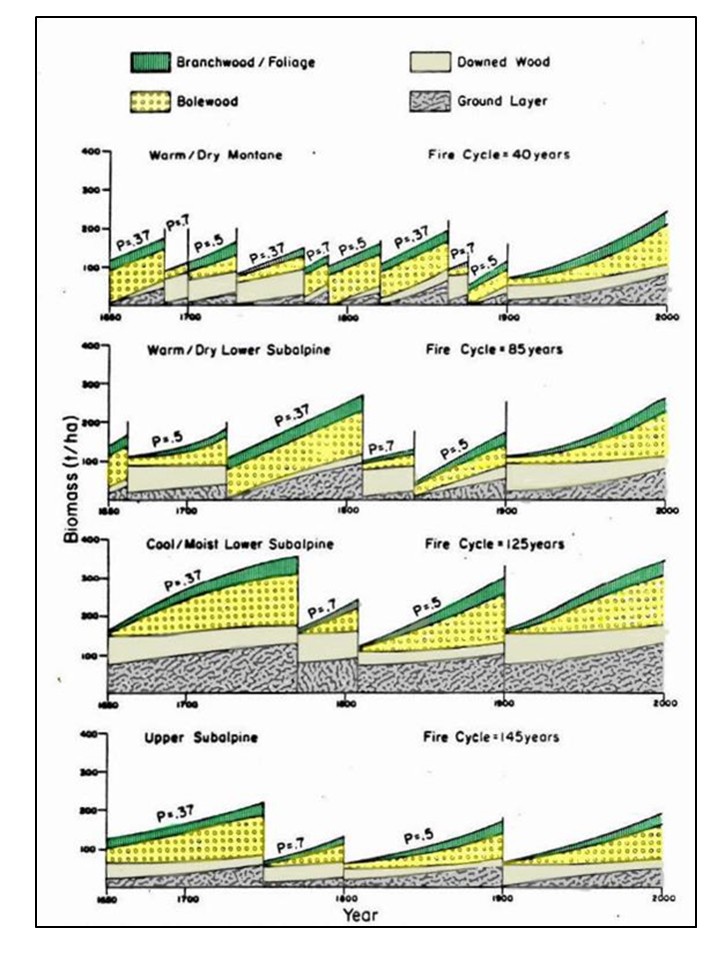
Biomass and fire frequency in Banff ecoregion’s forests.
Banff forests create biomass – organic matter—and lots of it. Through photosynthesis, woody growth, and litter production adds a ton per hectare to the park. That 100 tons or two semi-trailers full of compacted organic matter per year per square kilometer. If you were raking your yard, that’s 10 kilograms, or a wheelbarrow full per square meter. The graphs above show how historic the fire regimes regulated this biomass production. Warm-dry montane forests have the shortest average fire cycles (~40 years) with the time between burns lengthening to over 145 years in the upper subalpine. The “p” value shows the probability that a forest would reach this age without burning with .5 indicating the time-since fire at next burning. In general, more than 2/3 of forests will burn before this (intervals with p~.7), and only a small number will reach long times-since-fire (p<.37).
Organic accumulation is generally most rapid about 100 years after fire, as the forest canopy closes, mountain pine beetle mortality increases, the forest floor cools, and decomposition on slows. After about 200 years accumulation slows. In very rare cases, forests may reach maximum biomass of about 300 tons/ha at 100-200 years age where productivity declines due to lack of nutrients and roughly equals decomposition. In the past, forests of this age almost never occurred in the montane and warm/dry lower subalpine (p <.2), rarely in the cool moist lower subalpine, but more commonly in the upper subalpine spruce-fir forests.
Lightning fires are rare on the eastern slope of the Rocky Mountains. Prior to 1900, Indigenous people burned most of the area, and the removal of these people from national parks led to the general aging of forests and increases in biomass shown in the graphs. Fires ending long times since the last burn inevitably burn hot, killing most trees. The 2024 Athabasca Valley Fire in Jasper is a classic example. Historically, the montane and lower subalpine forests here burned every 40 to 85 years, and in Jasper’s case, the last large fire was in 1889. Due to high fuel loadings, the fire burned over 30 km in 3 days, releasing a massive amount of energy, generating extreme winds, and eventually severely damaging the town.
References
JFT (Jasper Fire Documentation, Reconstruction, and Analysis Task Team). 2025. Jasper Wildfire Complex: Fire Behaviour Documentation, Reconstruction, and Analysis. Information Report NOR-X-433. Northern Forest Research Centre.
White CA 1985 Fire_and_biomass_in_Banff_National_Park_closed_forests-complete