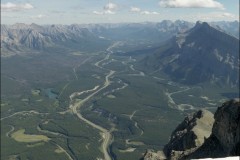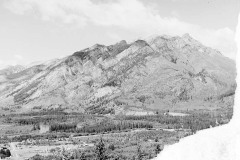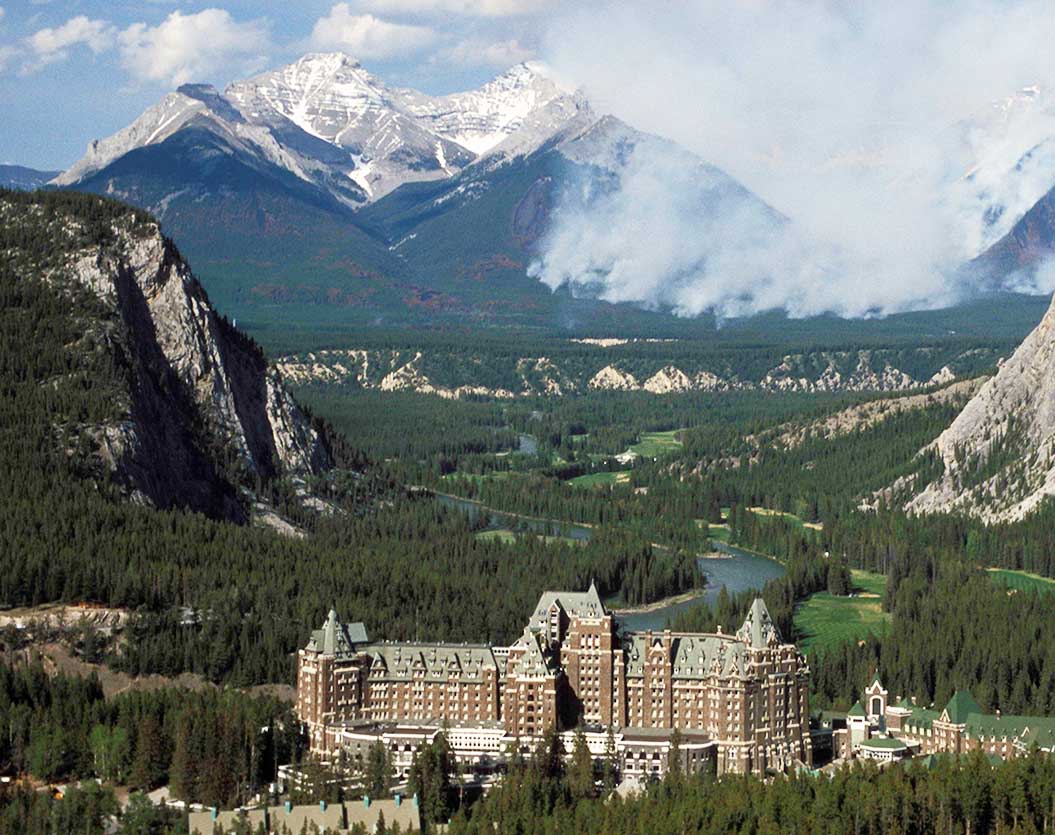
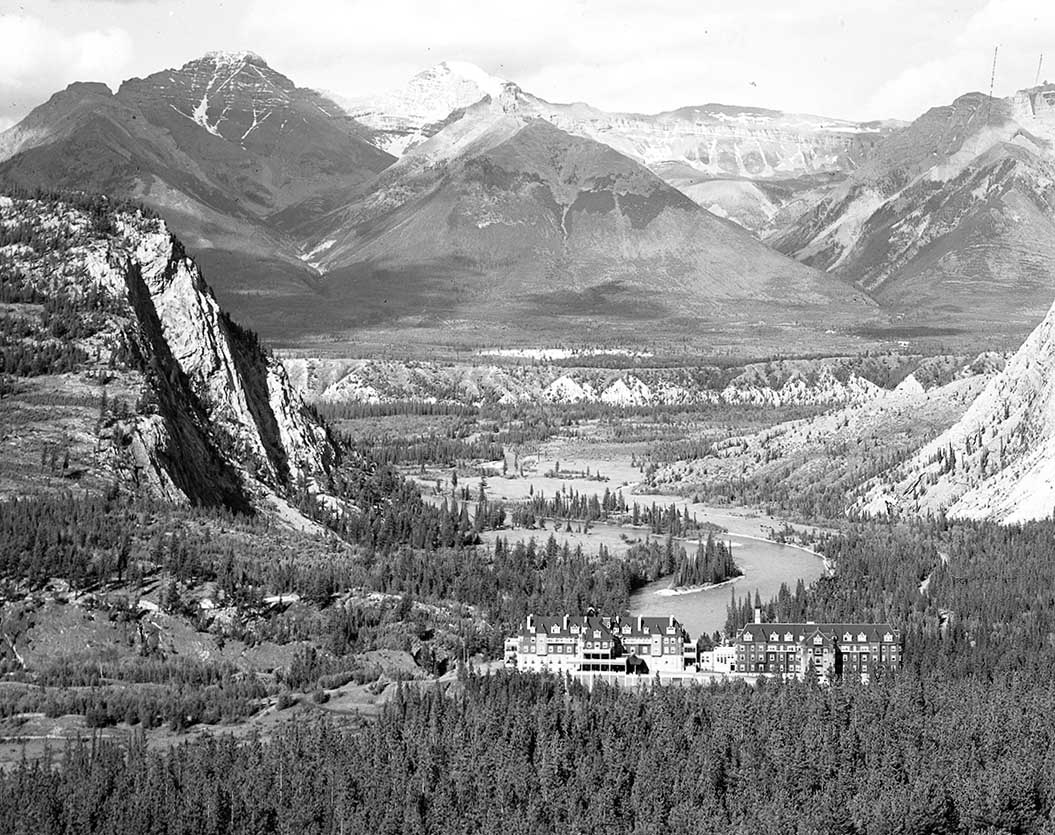
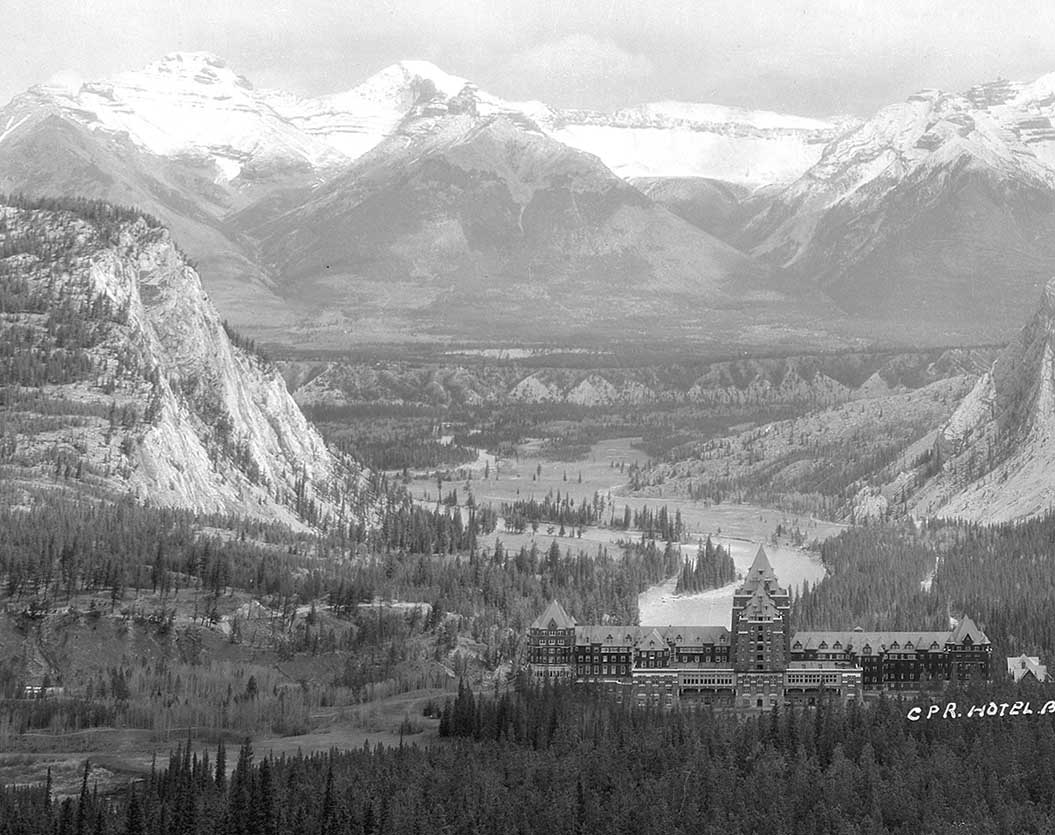

Banff Springs Hotel and montane meadows in ~1900, ~1920 and ~1930 (Whyte Museum Archives) and during Fairholme Prescribed Fire in 2003 (Parks Canada).
On September 18, 1845 Father Jean De Smet, the far-roaming American priest reached the meadows at the mouth of Spray River where it enters the Bow– just below today’s Fairmont Banff Springs Hotel. His party had just had a tough trip from the Columbia valley, crossing the Great Divide at “Whiteman’s Pass”. Then making a route finding mistake, they missed the main trail going directly eastwards by Spray Lake to today’s Canmore, and instead pushed through the deadfall of a recent massive forest fire in the main Spray Valley. Finally reaching meadows of the Bow Valley where the today’s world-famed golf course lies, De Smet recounted:
We reached the Bow or Askow river in the evening, and pitched our solitary tent upon the shore. Here we discovered some vestiges of a savage party. Five days previous, nine lodges of Indians had encamped upon the very spot. We made a careful search, and my guides imagined they were the formidable Blackfeet! We, the same day, saw two smokes at the extremity of the plain over which these barbarians had traveled. The 19th and 20th, we followed the tracks of our unknown predecessors, and they appeared more and more recent. I dispatched my two guides to reconnoitre, and as certain whom we were so closely pursuing. One of them returned the same evening, with the news that he had found a small camp of Assiniboins of the Forest…
De Smet’s observations are at the intersection point in space and time of two vastly different cultures: the Indigenous people’s whose frequent burning had created the meadows, and the advance of a globalized economic culture that within a few decades would maintain the fairways of the golf course.
The rapid cultural transition is particularly traumatic in Banff, Canada’s first national park where Indigenous burning shaped natural ecosystems for millennia, but where today fire must be often aggressively suppressed to protect thousands of people and millions of dollars in infrastructure. A pathway must be found where the current culture can somehow protect lives and livelihoods, while at the same time conserving nature for “the benefit and enjoyment of future generations”. One approach to more seamlessly link modern and long-term ecosystems in space and time is a “roof to region” perspective.
Back to “Burning Banff” Mainpage