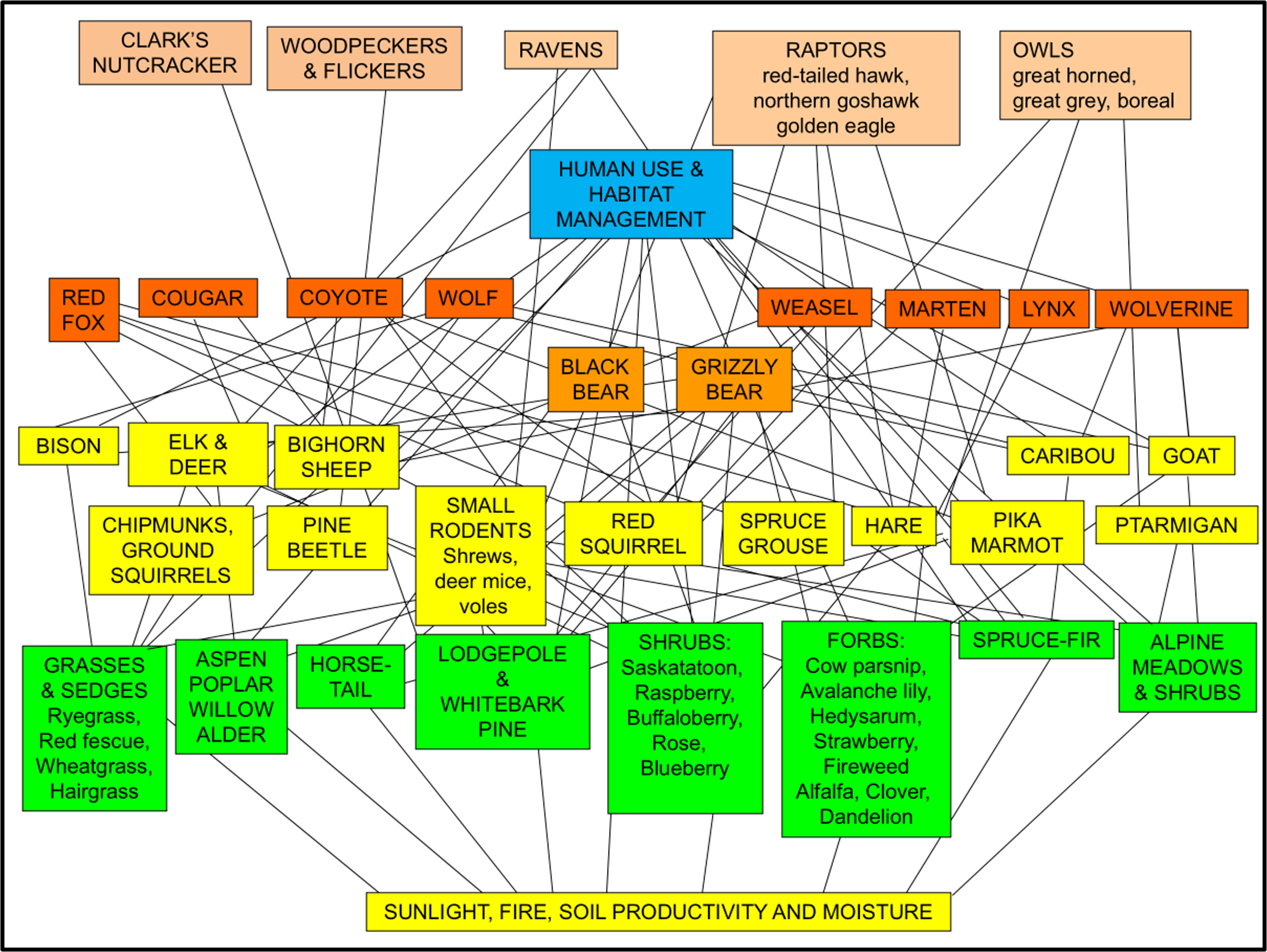
Food web diagram for the Banff National Park ecosystem. Humans have long had an important role in hunting, gathering and burning in the landscape. Maintaining or restoring long-term ecological and cultural interactions between species reduces forest biomass and reduces wildfire risk.
Maintaining and Restoring Ecological Integrity
Increasing understanding of the ecological and cultural legacy influencing national park landscapes led to a profound amendment to the National Parks Act in 1988. Parks were required to maintain or restore “ecological integrity” as a first priority in managing national parks:
“An ecosystem has integrity when it is deemed characteristic of its natural region including the composition and abundance of native species and biological communities, rates of change, and supporting processes.”
By evoking tenets from the science of ecology, this definition attempted to put measurable and defensible criteria around the questions of what is natural, and the relative degree of human-caused impairment. The idea of ecological integrity also recognized that the long-term influences of humans might be a characteristic and important component of some ecosystems. Since the 1990s, park management strategies have identified key long-term ecosystem conditions and processes in the Canadian Rockies, instructing Parks Canada staff to maintain initiatives that support the restoration of ecological integrity. In Banff, facilities were moved to increase the movements of wary carnivores through wildlife corridors, thereby increasing predation rates on prey. In addition, Banff and Jasper wardens re-instituted practices of the 1960s by removing elk from areas where predation could not be restored. Engineers installed additional highway fencing and wildlife crossing structures to minimize road-kills and maximize wildlife movement. Banff, Jasper, Yoho, and Kootenay park staff increased prescribed burning in their respective parks to maintain the long-term important role of First Nations’ firing of the landscape.
Ecological and Cultural Integrity Reduces Extreme Wildfire Risk
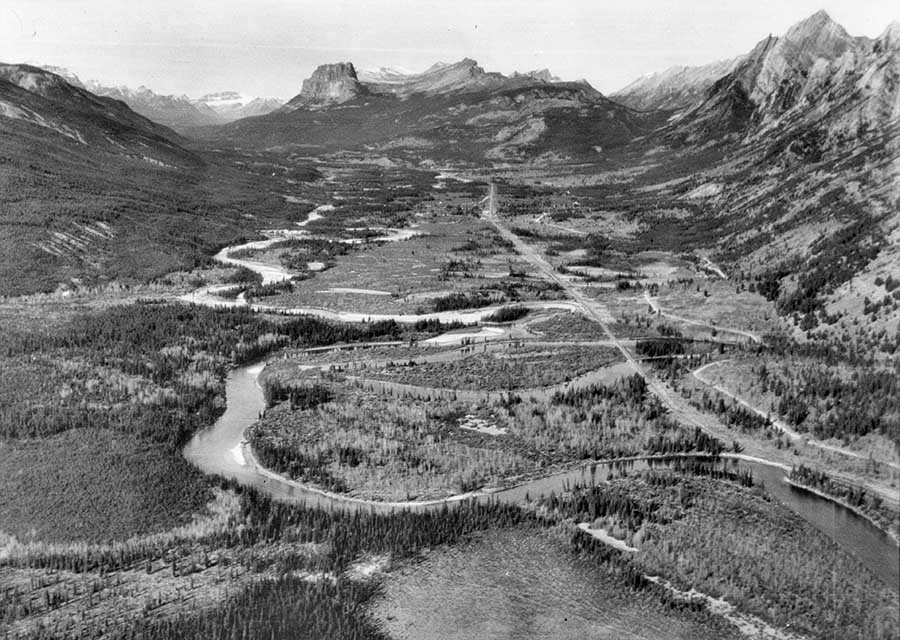
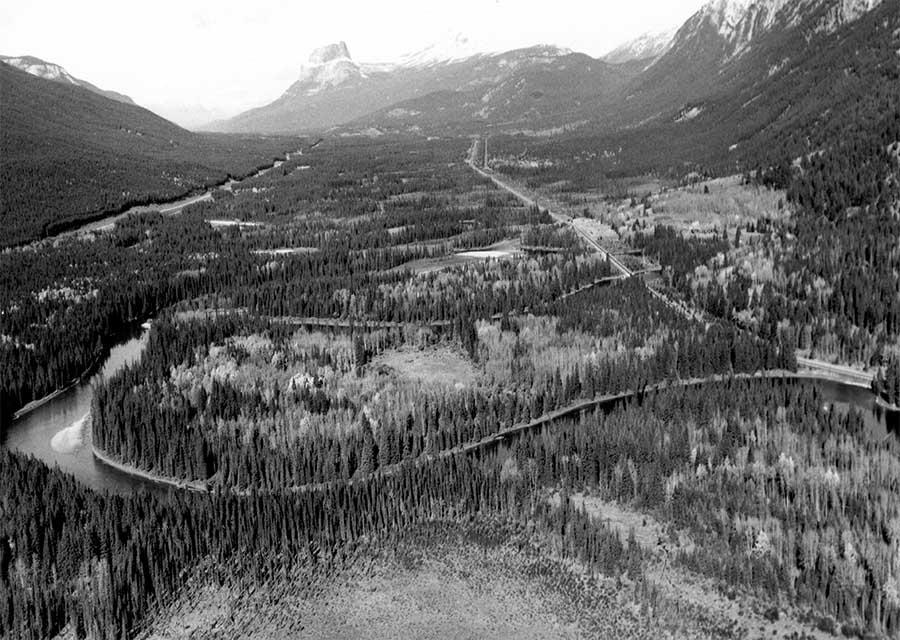
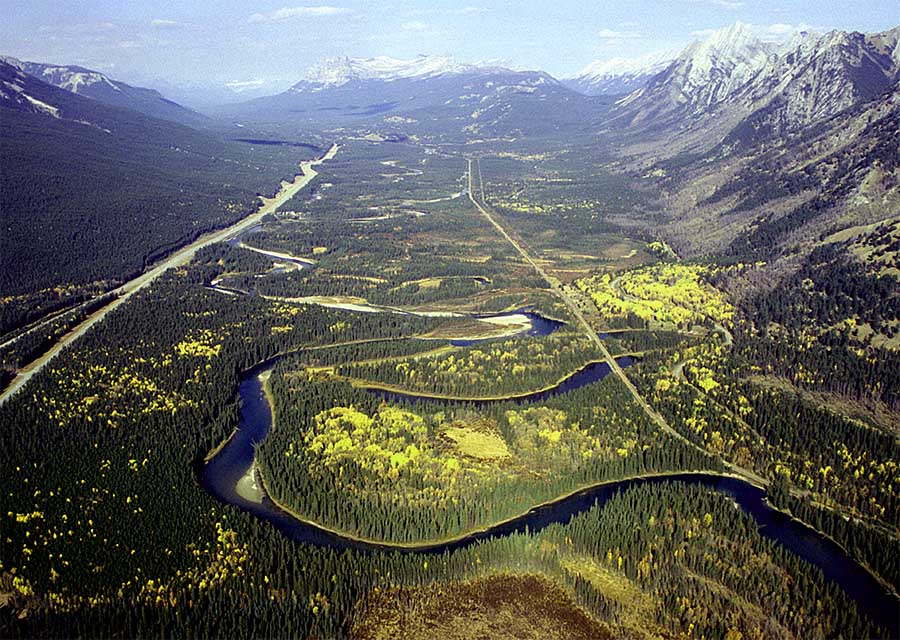
The Bow Valley below the Sawback Range (on right) in Banff National Park in 1921 (NAPL-CA-114-74), in 1986 (CW-P1-14), and in 2003 (CW-2003-10B-05). The early image shows a long-term culturally managed landscape dominated by grasslands and shrublands with relatively low wildfire risk. Removal of Indigenous peoples and fires suppression is creating increased cover of flammable conifer forests. Parks Canada has used prescribed fire restore grasslands on the Sawback Range on the right side of the photograph.
Over five thousand years ago, Indigenous peoples followed the glaciers as they retreated up the valleys of the Rockies, and the resulting revegetation was structured by human gathering and burning and hunting patterns on large herbivores. Not surprisingly these ancestors created and maintained a vegetation cover that was relatively stable and provided predictable habitats for the plants and animals providing subsistence foods, clothing and shelter. Along well used valley bottom corridors, these people followed the standard cultural practice of burn often, burn early, and burn light. This created the long-term fire history pattern revealed traditional knowledge and recent tree ring studies, and so well illustrated by historical photographs. These low to moderate intensity fires at short intervals helped maintain meadows, shrubfields, aspen groves, Douglas-fir/lodgepole pine savannah and glades, and large areas of relatively young forests of pine, spruce, and larch.
The simplest and time-proven strategy to reduce fire risk in modern landscapes is to return long-term fire frequencies to various native plant communities. Mechanically and fire created fuel breaks can provide local control lines and patches to reduce fire intensity and provide opportunities for containment, but the best overall strategy is to integrate fuel breaks into a broader landscape with reduced fire risk.
Return to Restore Ecological and Cultural Integrity overview page