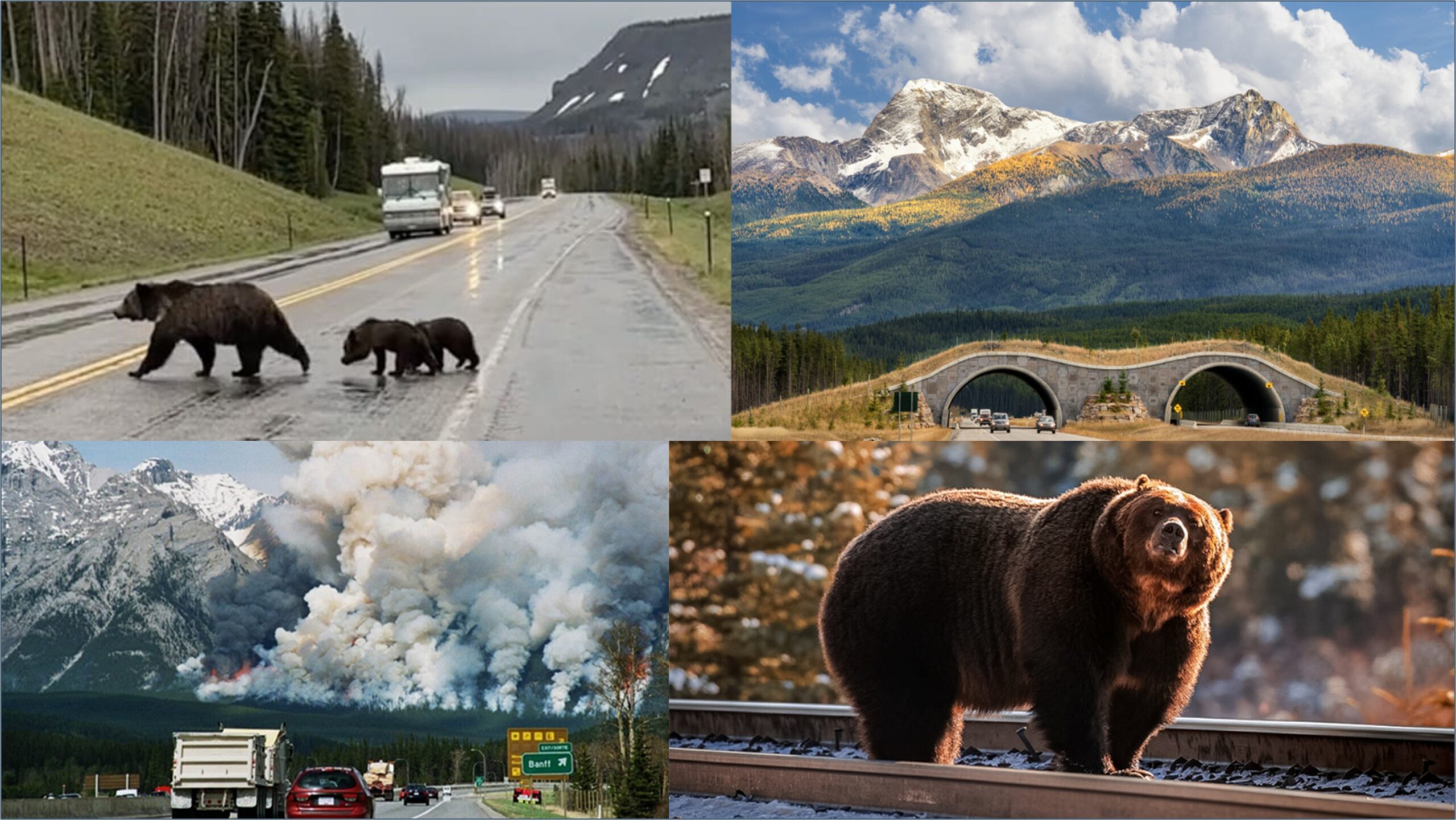
Grizzly bears seek out fire-created habitats where nutritious plant species and forage for prey species (elk, deer, sheep) are abundant. Due to fire suppression in the Bow Valley, most remaining high-quality habitat is now mechanically made clearings, or “habitat traps” near busy roads, railroads, townsites or on ski area runs where bears may be killed or habituated to humans. Parks Canada prescribed burns in and near the Bow Valley provides a natural alternative to these is habitats, while highway mitigation (fencing and crossing structures) and human use management in the valley provides safe travel routes between habitats and reduces grizzly bear mortality.
Banff’s Grizzly Bears
Park visitors travelling the busy four-lane highway west from Calgary enter one of the continent’s most unique areas. With 9,000 human residents and over four million annual visitors, Banff National Park is one of the busiest areas in North America where both humans and grizzly bears co-exist. Just beyond the highway fencing, often foraging in recently prescribed burns, the park is a core home range for nearly 100 grizzly bears. However, managing the big bears provides its challenges.
Bear Blobs: Buffalo Carrion, Garbage Dumps and Ski Hills
Historically, grizzly bear sightings were relatively common on the Great Plains where they fed rich berry crops, bison calves and carrion from kills by Indigenous people and wolves. Moving westward into the Rocky Mountains grizzlies were likely less abundant and avoided human hunters by remaining away from valley bottom travel routes. However, with the establishment of national park towns and hotels and resulting refuse pits, bears quickly adapted to the new source of nutrition and protection from hunting. For several decades, “seeing the bears at the dump” was a a highlight for many park tourists. By 1990 park managers closed the garbage land fills, recognizing that dump bears were clearly not a component of “natural ecosystems” and were increasingly a public safety risk. Park Wardens killed numerous bears during this as some bears failed to transition back to their traditional native food sources. However, always adaptive, grizzly bears soon discovered new sources of nutrition.
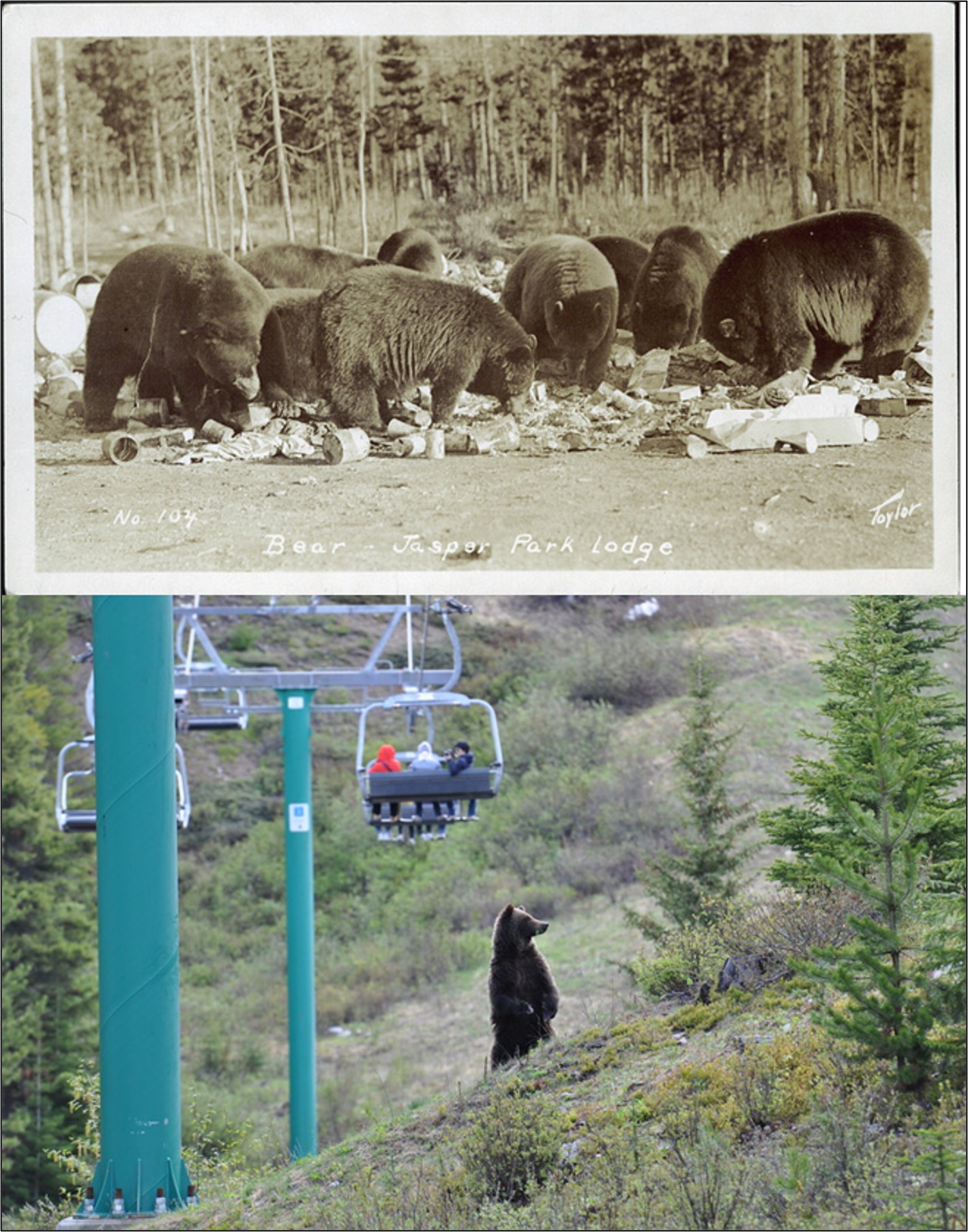
Bears are opportunistic omnivores, searching out rich sources of nutrition to fatten up during the spring, summer, and fall to prepare for winter hibernation. Grizzly bears select for fire-created habitats, but with ongoing fire suppression will utilize mechanically made forest clearings.
Near Lake Louise decades of fire suppression had gradually allowed a dense lodgepole pine forest to cloak Whitehorn Mountain from the valley bottom up to treeline. Increased forest cover reduced the abundance of important bear foods such as fruit-bearing shrubs (e.g. buffaloberry, grouseberrry), sweetvetch, other green vegetation (horsetail, avalanche lily), whitebark pine, ant colonies, and habitat for potential animal foods (hares, deer, elk, sheep etc.). However as shown in the then/now images below, expansion of the ski area created many kilometers of rich edge habitat along the runs where these food sources were relatively common. Further, re-planting of runs with forage species such as red fescue further increased bear foods.
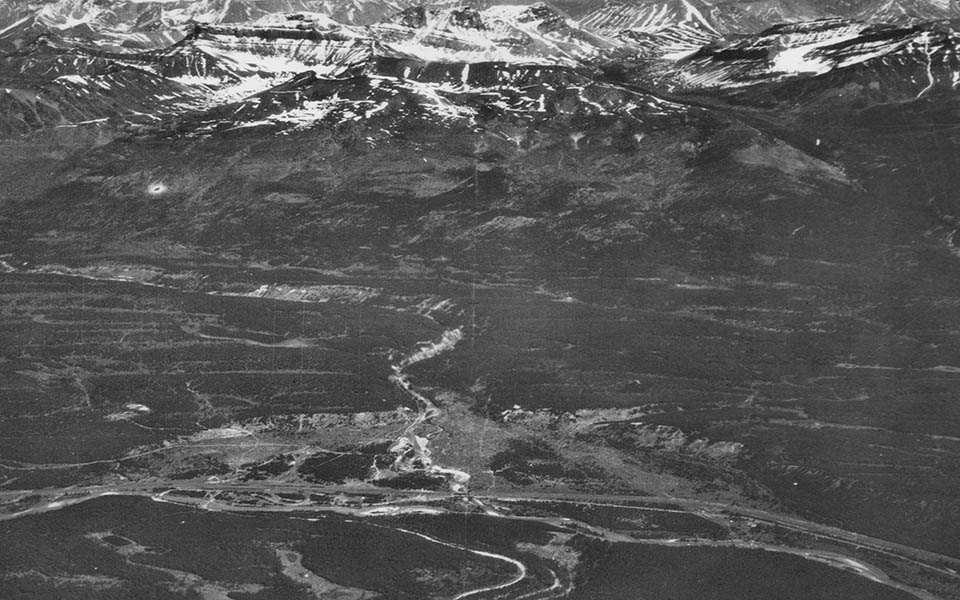
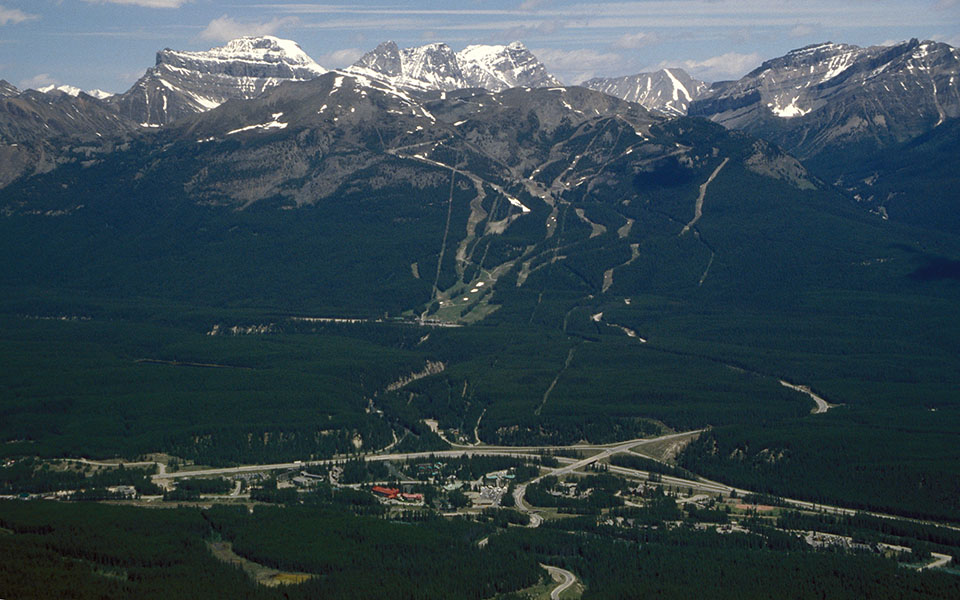
Lake Louise Village and ski area in 1931 (National Air Photograph Library and in 2003 (CW Collection).
The number of bears using Lake Louise increased slowly, but by the mid-1990s resort owners recognized they had an important tourism attraction, and Parks Canada recognized that ongoing fire suppression combined with ski run development created a unique opportunity for grizzly bear summer “stay-cations” on the ski hill, in some ways not dissimilar to the dumps they had just closed. By the mid-1990s park managers became increasingly worried that ski areas like Lake Louise and Norquay could become “habitat traps” essential for grizzly nutrition, but where habituation to humans and resulting mortality (control actions, highway and railway kills) could endanger Banff’s Bow Valley bears. Ongoing research using location collars clearly showed the pattern of “blob of bears” attracted to the high-quality habitat on the ski hill compared to other areas where fire had been suppressed.
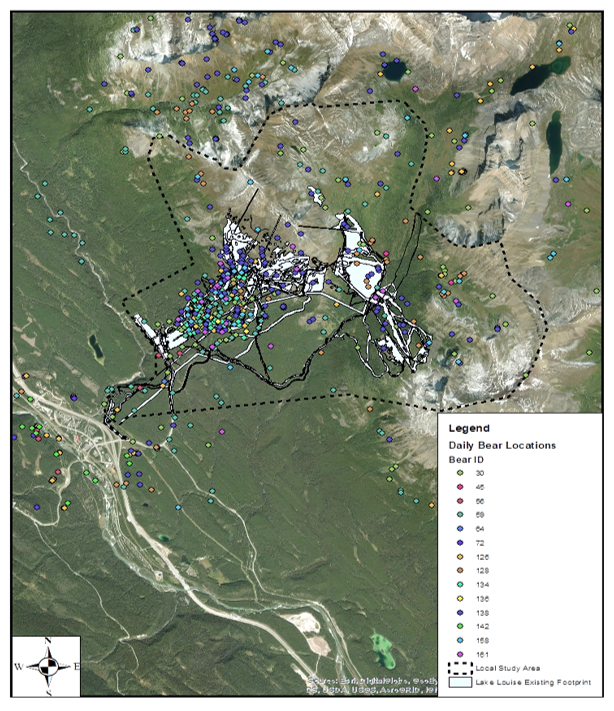
Grizzly bear observations on Lake Louise Ski Area during the period 2014 to 2019 (ESRI Digital Labs). Bears are attracted to the ski area due to ongoing fire suppression in adjacent landscapes and the presence of high quality habitat on, and along the edges of ski runs.
Adaptive Grizzly Bear Management
The relatively abundant grizzly bears on Lake Louise ski area presented opportunities to test a range of new and innovative park management policies that could possibly mitigate, or at least adapt to the situation:
- human use management– summer park visitors to the ski hills are generally restricted to the chair lifts and hiking trails above heavily used grizzly habitat. The parking lots and lodges at Lake Louise ski area are surrounded with electric fencing. Bear sightings are common, but direct interactions with the bears are rare.
- reduce highway mortality– fencing and crossing structures allow bears and other species to safely come and go from the area.
- careful garbage management– Parks Canada has pioneer bear-proof garbage containers to minimize habituation.
- prescribed burning in areas adjacent to ski area– Parks Canada has plans to do major prescribed fires in adjacent watersheds such as Baker Creek. Similarly, nearer to the Town of Banff and Norquay Ski Area, Parks Canada has done major burns on the Sawback Range and on the Fairholme Bench that provide alternate high-quality habitat for grizzly bears, their forage species, and other wildlife.
The cumulative effects of these actions appears favourable at this time. Clearly construction of fuel breaks to protect Lake Louise Village, the Chateau Lake Louise and other infrastructure from wildfires will further grizzly bears to the area. However, the fuel breaks can also provide opportunities to use prescribed fires in the upper Bow, Pipestone, and Baker Creek watersheds that can disperse grizzly use into more remote areas. Considering Indigenous forest management wherever possible (“burn early, burn often, burn light”) may provide a classic case history where ecological and cultural restoration interact to provide refuges for grizzly bears from “habitat traps”.
Return to Ecological and Cultural Restoration overview page
References
Gibeau ML, Clevenger AP, Herrero S, Wierzchowski J. 2002. Grizzly bear response to human development and activities in the Bow River Watershed, Alberta, Canada. Biological Conservation 103: 227-236.
Lamb CT, Mowat G, McLellan BN, Nielsen SE, Boutin S. 2017. Forbidden fruit: human settlement and abundant fruit create an ecological trap for an apex omnivore. J Anim Ecol. 86(1):55–65.
McLellan, CR. 2018. “Food Availability and Grizzly Bear (Ursus arctos) Selection of Post-Fire and Thinned Forests in the Mountain National Parks of Canada.” MSc Thesis, University of Alberta.