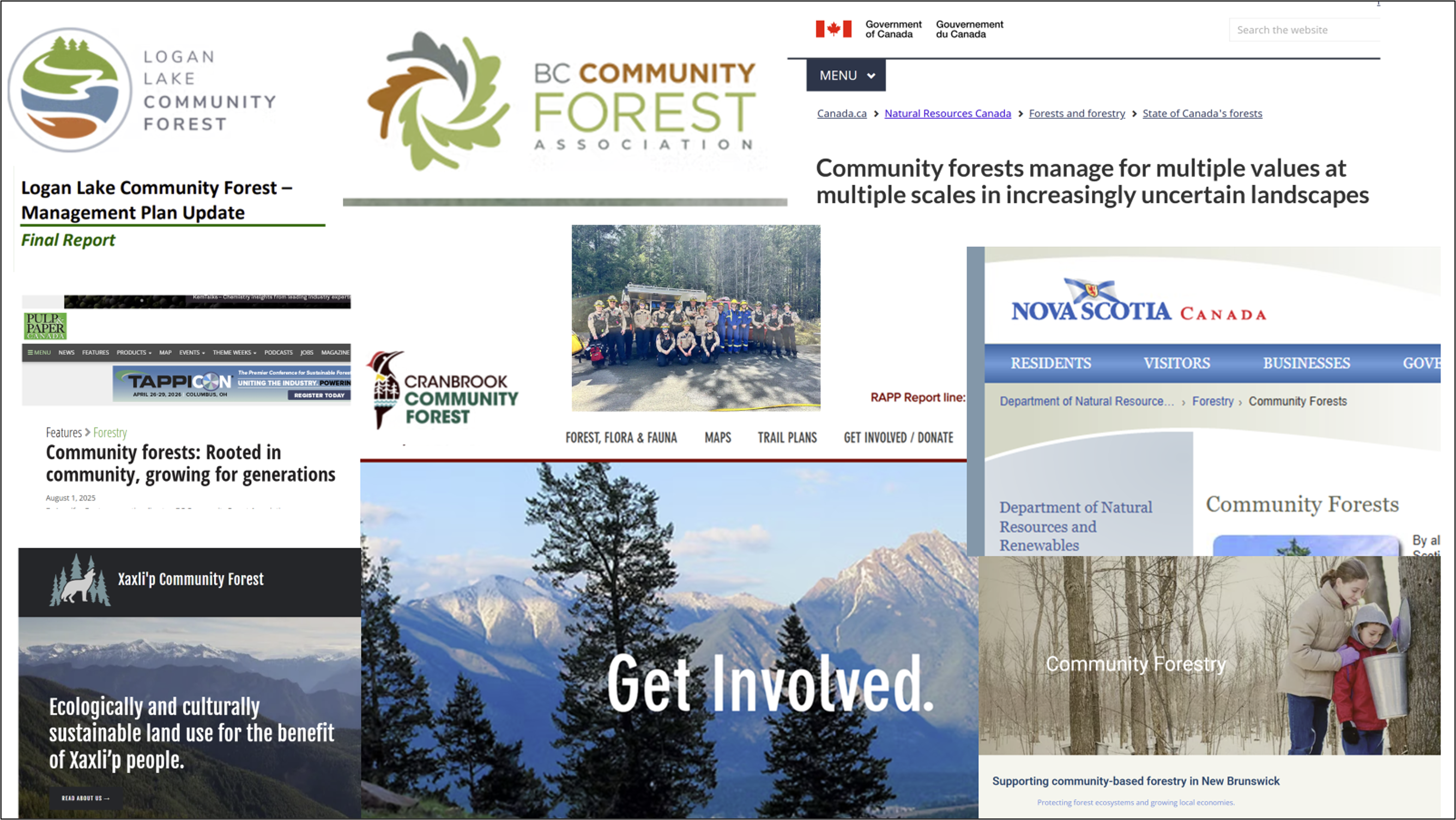
The Bow Valley needs to increase its fire management and risk reduction capacity by at least four times from current levels. “Community forests” are increasingly regarded as an essential landscape approach to reduce wildland fire risk. These organizations engage local businesses and citizens to manage vegetation and biomass to create conditions favourable for safe and rapid wildfire control, and work with local people to reduce risks to public safety and infrastructure. Click to enlarge image.
Background
The crisis of increasing wildfire risk to communities, and “roof to region” solutions require urgent and innovative governance, harvest licencing and economic support for ongoing biomass reduction in the intensive forest management zone around communites. Due to a rash of threatened and damaged towns and hamlets, British Columbia has taken the lead in establishing “community forests” in broad zones up to 20 km out from urban areas and important infrastructure. The community forest zones and their governance organizations form a critical link in the chain of a “roof to region” risk reduction program, forming the zone between the urban area and more remote forests.
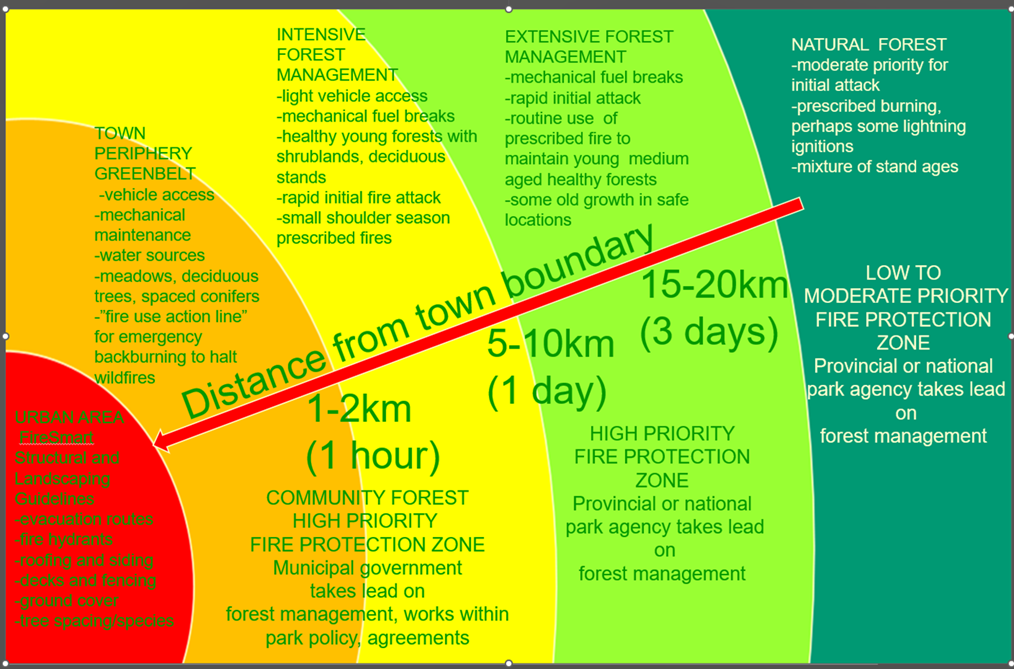
Community forests help provide a roof to region chain to wildfire risk especially in the zones where wildfires may reach the community within 1 hour to 1 day.
A recent review of the BC community forest program observes:
Community forests are leaders in wildfire risk reduction in British Columbia. For over a decade, they have proactively worked to reduce the risk of catastrophic wildfire in the Wildland Urban Interface (WUI) zone surrounding rural communities. They see the urgency of the problem for their communities, and they have prioritized fuel management activities on their land base. Community forests are often the point of connection between communities and their surrounding forests, and as a result have developed strong and trusted relationships and meaningful engagement strategies. (British Columbia Community Forest Association, 2024)
Community forests reducing wildfire risk require innovative ecological management, integrating modern technology of forest harvesting and biomass reduction (e.g., brushing and mowing) integrated with Indigenous traditional knowledge of fire to create habitat types with low fire intensities. In town or villages surrounded by parklands, community forest objectives to reduce wildfire risk may be unique:
- Unlike commercial forests replanting and biomass production is often not desired.
- Unlike more remote parklands managed for a “natural” fire regime, higher fire intensities are not desired.
As importance as their ecology is their politics and organization. Community forests link people to their surrounding landscape. The are often established as not-for-profits (NFPs), with an open governance structure that encourages participation by local citizens and businesses. As NFPs they can obtain grants and donations and priorize so that funds from timber harvest can be re-channelled into creating “firesmart” landscapes.
The Case for a Bow Valley Community Forest
The Canadian federal, Alberta provincial, and Banff and Canmore municipal governments are now fully engaged in major projects to reduce wildfire risk in the Bow Valley. This program intends to protect citizens and park visitors, and save from incineration the towns, adjacent hamlets, ski areas, powerlines, railway line, and other infrastructure. No one wants a repeat of Jasper 2024, Waterton 2017, Fort MacMurray 2014 or Slave Lake 2011.
A wildfire safe landscape of managed vegetation cover, fuelbreaks, powerline glades, access trails, fire use action lines and other infrastructure associated with an intensive forest management zone (assuming ~100 square kilometers in the Bow Valley) will arguably be one the most valuable economic assets for the national and provincial parks that surround communities and infrastructure. It will require initial substantial costs, followed by ongoing major operation and maintence outlays:
- Cost of forest clearing- Depending on the location and type of fuel break, removing flammable coniferous forests and downed wood fuels can range from a positive return of about $10K/ha (from commerical wood) that is often rolled over to treat more land where costs require subsidies and grants to a negative return, or cost of $10K/ha near residential areas. In general, the closer to infrastructure the higher the cost. As assuming an approximate negative input cost of ~$2k/ha for 100 sq km (10,000 ha) of intensive forest management zone suggests that total cost could reach $20M if only mechanical methods are used. Costs could be reduced by using alternate methods such as partial felling and burning, or patch burning.
- Cost of maintenance- Assuming a 10 year maintenance cycle for the 100 sq km (1000 ha/year) and up to $500/ha if mechanical means are used suggests annual costs of $500K which again can be reduced with prescribed fire.
- Although these costs seem high, consider that the value at risk being protected are in the billions, and the public safety value is incalcuable.
Similar to the community forest programs described above, Bow Valley citizens and businesses will recognize that the scale, complexity, costs and ongoing management of program will require that an additional organizational configuration is required to “fill in” between the existing government services. Consider that:
- Municipal emergency and fire department services– These organizations are fully committed to the top priority work of developing/implementing FireSmart standards and public evacuation plans for municipal neighborhoods and lands. There are ongoing and increasing demands for fire department wildland fire cross-training and operations to assist in forested areas in and near communities.
- Federal and provincial wildland fire agencies – These organizations are fully committed to regional wildfire planning, wildfire risk reduction and emergency suppression operations across vast areas of parks and multiple use forestry lands.
- Community forest organizations– These organizations are generally established to fill the zone requiring intensive forest management between between municipalities and more remote park and forestry lands. There are numerous configurations– here’s a link to some discussion on what might apply near Banff and Canmore: Bow Valley Community Forest and Wildfire Protection Society
Table of responsibilities of management entities for “roof to region” fire management for communities and surrounding national and provincial parks: all agencies (blue), municipal governments (pink), community forests (yellow), and park agencies (green).
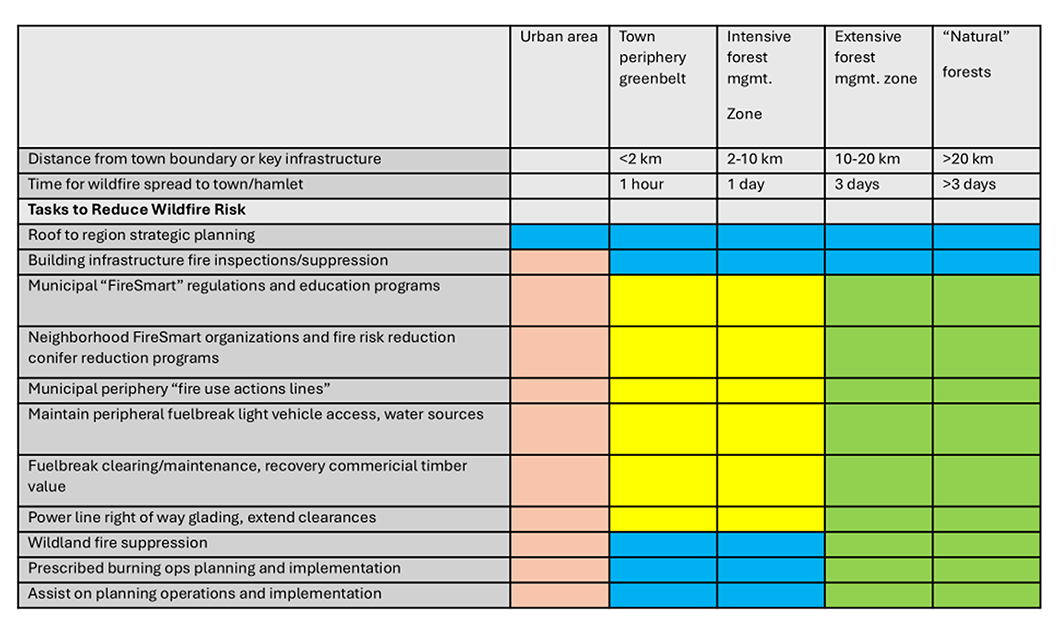
A community forest organization fills a critical gap by taking the lead on tasks currently either not filled or only partially filled by municipal, provincial or federal agencies. These initiatives recognize that “roof to region” approaches can fail without the support and funding from all interest holders that creates and maintains manageable fuel and fire risk conditions in the critical peripheral greenbelt and intensive forest management zones.
The Bow Valley Community Forest: A Prototype for Canadian Parks and Protected Areas?
Banff, Canmore, Lake Louise and associated developments lie in one of Canada’s most iconic parklands—the Bow Valley Corridor with of astoundingly high economic, historic and cultural value. Similar to the core area of many other federal and provincial parklands, it was the past homeland for Indigenous peoples. Their traditional use created a unique eco-cultural landscape that had relatively low wildland fire risk. Unfortunately, post-contact federal and provincal government fire suppression resulted in major increases in biomass and fire risk. Again, this is in common with many Canadian parks and protected areas where high visitor use and development centers often had a long cultural history that has been greatly altered. Establishing a prototype “community forest” in the parks of the Bow Valley Corridor will create guidelines to reduce wildland fire risk having application across Canada for communities in and near parks, wildlands, and forests for several broad categories of park management interest:
- Immediately increased forest management capacity– Over the last two decades forest management in the Bow Valley has averaged less than .5 to 1 square km per year. This needs to increase by an order of magniture to 5-10 sq km per year to address the crisis of high fire risk, and within a decade to 20 sq km year (largely with prescribed or contained fires) to balance and eventually reduce biomass accumulation. A new organization, focussing on the high forest risk zone near communities is imperitive in the Bow Valley, and the concept could be applied to many other regions of Canada where parks and protected areas dominate a landscape.
- Participation and governance of key interest holders- The key objective of community forests is to integrate stakeholder participation in programs to reduce wildland fire risk. Depending on provincial and federal legislation this can be achieved through various licencing or tenure arrangements to manage forest fuels. In national and provincial parks a preferred option may be to approve a strictly regulated licence for biomass removal and associated harvesting permits to a not-for-profit entity. Banff National Park staff have long and routinely issued these permits on park lands for everything from maintaining powerlines to providing water, gas and internet to the town. Alberta Provincial Parks recently issued permits and guidelines to the Town of Canmore to reduce fuels in a zone of ~2km around the town. The province of British Columbia now offers training and certification for specialists reducing fuels in community parks and near-community zones.
- Ecological integrity– Canadian parks and protected areas all have enabling legislation requiring various levels of maintaining characteristic native ecosystem states (e.g., “natural”plants and animals) and the processes that influence them (e.g., fire, predation, herbivory, Indigneous use). Ongoing fire suppression has generally increased the potential for high intensity fires, and often most greatly near developed areas. Community forest guidelines will specifically refine how these ecosystems should be restored in high risk areas and the techniques that may be required and encouraged.
- Cultural integrity and reconciliation– In general, Indigenous landscapes had signicantly less risk of extreme wildfire behaviour. Reducing wildfire risk in community forests will often seek to restore these condition, working with Indigenous peoples to adapt traditional knowledge to current fire risk and land use situations.
- Cost recovery and financial management– The high forest biomass conditions of current high fire risk landscapes may have merchantable timber value if this can be recovered before insect attack or burning. However, long-term maintenance costs can be high to maintain fuel breaks or long-term landscapes with ecological and cultural integrity. Over time community forests will require a diversity of funding sources.
- Simple establishment- Given the variety of land tenures in the Bow Valley, likely a “Bow Valley Community Forest Society” would be just that, and hold no tenures. It would simply be a “go to” non-profit that can provide the most efficient and politically expedient services to reduce fire risk, and also recover/invest any fiber income accrued for maintenance or further projects. Its strength will be expertise and financial capabilities, not land tenure. The Society’s members continue to hold their varied tenures, but make agreements for service when required.
Return to Bow Valley Wildfire Risk Reduction Overview
References
Copes-Gerbitz, K., S. Dickson-Hoyle, S.M. Hagerman, and L.D. Daniels. 2020. BC Community Forest Perspectives and Engagement in Wildfire Management. Report to the Union of BC Municipalities, First Nations’ Emergency Services Society, BC Community Forest Association and BC Wildfire Service. September 2020. 49 pp.
British Columbia Community Forest Association. 2024. Enhancing Wildfire Resilience: Summary Report of the BCCFA’s Wildfire Risk Reduction Economic Recovery Initiative. Victoria, BC.
British Columbia Ministry Forests. 2017. Community Forest Agreement: Application Requirements. Victoria, BC.
Canadian Parks Council, ed. 2008. Principles and Guidelines for Ecological Restoration in Canada’s Protected Natural Areas. Canadian Parks Council.
FireSmart Canada. 2024. Blazing the Trail: Celebrating Indigenous Fire Stewardship. Canadian Interagency Forest Fire Centre.
World Economic Forum. 2026. From Wildfire Risk to Resilience: The Investment Case for Action. White Paper. Davos, Switzerland. https://www.weforum.org/publications/from-wildfire-risk-to-resilience-the-investment-case-for-action-2026/.