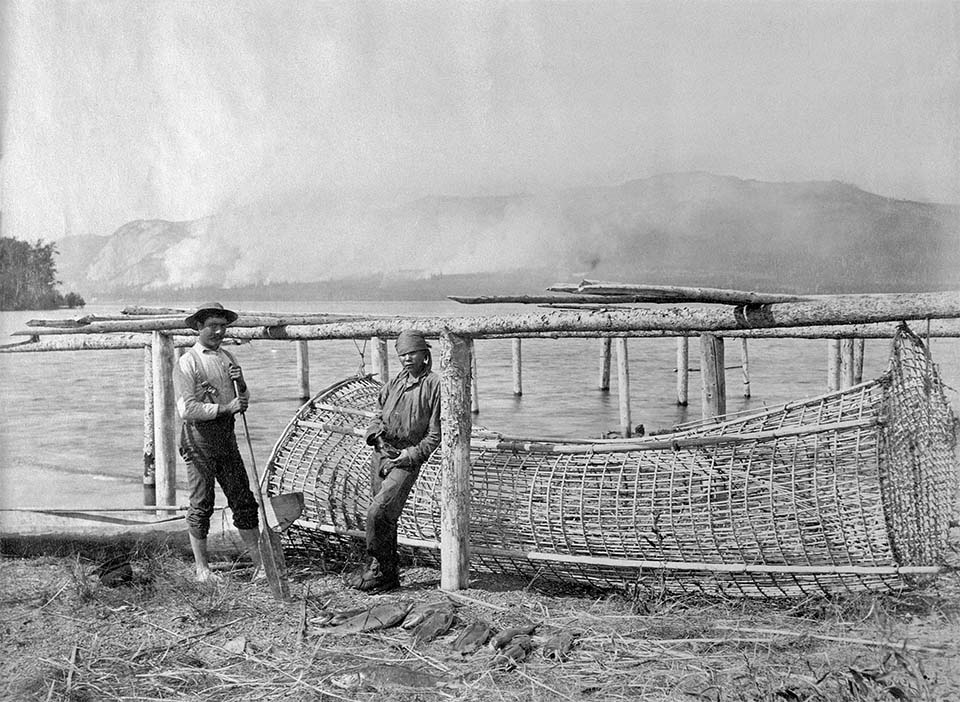
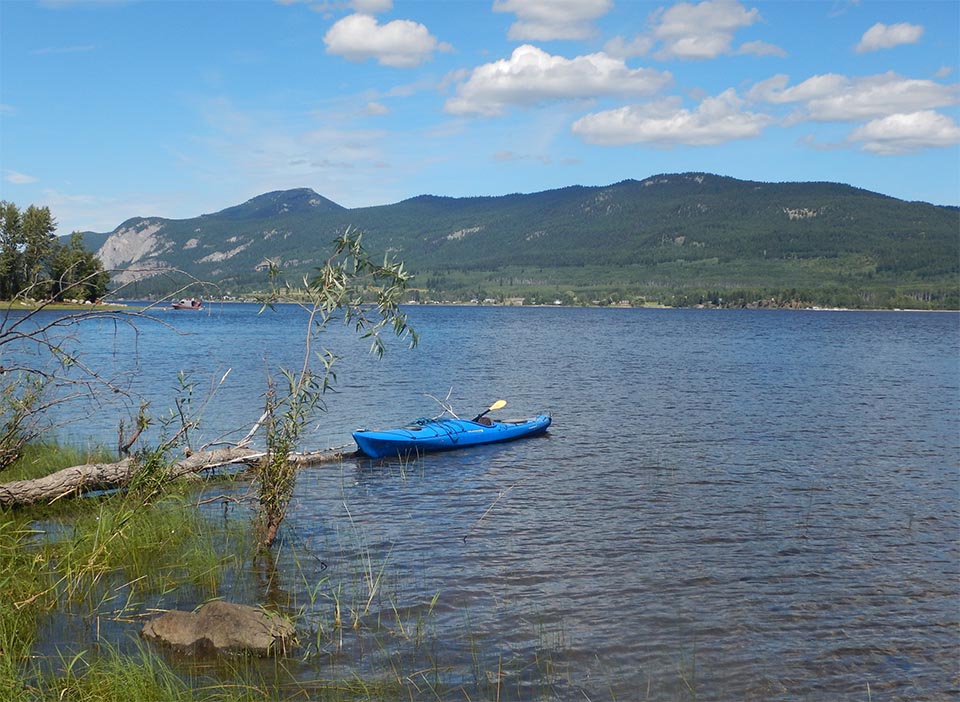
Fishtrap at inlet to Stuart River on the northern end of Stuart Lake, c. 1900 (Hudson’s Bay Company Archives N-11714, thanks to Ted Binnema for archival sleuthing), and in 2021 (CW-2021-08-28-4076). The historic picture was likely taken in the fall when water levels had dropped.
This image captures an interesting dilemma of managing food sources during the Indigenous to European cultural transition. Clearly salmon was the main subsistance fare at Fort St. James, but this was subsidized by plant foods (berries etc.) likely common in the shrubfields being burned by a low intensity fire in the background of the ~1900 fire. When they greened up early in the spring these burns may have also attracted some of the very few moose that persisted near salmon fisheries. Clearly this Indigenous burning was routine– the aspen and shrubfields still persist in the modern photo.
However, as domestic cattle were brought into the area, Indigenous fire was certainly hard on wooden fences, and may have periodically destroyed winter cattle forage or hay fields. Fire suppression became the order of the day.
The image also shows how the Indigenous “burn early, burn often, burn light” regime could have favoured caribou that were relatively abundant on the alpine and subalpine plateaus at higher elevations. The lower elevation burns in late and early season in essence help partially protect the upper elevations from midsummer megafires. Moreover the burns facilitated human hunting of any moose that wandered into the area, thus keeping wolf densities very low. This type of human-caribou interaction likely stretched across boreal reindeer-caribou range from Norway to Labrador. We may indeed long-term mutualists– friends long before Santa Claus first hitched up reindeer.
Map
Fort St. James, Regional District of Bulkley-Nechako, British Columbia, Canada