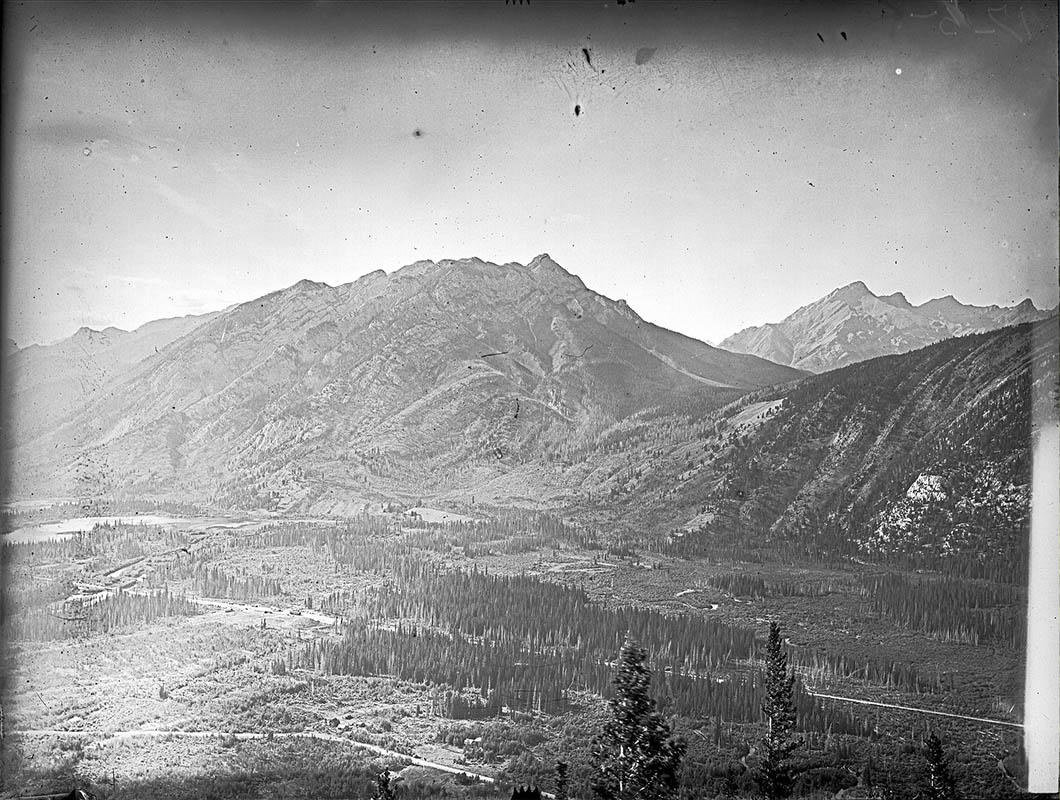
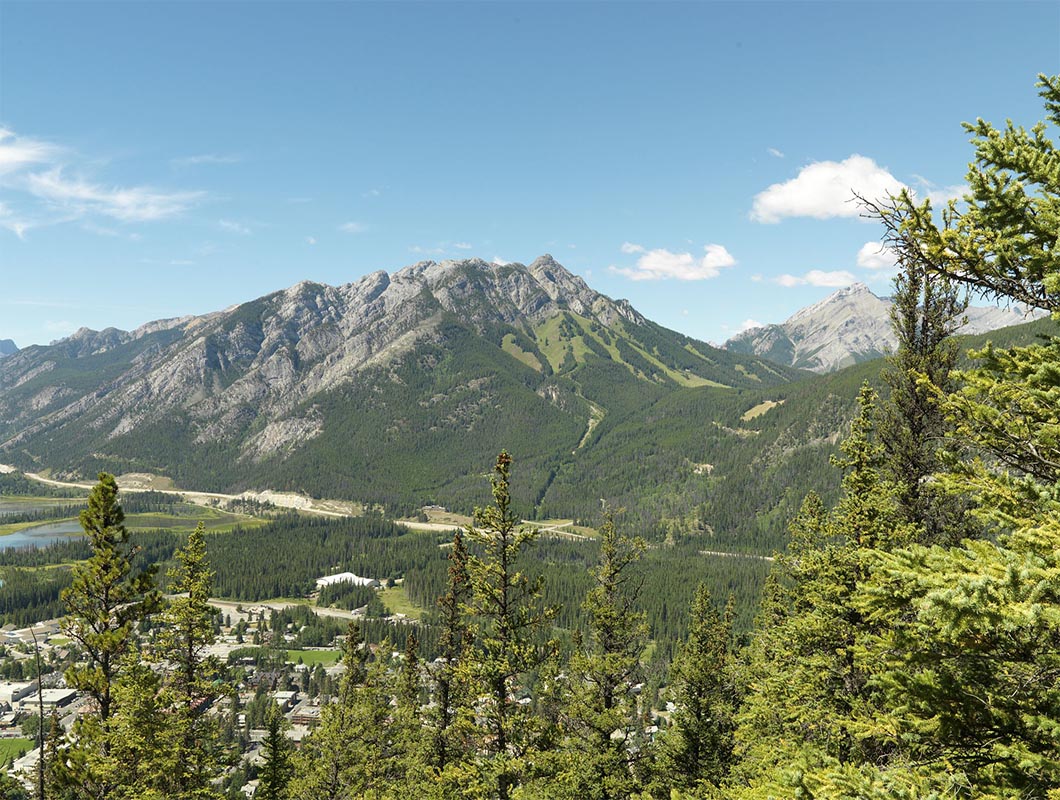
Mount Norquay in 1888 (Mountain Legacy Project) and 2014 (CW Photo). These slopes historically had some of the highest fire frequencies in Banff National Park creating grasslands and shrublands. Fire suppression has created a dense and decadent conifer forest that will burn explosively, and rapidly reach the resort on the slopes above them. Protecting Mt. Norquay’s skiing and summer tourism infrastructure while restoring a long-term regime of frequent low to moderate intensity fire is a unique challenge, and must be a top priority for the national park and the local communities. Mount Norquay should become a founding member and leader of a Bow Valley Community Forest.
A Cultural and Ecological Icon
The slopes of Mount Norquay, rising about Vermilion Lakes and the Town of Banff are an ecological and cultural focal point of the national park. Humans camped and hunted bighorn sheep on its lower slopes as early as 10,000 years ago. Frequent burns spreading its slopes created unique habitats of grasslands, aspen groves, open savannas of Douglas-fir, and young stands of lodgepole pine. By the late 1880’s, Banff’s first tourists climbed Norquay’s fire-maintained slopes to sightsee above the town, and soon thereafter early Banff residents took to the same fire-gladed slopes for winter skiing. In 1928 the Banff Ski Club built a warming cabin, by 1935 a narrow road had almost reached the lodge, and skiers from Calgary were regular visitors. Norquay hosted hundreds of skiers attending the Dominion Ski Championships in 1937. In 1940 an expanded association built a new lodge, then in 1941 Banff’s first ski lift– a rope tow on the lower Lone Pine.
Starting in 1947 a series of commercial interests owned Norquay, building Banff’s first joint summer sightseeing and winter skiing chairlift in 1947 that reached the top of the slopes below the cliffs, and later expanding ski runs further to the north. Each year thousands of vehicles ascend the road to see the town from the Green Spot viewpoint and visit the winter and summer resort attractions. Mt. Norquay provides a range of winter activities (tubing, snowboarding, skiing) and summer attractions (sightseeing and via-ferrata tours). Today, as it has been for over a century, Norquay remain’s Banff’s “community resort”.
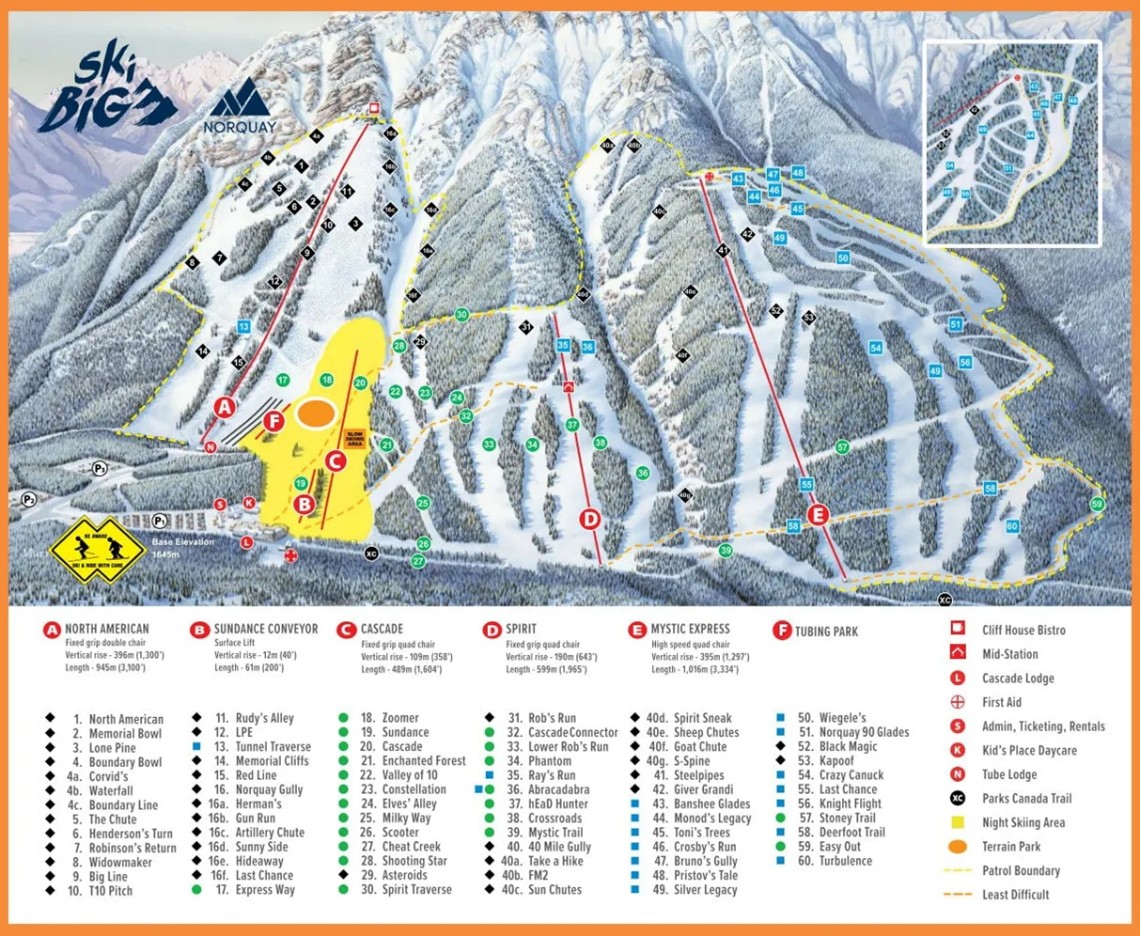
Infrastructure on Mount Norquay. The resort has done extensive FireSmart work around buildings and ski lifts on the lease. The risk of extreme intensity fires reaching the area from Parks Canada’s lands downslope and upwind (left side of image) remains high.
Increasing Fire Risk
All the while the resort developed, national parks wardens routinely suppressed any fires across the mountain’s slopes. Forests gradually closed-in requiring routine brushing of ski runs. On the lower slopes meadows shrublands and aspen groves disappeared. Ancient Douglas-fir surviving many fires were surrounded in dense conifers. Over time, the risk of a high intensity wildfire sweeping up Mount Norquay became extreme. By the 1990s a fuse-line of warm-dry slope of unbroken decadent conifers lay directly above ignition sources from power lines, the Trans Canada Highway, the railroad, and the busy streets and trails around Banff. Arguably, the resort was now a “Ground Zero” for a potential wildfire disaster. In fact, recent fire growth modelling shows that Norquay would be quickly engulfed by fires starting west and southwest of the resort.
A prescribed fire in April 1992 had removed fuels up valley from western ridge on the mountain (see image below). As expected in the fire’s plan, the remaining winter snowpack on the mountain in April was important to contain the burn. However, closer to the resort, large-area mechanical clearings likely followed by routine use low intensity prescribed fires will likely both be important on the lower slopes of the mountain near the access road. These have yet to be implemented at the scale necessary.
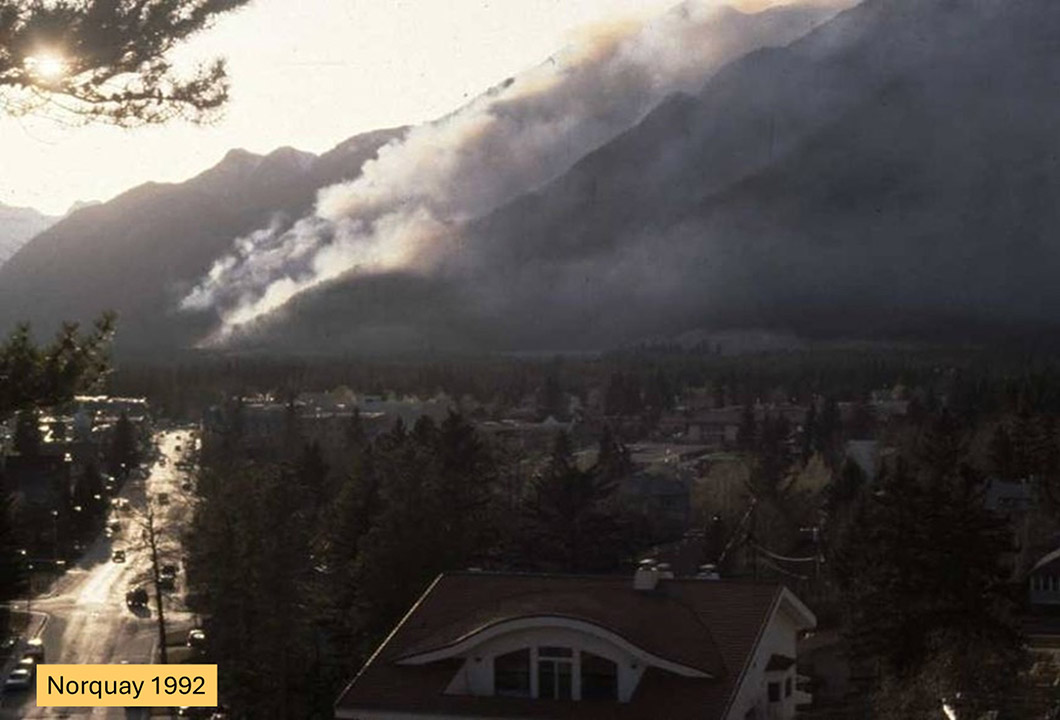 A prescribed fire in early May 1992 was contained by snow still remaining on northern and easterly aspects of the mountain. The ski resort was actually open on this day, and staff helped arrange some “plumbing” to keep the grass from burning on the North American slide paths. This early season, low intensity burn thinned forests and removed flammable juniper across >300 ha upwind of the resort. The fire was also significant because it was the first official deployment of Parks Canada’s recently developed Incident Command Team system. Today Parks Canada’s IC teams work on dangerous fires across Canada, but these staff obligations to national emergencies have now actually decreased capacity for local forest management.
The Parks Canada (2011) Site Guidelines that approved Norquay summer use recognized the crisis, requiring that future in future plans the ski area and Banff Nationa Park would proceed a cooperative effort with:
Restoration of natural vegetation patterns, composition and structure in and adjacent to the lease through an enhanced run/vegetation management strategy to the one outlined in Section 5.10 – Vegetation Management by:
▪ restoring open habitat patches (eg. Douglas fir savannah, montane grassland) between the TCH and the leasehold through mechanical clearing;
▪ prescribed burning near the leasehold; and
▪ wildlife habitat improvements off the leasehold.
Following this direction, in the 2013 Norquay Long Range Plan the resort owners and Parks Canada agreed to jointly implement a strategy for use of fuelbreaks and prescribed fires to reduce restore native vegetation cover on the mountain. Since then, the resort owners have systematically reduced risk next to their buildings and lift towers. However, as the repeat photographs above illustrate, Parks Canada has made little progress near the resort’s lease to clear dense forests and restore vegetation types with less risk of extreme fire behavior. Strangely, a recent Parks Canada website posting shows that fuel reduction work was done along the road, but this is inaccurate– work was done only at the base of the access road above the Juniper Inn and powerline.
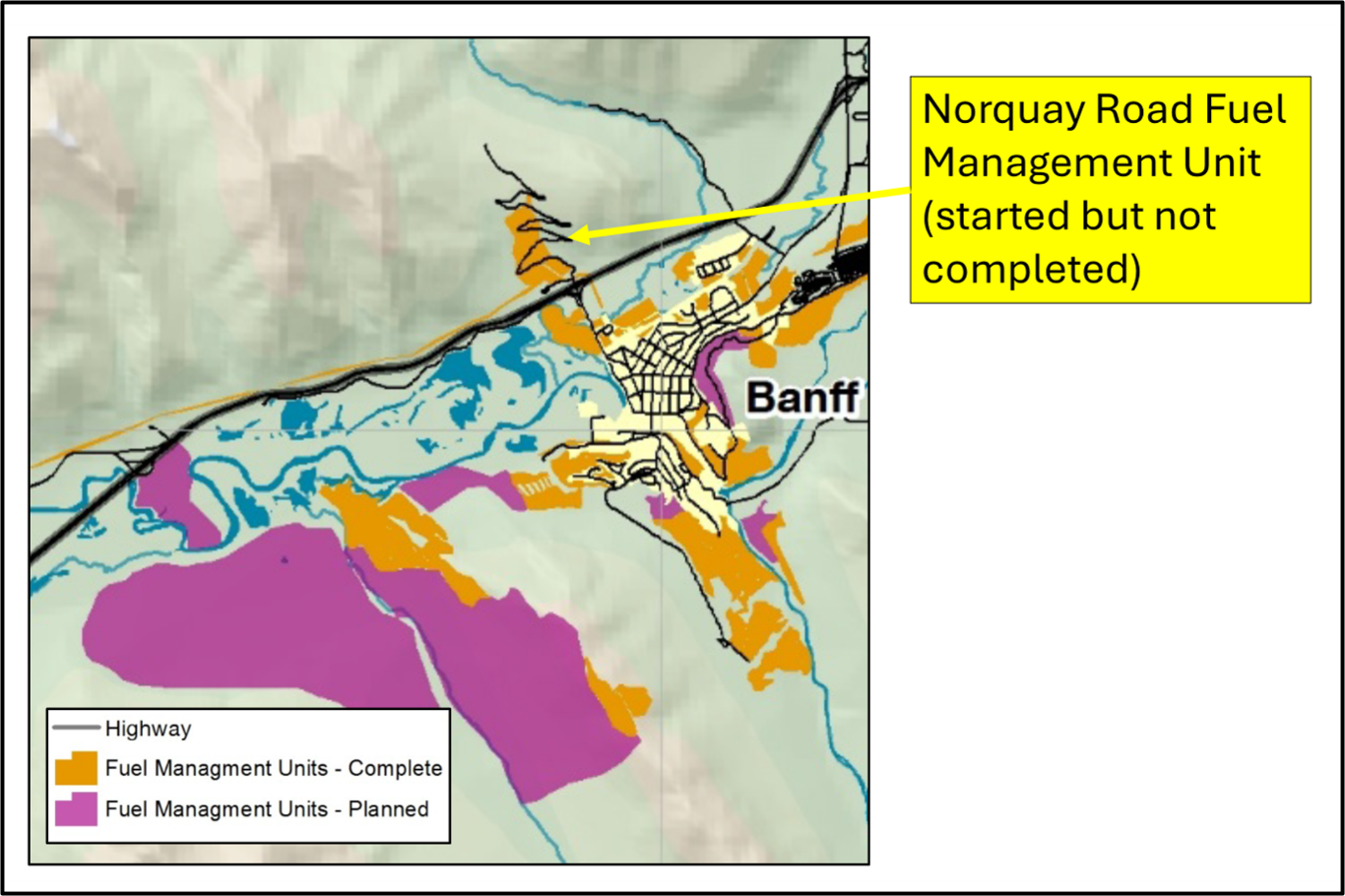
A Parks Canada December, 2025 Facebook posting of ongoing progress of Town of Banff area fuel management projects. The unit shown along the Norquay access road is actually not complete– at most it is only 10% done.
Opportunity for an Innovative Approach
The owners of the resort on Mount Norquay have done extensive fuel reduction and FireSmart work on their lease. However, due to its other obligations, Parks Canada evidently does not have the capacity to reduce danger on off-lease forests on Norquay’s warm/dry upwind slopes before a wildfire seriously threatens or damages the resort, and as indicated above may not be even aware of its own lack of progress. One option for the owners to accelerate work to reduce risk is to explore a cooperative organization– Parks Canada would provide guidelines for off-lease forest clearing, but the resort owner would work with a non-profit foundation such as a a “Community Forest Society” to conduct the work in return for the value of the wood and contributions that reductions to ski area risk of wildfire damage.
If Mount Norquay’s owners, the nearby Juniper Inn, Town of Banff, Town of Canmore, Alta-Link and Fortis electricity providers, Parks Canada, other partners, and ultimately Canadians choose this option to save the resort and its surroundings from conflagration, a “Bow Valley Community Forest Society” could serve as a protype for the country through:
- rapid expansion in financial and operational fire risk reduction capacity
- rapid expansion of societal support
- rapid expansion of specialized expertise to reduce fire risk in parks and protected areas, and this expertise could be cost-efficient by sharing with other Bow Valley communities that share the level of risk, and often from the same future potential fires;
- rapid increase in landscape level integration of FireSmart principles
Conclusion
The all-season resort on Mount Norquay is important to national park ecology and is a foundational to Banff’s culture and economy—it deserves the best of fire management and innovative partnerships to preserve this heritage. Saving Mount Norquay could serve as a proto-type for communities across the country that not only want to protect their houses, but also their economy.
Return to Reduce Bow Valley Wildfire Risk Overview page
View Mountain Resorts vs Wildfires
References
Hunter, Eddie. 2000. The Spirit of Norquay: A History of Skiing Banff National Park’s Mount Norquay. Banff, AB: Banff Mount Norquay Ski Area.
Parks Canada. 2009. Banff Field Unit Fire Management Strategy. Banff National Park.
Parks Canada. 2011. Mt. Norquay Ski Area Site Guidelines for Development and Use. Ottawa, ON. 85p.
Mt. Norquay. 2013. Long Range Plan. Ski Mount Norquay. Banff, Alberta.