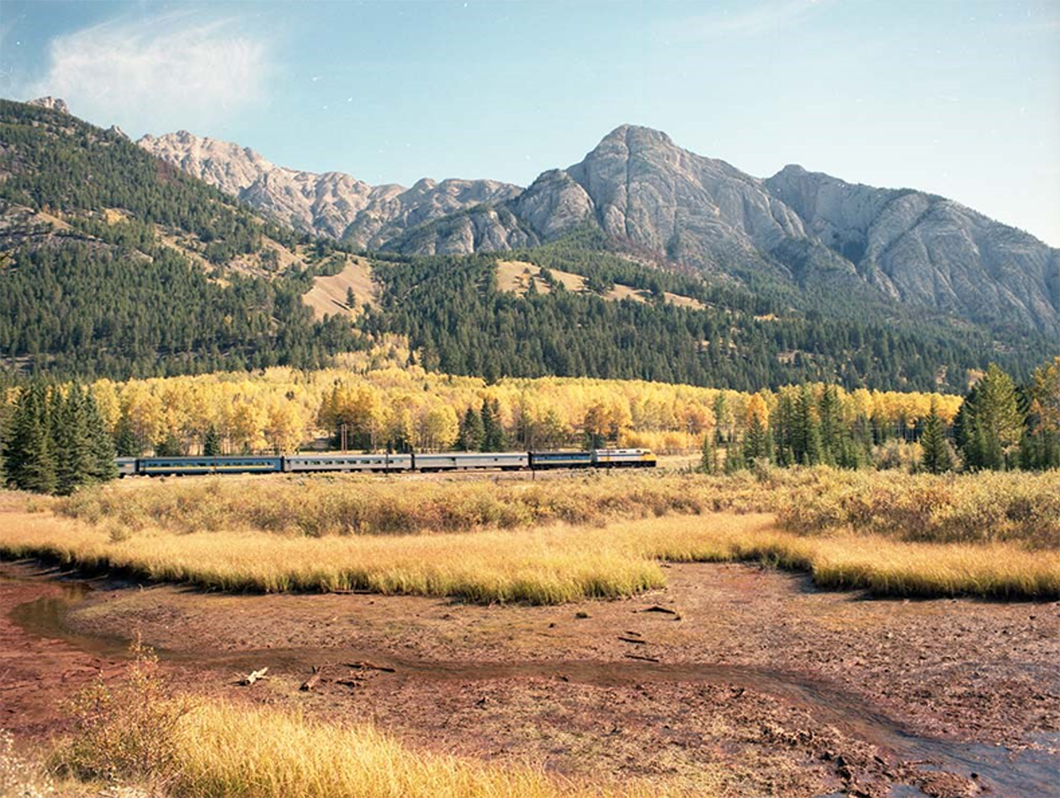
Willow shrublands, aspen groves and grasslands below the Sawback Range in the early 1960s (Nick Morant, Whyte Museum of the Canadian Rockies). Frequent Indigenous burning created this deciduous vegetation– it has low to moderate risk of intense fire.
As early European travellers David Thompson and James Hector entered the valleys of Canadian Rockies they record travelling up well-used trails through of grasslands, shrublands and deciduous forests—not the dense conifer stands we see today. This was the product of thousands of years of Indigenous peoples using fire to culture their homelands—creating good travel routes and productive plant and wildlife habitats. Moreover, these Indigenous fire practices maintained a positive feedback loop where routine fire use removed conifers, and created grasslands, shrublands and deciduous forests that were in turn easier safely burn with a “burn early, burn light, burn often” strategy that diminished intense crown fires during midsummer drought periods.
Although the burned patches around its periphery of the valley were unsightly, after park establishment and a period of fire suppression, the open parklands and glades along the Bow Valley were an appealing tourist attraction. Especially from mid-September to early October the “fall colours” of golds, reds and oranges turning aspen, poplar, willow and birch leaves drew many tourists into the valley, the same way larches due today.
Repeat photographs show that this open landscape has been lost over time, now buried under dense forests of conifers that are increasingly disease prone and create deep fuelbeds for intense fires. How did this transition occur in Canada’s fire national park where the objective was to maintain long-term natural conditions?
Historically and currently four key trends continue to shrink areas of native grasslands, shrublands and deciduous forests in Banff National Park:
- Fire suppression– relatively frequent fire, often historically caused by Indigenous peoples, reduced conifers that use seeds to reproduce. This frequent fire stimulated reproduction of grasses and broad-leafed woody plants that sprout after burning. Supressing fire reverses these processes.
- Losing Indigenous hunters and 4-legged predators– Early park management practices included removal of Indigenous peoples and predator control. Resulting high densities of prey species such as moose, elk, deer and bighorn sheep began to reduce palatable species such as aspen, willow and saskatoon.
- “Elk ranching” near townsites– Restoring 4-legged predators such as wolves in parks has concentrated elk (and sometimes deer) in refuges near busy townsites such as Banff, Jasper, and Canmore. Political and ecological researcher interests have limited actions to reduce elk numbers to reduce impacts on palatable broad leafed plants such as aspen.
- “Bison ranching” in the Red Deer valley restoration zone– Historically bison were at low density at the edge of their range in the eastern slopes of the Rockies. Unfortunately, bison Banff’s bison restoration project population objectives are resulting in high winter and spring densities on valley bottom winter ranges. This will impact native grasslands, aspen, and shrublands.
- Rising treelines and alpine larch– A combination of warming climate and fire suppression has increased the trend of evergreen conifers to increase in elevation over time, and decreasing the cover of alpine larch and meadows. On the continental divide this increases the probability that hot mid-season fires from the west will cross the continental divide and advance into the Bow Valley.
Each of these trends reverses ecological processes maintaining vegetation thats tend to burn early, often, and light, and creates conditions for high intensity megafires.