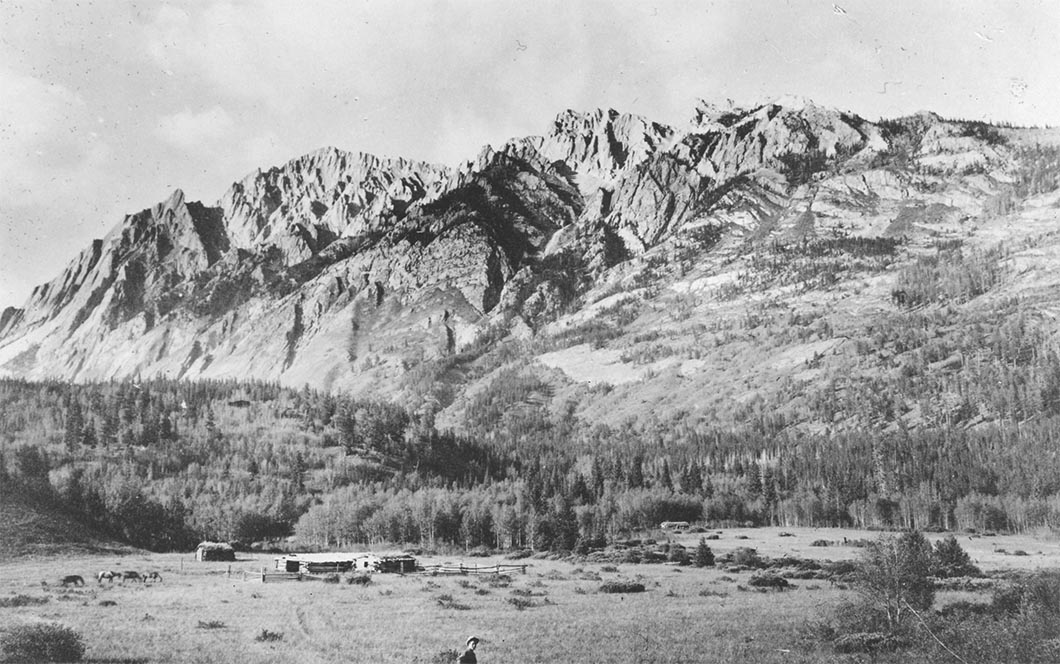
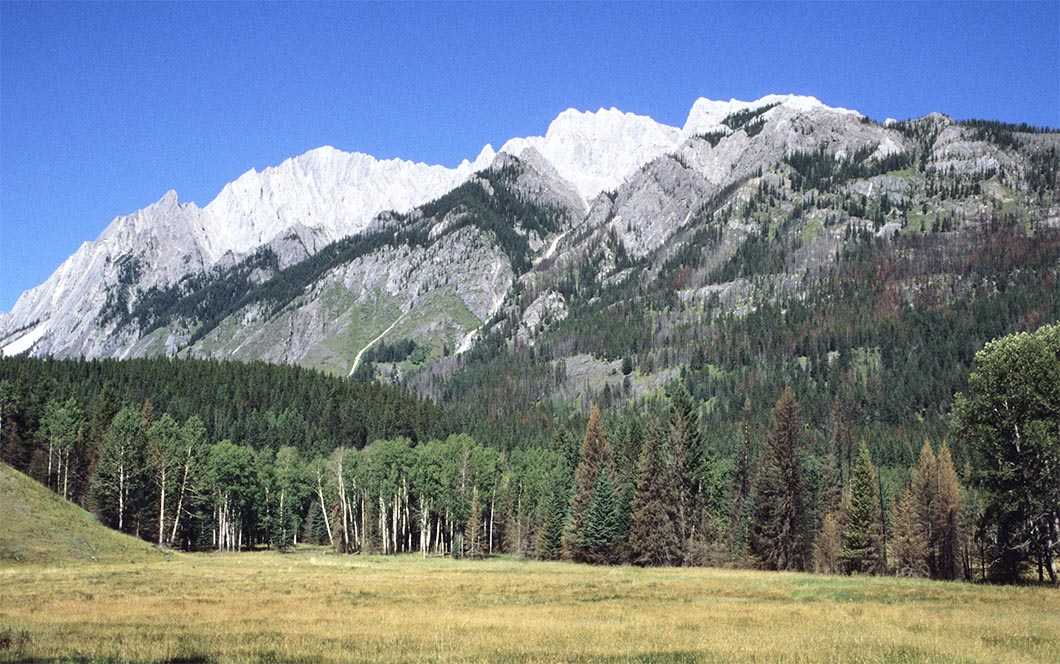
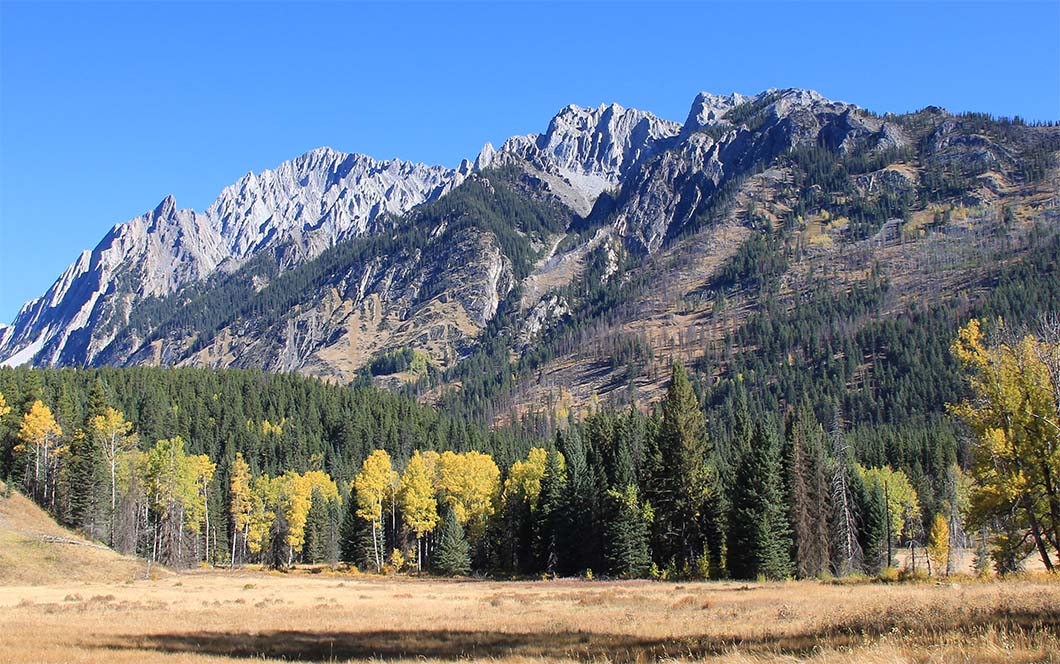
Hillsdale Meadows and the Sawback Range in 1902, 1999 and 2017 (Images: Glenbow Museum, CW collection).
Historically the meadows and slopes upslope and downwind likely burned every 20 years or more frequently depending on Indigenous use and traditional fire management practices. Parks Canada prescribed burned the slopes of the Sawback Range several times between 1985 and 2017. With each prescribed fire the hillside vegetation is more closely restored to the long-term pattern of vegetation types that have lower risk of high intensity wildfires.
Work with Nature: Restore Vegetation Types that Reduce Fire Risk
Ecologists have inventoried vegetation communities and their relative flammability across the mountain national parks and for Bow Valley in particular. For fire groups (plant communities with similar regimes) the general pattern is that the more recent the last fire, the lower the intensity of fires. Conversely as the vegetation ages and develops as the time since fire increases the trend in Banff and many other forests is towards high intensity crown fires. The most spectacular recent example of this is the July 22-26 Jasper Complex fire where over 300 km2 of greater than 100-year-old montane and subalpine forests burnt severely damaging the Town of Jasper. A large area of high biomass accumulation and flammable vegetation interacted with a drought and hot weather to create explosive fire behavior. Similarly, fire suppression in the Bow Valley is creating increased conifer forest cover as shown in the images below (click image to enlarge).
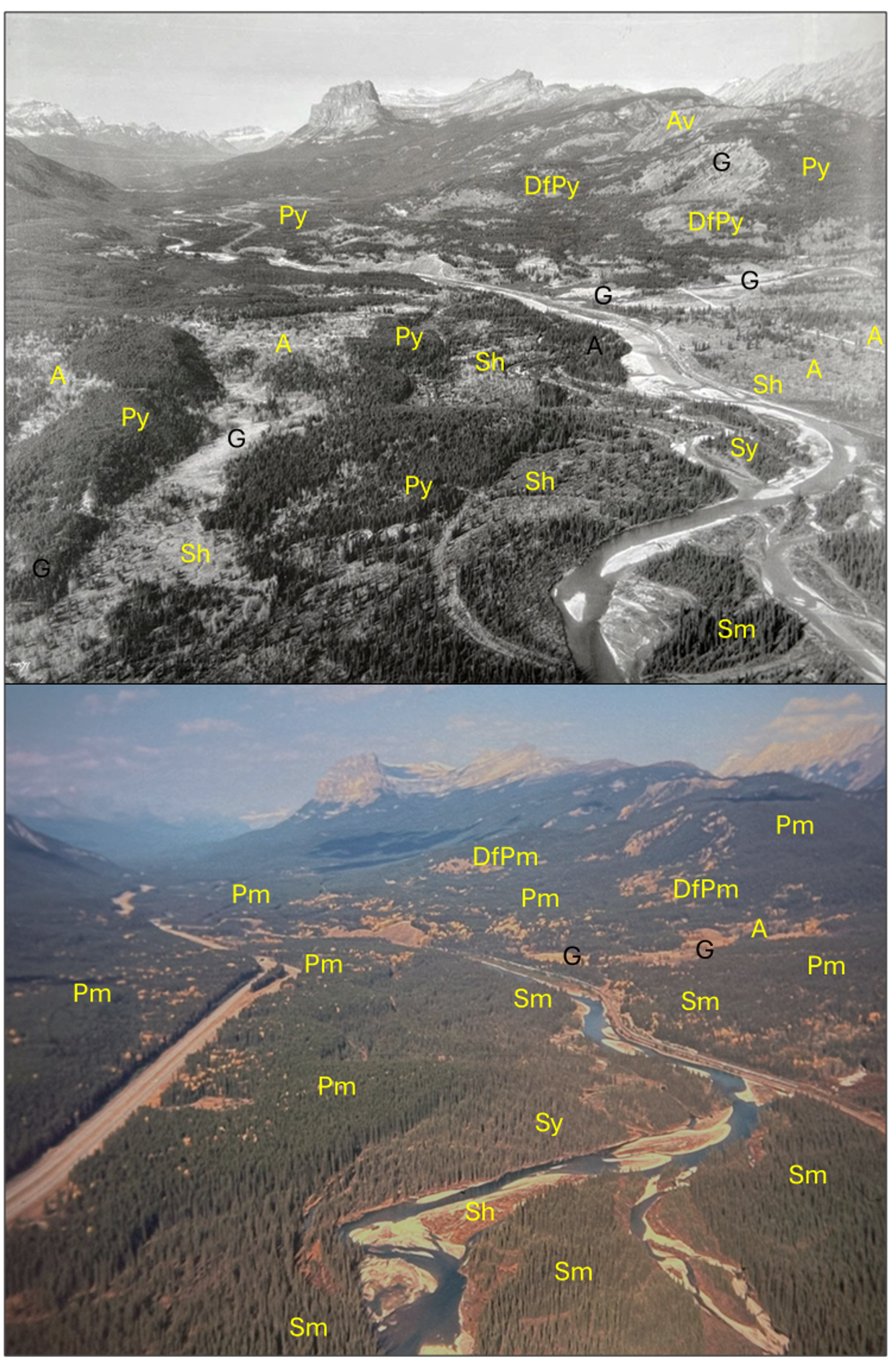
Banff’s Bow Valley near Hillsdale Meadows in 1921 (National Air Photograph CA-114 series) and in 2003 (CW-2003-10B-12) showing the Trans Canada Highway (left) and KCCP Railroad (right). Historically Indigenous burning in the area created a diversity of vegetation types that burned with relatively low to moderate fire intensities. Today the area is increasingly dominated with dense conifers which will burn high intensity. The Bow Valley’s main powerline is now screened within dense timber and will be severely damaged.
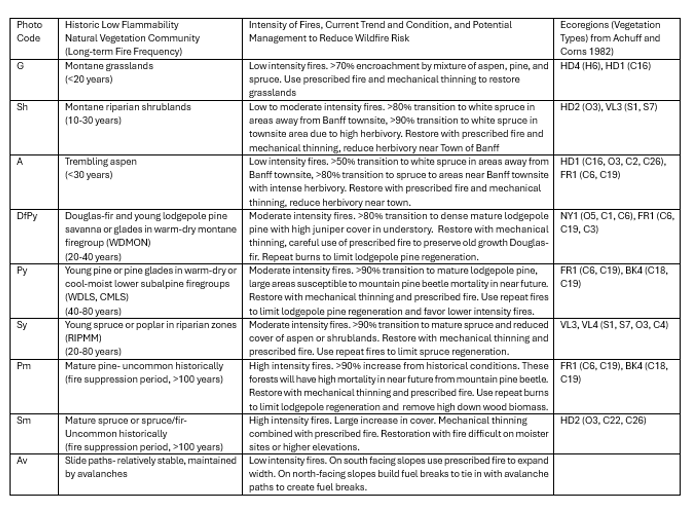
Several native plant communities and age-classes of communities shown above have relatively low fire intensity potential in their historic state and could restored by Parks Canada to reduce risk to park communities, infrastructure and visitors. These are coded on the two historic photographs above, and described in the following table, referencing their general long-term condition, current conditions after over a century of fire suppression, and potential management to reduce wildfire intensity.
Banff National Park firegroups, ecosites, vegetation types and their risk of high intensity wildfires.
Progress and Problems in Vegetation Restoration
As shown in the first set of repeat photographs, prescribed burning on the southwest facing slopes of the Sawback Range is returning the landscape to vegetation types with less potential for high intensity wildfires. However, on the flatter slopes and valley bottoms shown along the river, prescribed burning has been limited and may not be possible with existing dense conifer cover. Restoration may require partial felling and burning of conifers, or commercial timber harvesting and piling and burning in some areas. Routine prescribed burning will only be possible once grasslands, shrublands, and more open conifer conifer forests have been restored. Large, well-maintained fuelbreaks will be required to contain prescribed fires. Eventually, a routine “burn early, burn often, burn light” program would restore the valley to the long-term conditions of lower risk of intense wildfires maintained by Indigenous peoples.
Return to main “Ecological and Cultural Restoration” overview page
Go to page describing power line risk issues
References
Achuff, P. L., and I. G. W. Corns. 1982. “Vegetation.” In Ecological (Biophysical) Land Classification of Banff and Jasper National Parks. Volume 2: Soil and Vegetation Resources, edited by W.D. Holland and G.M. Coen. Edmonton: Alberta Institute of PedologyVolume 2: Soil and Vegetation Resources, edited by W.D. Holland and G.M. Coen,. Edmonton: Alberta Institute of Pedology.
Achuff, P.L., I. Pengelly and J. Wierzchowski. 1996. Vegetation: Cumulative Effects and Ecological Futures Outlook. Chapter 4 in: Green, J., C. Pacas, L. Cornwell and S. Bayley (eds). Ecological Outlooks Project. A Cumulative Effects Assessment and Futures Outlook of the Banff Bow Valley. Prepared for the Banff Bow Valley Study. Department of Canadian Heritage, Ottawa, ON. 47pp.
Rogeau, M. P., and D. Gilbride. 1994. Fire History of Banff National Park. Parks Canada.
Van Wagner, C. E., M. A. Finney, and M. J. Heathcott. 2006. “Historical Fire Cycles in the Canadian Rocky Mountains.” Forest Science 52: 707–17.
White, Clifford A. 1985. “Fire and Biomass in Banff National Park Closed Forests.” Colorado State University.