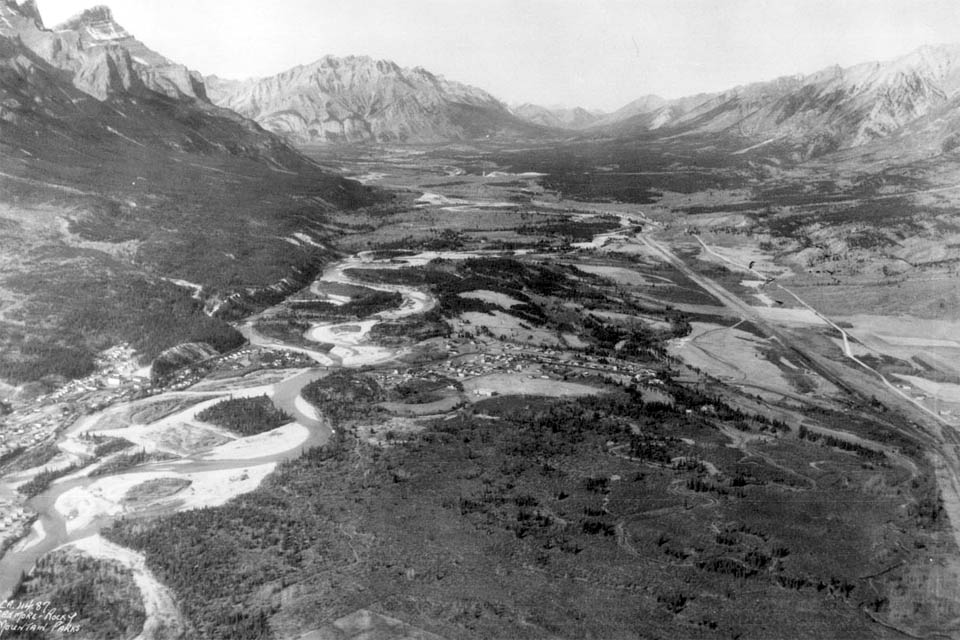
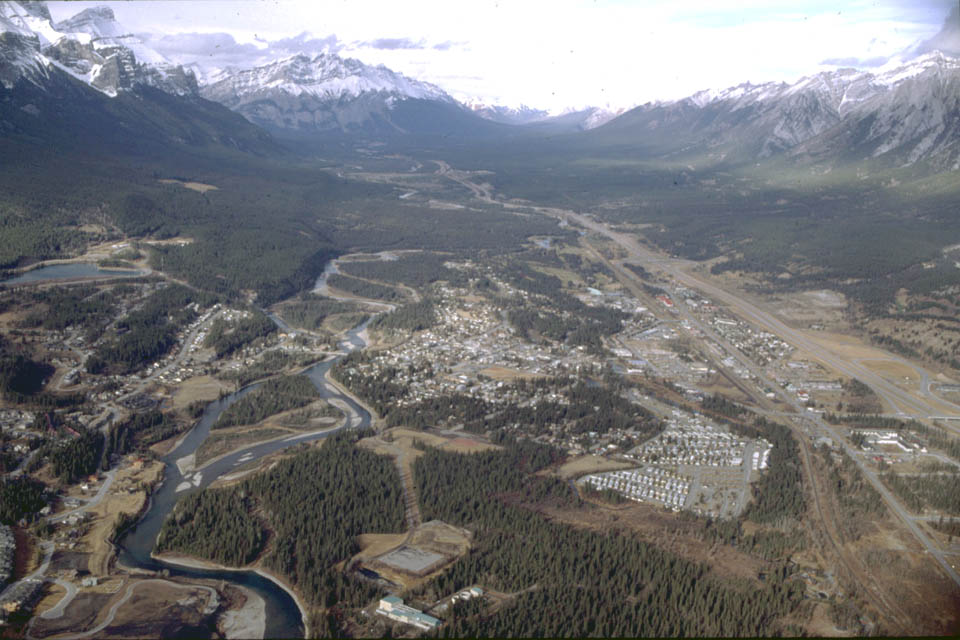
Canmore Corridor, Bow Valley in 1922 (National Air Photo Library) and in 1999 (CW photo). One explanation for the high fire frequency in the valley bottom of eastern slope rivers is that Indigenous peoples routinely burned these areas to attract them off the plains into valleys where they could be contained and hunted, particularly in winter. People may have even purposely herded bison off the plains into these burned corridors. In the Bow Valley, once bison were above Lac des Arcs, they were effectively “stored on the hoof” for future use.
The pattern of Indigenous burning in most the world’s ecoregions follows a relatively predictable pattern of maintaining fire-created vegetation in yards, corridors, and mosaics (Lewis and Ferguson 1988):
- Yards- Areas near villages or long-term campsites where vegetation is intensively managed to reduce to provide predictable resources such berry fields, shoot and root meadows, or localized wildlife habitats. Likely a “burn early, light, and often” strategy is used.
- Corridors– Trails or water routes where fire is routinely used to keep trails open, signal neighboring peoples, clear campsites, or provide habitats for plants or wildlife, again often with a “burn early, light and often” strategy. If travel through corridors occurred later the fire season larger fires would be expected. Fires lit wetter periods while in travel corridors could be “banked” in logs or stumps so they could burn later as drying occurs.
- Mosaics– Areas adjacent to yards and corridors where which may be burned by cultural fires lit near corridors or yards other purposes spreading to larger areas during periods of dry or windy weather. Other times mosaics might be burned for warfare, or large scale wildlife habitat management (e.g., burning large grasslands to influence bison movements). Otherwise, due less human use, and no direct objectives for fire use, mosaics might have longer fire intervals or contain patches of older vegetation that has escaped fire.
The eco-cultural fire history of the Bow Corridor illustrates all these uses of fire. The yards are the large grasslands and streamside shrublands near the present towns of Canmore and Banff that were clearly favourite long-term campsites Indigenous peoples. Further up valley, the size of meadows shrinks but small grasslands still exist on alluvial fans near Hillsdale, Johnson Creek and Baker Creek. Joining these yards is a valley bottom corridor of with historic high fire frequency visible in the historic photographs. This is the least cost energy route through the mountains long-used by people, then more recently followed by the railroad and Trans Canada Highway. This corridor is an interesting case where frequent burning of the valley bottom not only followed the pattern described above and may have also created an open grassland corridor that lured foothill bison further into the mountains where they could be predictably located, especially during the winter. Bison in this corridor could be lured with smaller spring burns into meadows for hunting.Further from the valley bottom is a mosaic of subalpine forest with longer fire intervals. This high elevation mosaic of older forests and alpine areas even provided habitat for Banff’s mountain caribou up until 2008.
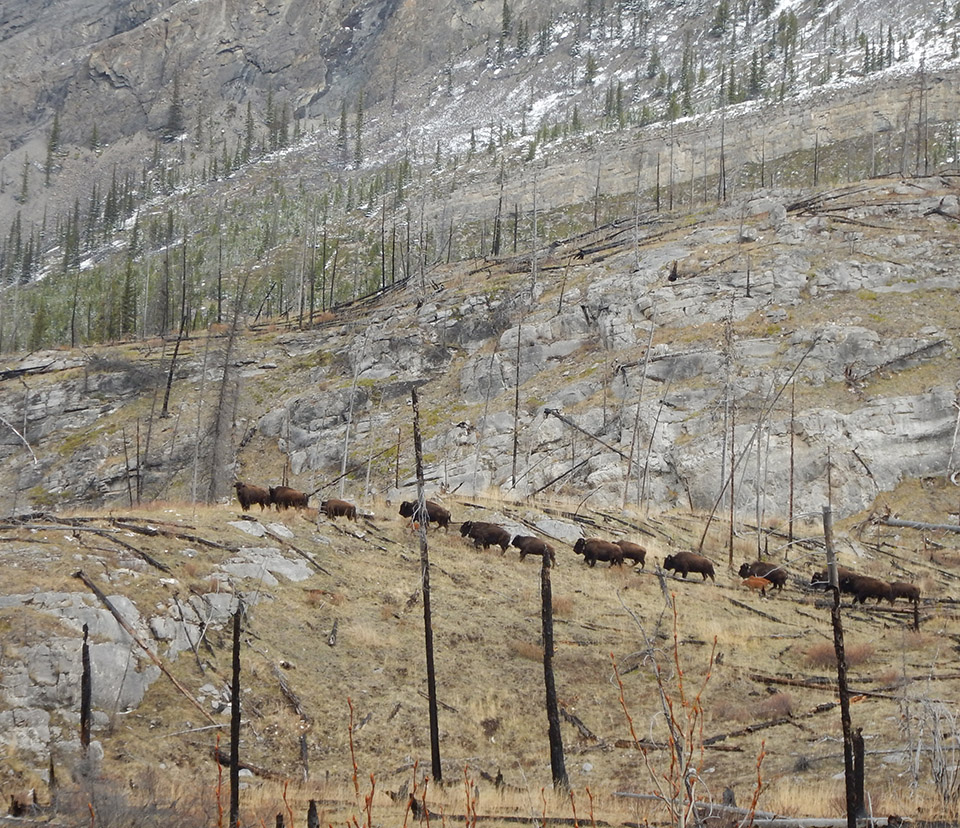
Restored bison in the Red Deer Valley moving upvalley in a movement corridor created by routine prescribed burns.
References
Heuer, Karsten, Jonathan Farr, Leroy Littlebear, and Mark Hebblewhite. 2023. “Reintroducing Bison to Banff National Park – an Ecocultural Case Study.” Frontiers in Conservation Science 4 (November): 1305932. https://doi.org/10.3389/fcosc.2023.1305932.
Hoffman, Kira M., Emma L. Davis, Sara B. Wickham, et al. 2021. “Conservation of Earth’s Biodiversity Is Embedded in Indigenous Fire Stewardship.” Proceedings of the National Academy of Sciences 118 (32): e2105073118. https://doi.org/10.1073/pnas.2105073118.
Lewis, Henry T., and Theresa A. Ferguson. 1988. “Yards, Corridors, and Mosaics: How to Burn a Boreal Forest.” Human Ecology 16 (1): 57–77. https://doi.org/10.1007/BF01262026.
Schepens, Gabriel, Jordan H. Seider, Barry L. Wesley, Darcy L. Mathews, and Brian M. Starzomski. 2024. “Colonial Management Drives Ecological Change Following the Exclusion of Indigenous Stewardship in a Stoney Iyethka Montane Grassland, Canadian Rocky Mountains.” People and Nature 6 (6): 2618–32. https://doi.org/10.1002/pan3.10747.
Stoney Nakoda Consultation Team. 2022. Enhancing the Reintroduction of Plains Bison in Banff National Park Through Cultural Monitoring and Traditional Knowledge: Final Report and Recommendations. Final Report. Stoney Nakoda Tribal Administration. https://a.storyblok.com/f/112697/x/d0b9253d5a/stoney_bison_report_final_rev2.pdf.