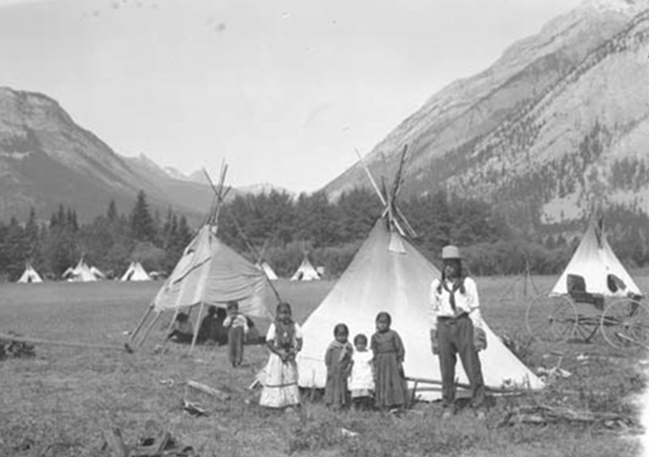
Îyârhe Nakoda Camp in Cascade Meadows ca. 1915. Traditional human use of the area caused the frequent fires that reduced conifer cover and maintained grasslands and shrublands. Moreover, Indigenous hunting kept large herbivore numbers low enough to allow growth of important montane plants such as willow, aspen, saskatoon, and rough fescue. Photo Source: Whyte Museum of the Canadian Rockies, Byron Harmon fonds (ca. 1910-1925) V-263/NA-3347.
The Cascade Meadows lie across the valley bottom below the famous waterfall. This has long been a traditional campground for Indigenous peoples. A high-volume spring rising from the base of the mountain provides a stream of water that stayed open during winter deep freezes and flowed in summer droughts. Historically the stream (now called Whiskey Creek) then meandered through shrubby riparian zone with a series of beaver dams surrounded by willows, saskatoon, dogwood and onwards to eventually join Forty Mile Creek. Aspen groves and shrublands surrounded the meadows themselves. This was a perfect place for a traditional camp for the Îyârhe Nakoda– providing cool spring water year-round, a streamside of berry bushes, roots and shoots, and nearby grasslands and mountain slopes used by bison and bighorn sheep.
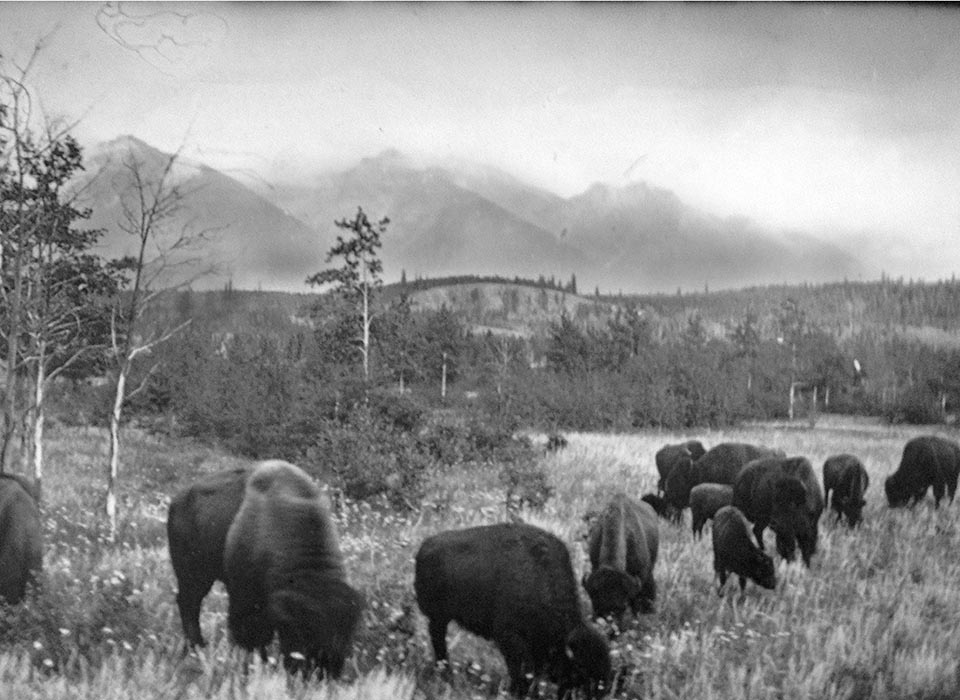
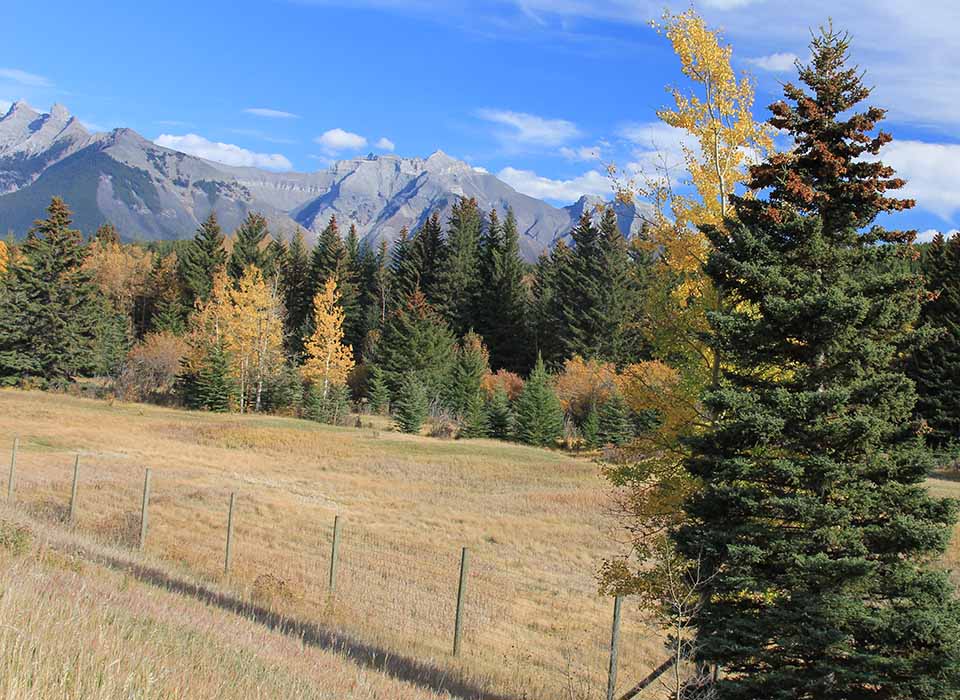
Bison (commonly called buffalo) grazing after recently being released into a paddock in Cascade Meadows in c. 1898 (photographer unknown, Whyte Museum of the Canadian Rockies) and the same area in 2015 (CW-2015-10-07-464). The historic vegetation of aspen, willow and saskatoon lining the creek could not withstand ongoing heavy browsing by the captive bison, and the historic photograph shows aspen stems already damaged by browsing or their horns. Since the early 1980s high numbers of elk use this area. Combined with ongoing fire suppression, the shrub aspen and willow groves have transitioned to less palatable balsam poplar and flammable white spruce. Heavily grazed exotic grasses and forbs now dominate the herbaceous cover.
The last buffalo was seen in Banff in the 1850s on the headwaters of the Bow River, but old wallows and bison bones in ancient campsites near the Cascade meadows indicate that bison periodically used this area. However, for millenia their range had not extended further west across the continental divide. Indigenous hunting in the Bow and other narrow valleys of the Rockies had long been important in keeping bison to the low densities (likely less than 1/sq km) that maintained ecologically diverse habitats in Cascade meadows, and limited bison populations expansion westward.
Return to Indigenous Legacy overview page
References
Binnema, T., and M. Niemi. 2006. “`Let the Line Be Drawn Now:’ Wilderness, Conservation, and the Exclusion of Aboriginal People from Banff National Park in Canada.” Environmental History 11: 724–50.
Farr, Jonathan James, and Clifford A. White. 2022. “Buffalo on the Edge: Factors Affecting Historical Distribution and Restoration of Bison Bison in the Western Cordillera, North America.” Diversity 14 (11): 937. https://doi.org/10.3390/d14110937.
Langemann, E. G., and W. Perry. 2002. Banff National Park of Canada: Archaeological Resource Description and Analysis. Parks Canada.
Locke, Harvey, ed. 2016. The Last of the Buffalo: Return to the Wild. Summerthought.
Schepens, Gabriel, Jordan H. Seider, Barry L. Wesley, Darcy L. Mathews, and Brian M. Starzomski. 2024. “Colonial Management Drives Ecological Change Following the Exclusion of Indigenous Stewardship in a Stoney Iyethka Montane Grassland, Canadian Rocky Mountains.” People and Nature 6 (6): 2618–32. https://doi.org/10.1002/pan3.10747.
Snow, John. 2005. These Mountains Are Our Sacred Places: The Story of the Stoney People. Fifth House.
Stoney Nakoda Consultation Team. 2022. Enhancing the Reintroduction of Plains Bison in Banff National Park Through Cultural Monitoring and Traditional Knowledge: Final Report and Recommendations. Final Report. Stoney Nakoda Tribal Administration. https://a.storyblok.com/f/112697/x/d0b9253d5a/stoney_bison_report_final_rev2.pdf