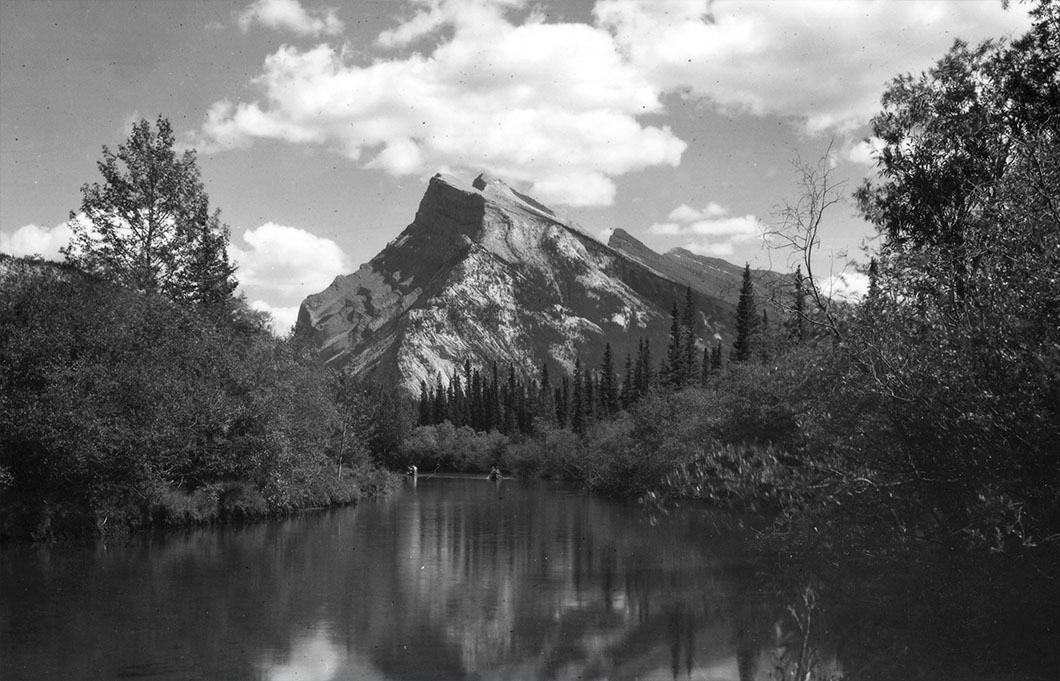
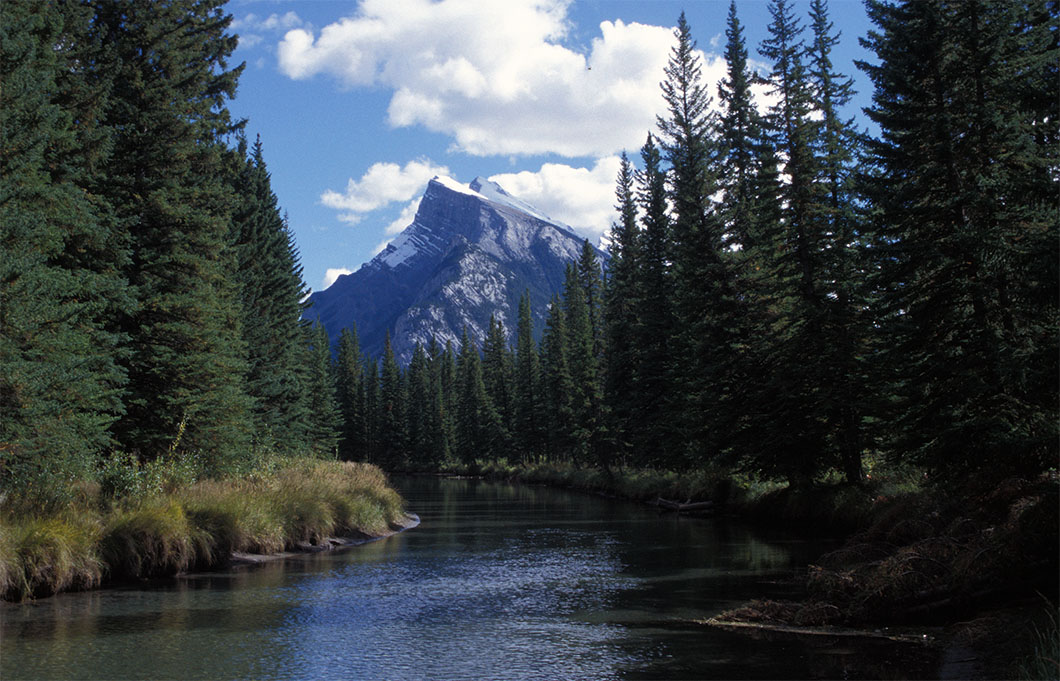
View of Mount Rundle from Forty Mile Creek in 1918 (Byron Harmon Whyte Museum NA-71-6244) and in 2005 (CW-2005-09B-05). Shrubfields that once predominated in riparian zones along the Bow River and tributaries are transitioning into dense white spruce forests. These form a potential wick of high intensity fire right down the center of the valley.
There was a logic error in the original fire group classification of Banff’s riparian zones (White 1985b). In grouping Banff Jasper ecosites (Holland and Coen 1982) and vegetation types (Achuff and Corns 1982) it was presumed that closed forests of white/Engelmann spruce (Vegetation Types C4, C32) along streams (Ecosites VL3, VL4, HC1) were usually conifer forests of various ages over time. Although this might be true in the lower subalpine, in the montane ecoregion its likely that two stable states with different fire frequencies might occur: shrublands of dwarf birch, shrubby cinquefoil and willow (VTs S1, S7) that could burn frequently (fire intervals <20 years), and periodically these might transition into closed spruce forests (C4) with less understory vegetation and much longer fire intervals (e.g., ~150 years as observed by White 1985b). Unfortunately, the long fire cycle state of these riparian ecosites has subsequently been mapped for the park (Parks Canada 2020) and assigned an even longer fire cycle of 250 years (see Banff Fire Frequency Map). Two wrong don’t make a right.
The ongoing error of managing for long fire cycles in montane riparian zones has two unfortunate consequences:
• Reduced Biodiversity– The shrubby phase of the VL3 and VL4 ecoregions provide habitats for a broader range of plant, avifuana, and mammal species (Achuff and Corns 1982, Holroyd and Van Tighem 1983). Of current human interest is habitat for numerous songbirds and waterfowl species, beaver and moose, and a reasonable hypothesis is that Indigenous cultures also valued this biodiversity and frequently burned riparian zones to prevent transition into spruce forests.
• Increasing Risk of High Intensity Wildfires in Valley Bottoms– The shrubby phase of riparian zones is relatively flammable in spring and fall compared to adjacent dense spruce forests. But fires burn with much less intensity. Likely Indigenous people use this differential flammability to maintain shrublands. The transcontinental rail line is centered on riparian zones, and fires started by the steam engines maintained shrublands into the 1930s (White 1985a). In contrast, the current riparian zones are increasingly dominated by dense white spruce stands with moss understory tend to burn only during mid-summer droughts and at very high intensity. For example, the spruce-dominated riparian zone at the confluence of the Athabasca and Miette rivers likely contributed to fire damage in nearby Jasper townsite during the 2024 conflagration. Moreover, Parks Canada’s ongoing maintenance of high ungulate densities near townsites only accelerates the transition to spruce as elk and deer browse out the more palatable and less flammable species such as saskatoon, dogwood, willow, poplar, and aspen (White CA 2011 Banff Bow Shrubwatch Baseline update 2016-08-12).
Riparian zones transitioning to white spruce lie near to much of Banff’s infrastructure including highways, parkways, power lines, the railway and the town itself (Pengelly I 2024 Assessing Wildfire Risk Near the Town of Banff). The process forward should include using collections of historic photographs (e.g., the Mountain Legacy project etc.) to characterize and map the area of what state (shrubby or conifer vegetation) existed historically, what relationship this might have to Indigenous use patterns. Recognizing this long-term ecology might encourage managers to restore less explosive native riparian vegetation near communities and other human infrastructure.
Return to “Bow Valley Wildfire Risk Reduction” section overview