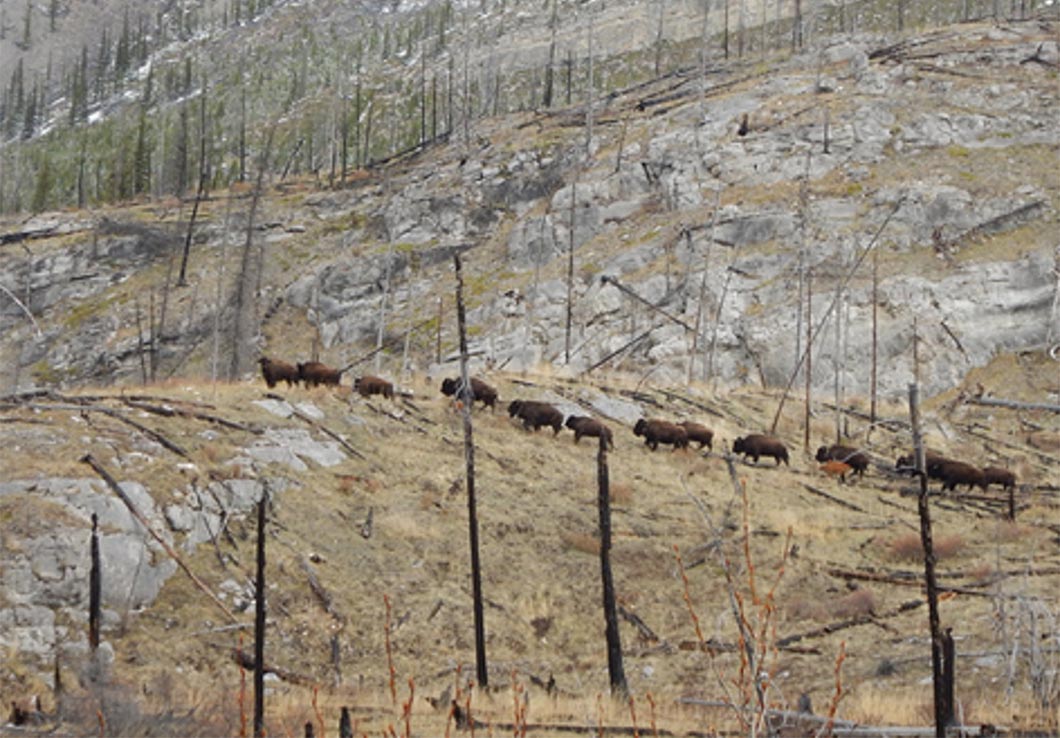
Bison moving upstream in Banff’s Red Deer Valley through an area that was prescribed burned two times in preparation for their reintroduction. Routine fire use by Indigenous peoples provided corridors for bison to move deep into mountain valleys.
In 2017, Parks Canada working with Indigenous peoples, restored 16 bison to Banff’s eastern slopes. The great shaggy beasts had been extirpated from the region for over a century to valleys on Banff’s eastern slopes, and they were returned to valleys that been recently prescribed burned to restore prime grassland habitats. By the early 2020s the herd had grown to over 100 animals, and 2024 Indigenous hunters also returned to the landscape to restore the ancient human role of hunting that shaped bison abundance and behavior patterns. Modern ecologists tend to refer to this process as a “rewilding” as per the graphic below, but more accurately the project was “de-wilding” as both Indigenous peoples and the buffalo returned to their homeland of many millennia since the Bow Valley’s great glaciers retreated to the headwaters.
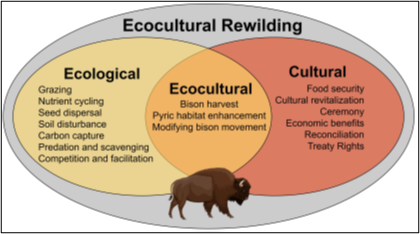
Ecologists perceive bison restoration in the remote Red Deer Valley of Banff National Park as an “ecocultural rewilding”. It is better described as “de-wilding” by restoring a long-term Indigenous homeland where use of fire and hunting structured the long-term ecosystem.
The long-term fire regime in Banff National Park—dominated by Indigenous burns—created frequently burned corridors that stretched from the plains up the main valleys well into the mountains. Along the corridors were meadows, shrublands open Douglas-fir forests and young gladed forests of pine that provided prime winter and spring habitat for bison. Early European travellers like David Thompson or James Hector mapped trails long-trodden by both bison and Indigenous peoples that linked these habitats to the plains. In cold winters, a phenomenon called the “rising of the buffalo” occurred as biting winds and freezing temperatures drove them off the plains and up into wooded foothills and the aspen parklands. In the foothills and mountain valley buffalo foraged on nutritious rough fescue grasses that later fed the cattle industry. When roaming herds reached the foothills, Indigenous peoples could then drive them further westward into pounds for immediate hunting, or even further west into the deepening snows of the narrow mountain corridors where the large shaggy beasts could be more easily located for later sustenance. In fact, intense human hunting in these narrow mountain corridors of the mountains likely created the western edge of buffalo range as evidenced by scant archaeological or historical evidence of bison occupying the broad grasslands of the Rocky Mountain Trench on the Pacific side of the continental divide.
Prescribed fire and Banff bison corridors
The 1997 Banff National Park Management Plan made provisions to evaluate restoring bison. Anticipating this change in park direction and where bison might be re-introduced, in 1990 park biologists began prescribed burning in first the Panther, then the Red Deer valleys the northeast corner of the park. These were watershed scale burns — first a fuelbreak was cut along the park boundary, and once this was burned out, large sequential prescribed fires were lit up upvalley and held by guards downwind. These burns expanded remnant valley meadows and shrublands. By 2017 when the first bison were returned, over 100 square kilometers of habitat had been renewed.
Of key importance for bison was to reburn many areas, especially along movement corridors. The first prescribed fire killed dense forests of >100-year-old pine and spruce, dating to the era when Indigenous peoples travelled the trails, burning as they went. Killed by fire, the old trees in the forest, as they fell, created jack-strawed piles of downed wood, impenetrable to humans and bison alike. However, after about 5-10 years these areas could be reburned due to an abundance of grasses and shrubs, creating the meadows and shrublands shown in the top image. In the Red Deer watershed, greater than 100 square kilometers of reburned habitat provides good forage, easy travel routes, and a landscape where bison’s predators can be detected and defended against.
Fire and Bison: Cultural Catalysts
While prescribed burning provides habitat for the bison, bighorn sheep, grizzly bears, and many other iconic species, it also provides a common ground for those with recent and long-term experience in Banff to share values and knowledge. First Nations groups have hunted, gathered, burned, and created cultures in the Canadian Rockies ecosystem hundreds of centuries. To think that modern scientists and park managers could have fully mastered techniques such as prescribed burning or managing bison in a few short decades seems ridiculous against this legacy of ancient understanding. Humans were historically bison’s dominant predator, and their hunting and burning patterns strongly influenced the typically low numbers and relatively complex movement patterns of bison in the mountains. In public parklands, where hunting is often banned, a cooperative approach between park managers and First Nations is thus essential. With continued effort and good will, Banff may serve as a model for other parks and protected areas where bison restoration is considered important for ecological integrity.
Adapting Bison Corridors to Current Human Use in the Bow Valley
The Bow Valley’s current railroad, highways and powerlines generally follow the “least-cost route” up the bottom of the southwest slopes that were once the trails followed by bison and humans. Routine burning along these trails made them, and the habitats they linked a relatively stable, predictable, and safe environment for Indigenous peoples to procure resources. There are lessons here for modern community and land managers seeking to reduce fire risk to current human use and infrastructure.
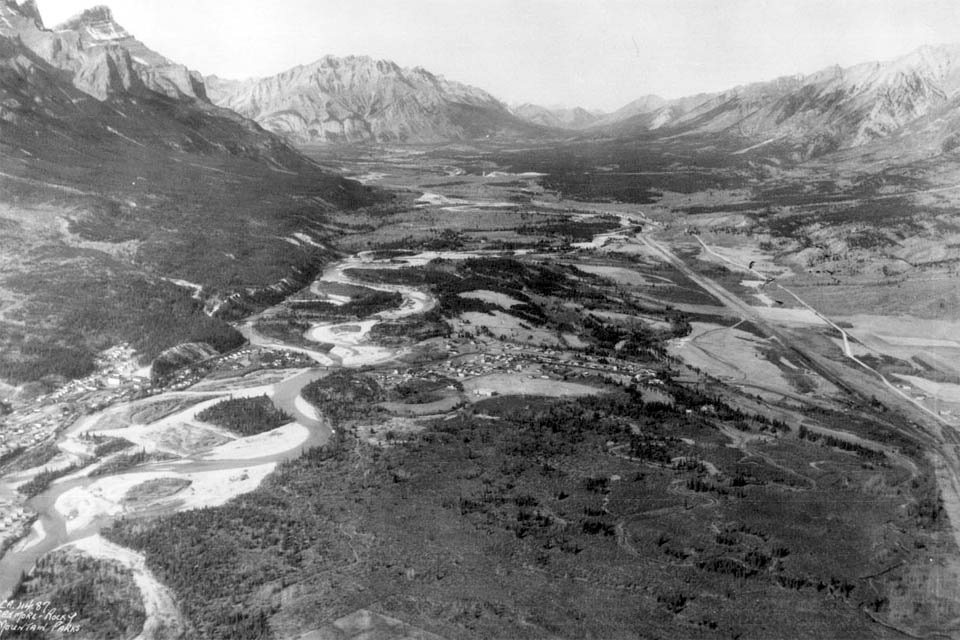
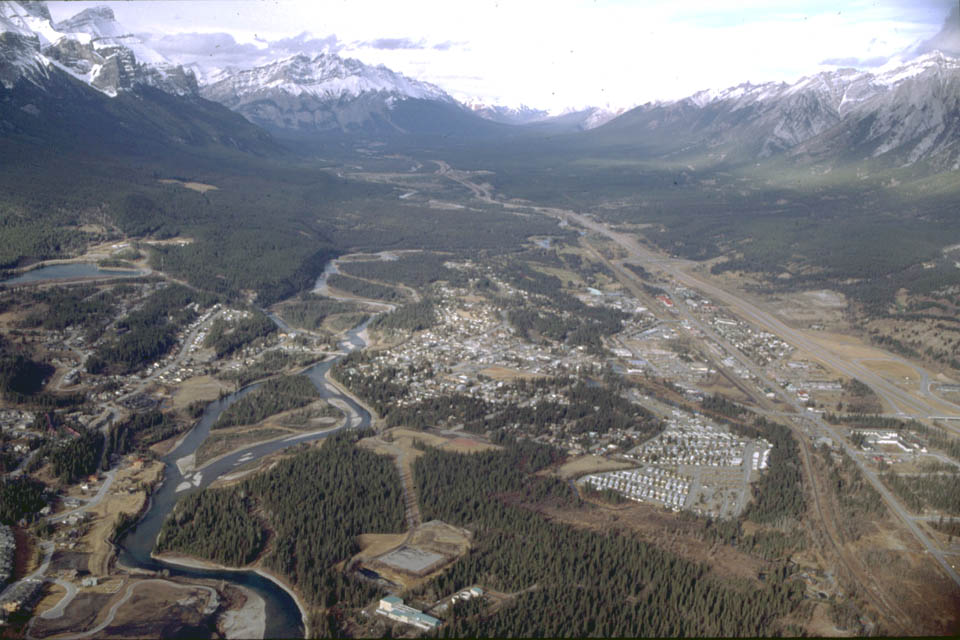
Town of Canmore in 1921 and 2001 (National Air Photograph Library and CW files). Railways, highways and powerlines now follow the long-term corridor once routinely used by humans and bison. Wildfire risks could be reduced by returning some lands in parks and protected areas to Indigenous patterns of burning that encouraged the buffalo to venture up the valley from the plains.
One timely application is forest management along the AltaLink transmission line, the single connector that provides electricity from the Alberta grid to Banff and Lake Louise. Again, this important infrastructure lies within the human-bison corridor up the valley, and routine Indigenous burning off of nearby trails and meadows kept historic vegetation conditioned by a “burn early, burn often, burn light” anthropogenic regime. From the 1980s until 2010 Parks Canada tested various tree-clearing and prescribed burning practices along the line to jointly restore ecological integrity and reduce wildfire risk. This management direction was abandoned over a decade ago. Instead, Parks Canada began managing for dense forests along the right-of-way to minimize aesthetic impacts. Perhaps this should be reconsidered given that a more optimal solutions that maintaining low wildfire risk, restoring ecological integrity, and while keeping low aesthetic impacts are possible.
Return to Ecological and Cultural Fire Management overview
References
Heuer, Karsten, Jonathan Farr, Leroy Littlebear, and Mark Hebblewhite. 2023. “Reintroducing Bison to Banff National Park – an Ecocultural Case Study.” Frontiers in Conservation Science 4 (November): 1305932. https://doi.org/10.3389/fcosc.2023.1305932.
White, Clifford A. 2019. “Where the Buffalo Roam: Fire Helps Welcome Back the Rockies Big Fauna.” Natural History (San Francisco, CA), September. White CA 2019 Banff burns and bison Nat His Mag
White, Clifford A., Daniel D. B. Perrakis, Victor G. Kafka, and Timothy Ennis. 2011. “Burning at the Edge: Integrating Biophysical and Eco-Cultural Fire Processes in Canada’s Parks and Protected Areas.” Fire Ecology 7 (1): 74–106. https://doi.org/10.4996/fireecology.0701074.