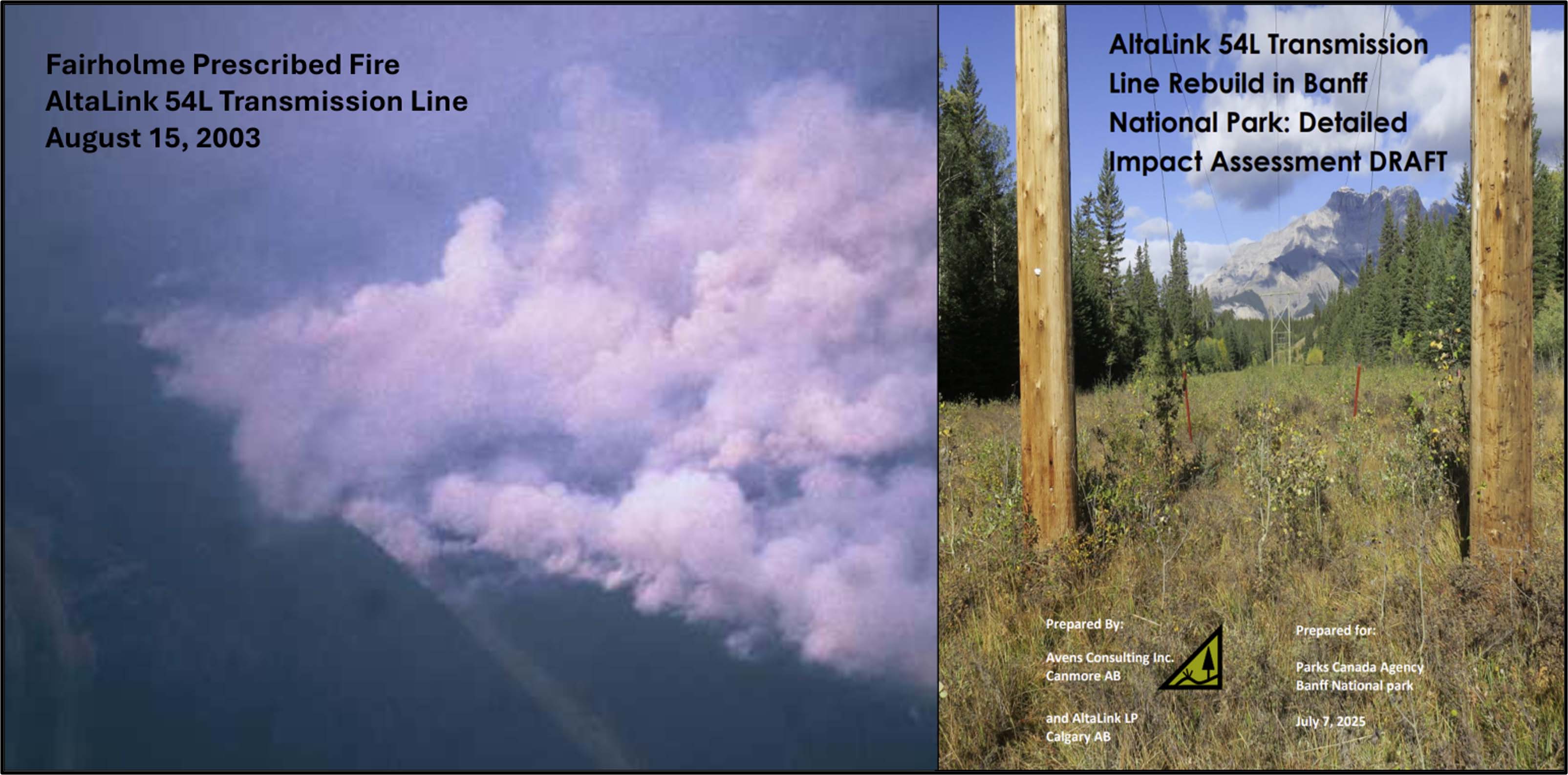
The AltaLink 54L Transmission Line is the sole connecting line for Banff National Park infrastructure to the Alberta electrical grid. The line runs through one of the park’s most important ecological special areas, and one of the highest fire risk areas– yet a recent assessment for a planned rebuild focusses on ecological constraints and maps individual “20-year danger trees” along the 54L right-of-way. However it does not describe broader area wildland fire management options to reduce risk. The left image above shows fire behaviour on August 15, 2003 that damaged a section of the line and interrupted Banff National Park’s power for many hours.
Background
The extensive tourism infrastructure in Banff National Park is linked to the Alberta grid by a single power line. The line connected Calgary to the Lake Minnewanka Power project and Banff in 1941 and was extended in 1964 to Lake Louise. The line runs along warm, south and west facing slope of the Bow Valley with a history of frequent fires (~20-to-60-year fire cycle). At the time of powerline construction, forest cover was relatively open with young lodgepole pine, aspen, and open Douglas-fir/grassland savannas. Over time, forest cover has shifted to dense stands of dense lodgepole pine at high risk of a major mountain pine beetle mortality event. Due to the importance of wildland fire along the line, in the 1980s Banff’s expanding prescribed burning program worked extensively with staff from Calgary Power and its successor AltaLink. Standards and protocols were established for identifying and felling risk trees, and slash disposal in areas where prescribed burning was scheduled such as on the southwest facing slopes of the Sawback Range and Mount Norquay. In general, individual or stands of trees that threaten the line during a planned prescribed fire were simply felled away from the right-of-way and burned early or late in the fire season (the time of Indigenous burning in past times). This process often killed other trees creating wide (>60m) feathered glades along the line rather than a straight narrow right-of-way.
Experimental Right-of-Way Forest and Fire Management along the 54L Section
In the late 1990s Parks Canada management objectives required achieving the joint objectives of restoring the Fairholme Bench Special Area’s natural habitats, slowing mountain pine beetle spread eastwards, and reducing wildfire risk to the communities of Harvey Heights and Canmore’s Silvertip. The location of the AltaLink 54L powerline through the Fairholm Prescribed Burn (~20 sq km) and adjacent Carrot Creek Fuelbreak (~8 sq km) presented additional challenges (Coogan et al. 2021). Here, the terrain was relatively flat, so fire behavior would depend largely on wind direction and speed, not slope. Innovative forest management would be required to both restore desired ecological conditons and reduce fire risk to the powerline.
Several options were proposed 54L Power Line right-of-way to reduce the risk of damaging the line or causing power failures by prescribed fire or any wildfire escapes. In general order of disturbance magnitude and cost. A mix of the first three options were implemented with clearing done from 2000 through the spring of 2003:
- Hand-falling and burning to Create Feathered Glades– In the environmentally sensitive Morrison Coulee the core right-of-way was machine mulched, but nearby “risk trees” or bunches of trees were hand-felled away from the line and burned either before or during the prescribed fire. Routine burning of felled stems during the period 2000 to 2003 over time created a feathered glade that further widens the right-of way.
- Machine-felling to Widen the Right-of-Way– through the south-eastern half of the 54L section the line was widened to ~30m on either side with trees felled and laid along the edge, and slash piled for subsequent burning either before or during the 2003 Fairholme Prescribed Burn. On August 15, 2003 an escape from the prescribed in this area caused a multiple-hour power outage to Banff National Park. This treatment is now surrounded by a massive area of dense regenerating pine forest with a massive surface layer of downed wood from the 2003 fire. Due to poor subsequent line clearing and lack of prescribed fire it has extremely high potential for damage from wildfire even with proposed line upgrades.
- Machine-felling to Create Glades- Where the powerline passed through the Carrot Creek Fuelbreak, feller bunchers removed almost all trees in glades within ~100m of the line. Slash was spread and subsequently burned the spring following harvesting, and again in many areas during subsequent maintenance burns. This treatment protected the line during the prescribed fire, and continued to provide protection for over a decade until maintenance ceased;
- Bury the Power Line- Given the urgency to reduce mountain pine beetle risk on the broader area, this was not seriously considered in the 1998 to 2000 period of planning. Moreover, it was predicted that once long-term vegetation conditions were restored on the Fairholm Bench, or elsewhere along most of the Canmore to Lake Louise section, the line will lie in meadows, shrublands, young forests, or old-growth Douglas-fir savannas where it would be at less risk.
- Bundle the Powerline- The costliest option would be to move the line and “bundle it” with other infrastructure. Elsewhere, this includes combinations highways, railways or gas lines. Again, for the Fairholm Bench area this is not necessary if long-term vegetation conditions were restored.
After reviewing the potential outcomes and costs, a combination of the first three treatments were used to prepare the 54L line on the Fairholm Bench for the 2003 prescribed fire. Mechanical glading was used in the Carrot Creek fuelbreak, mechanical right-of-way widening for 2 km west of Carrot Creek, and “feathered glading” in the Duthill valley.
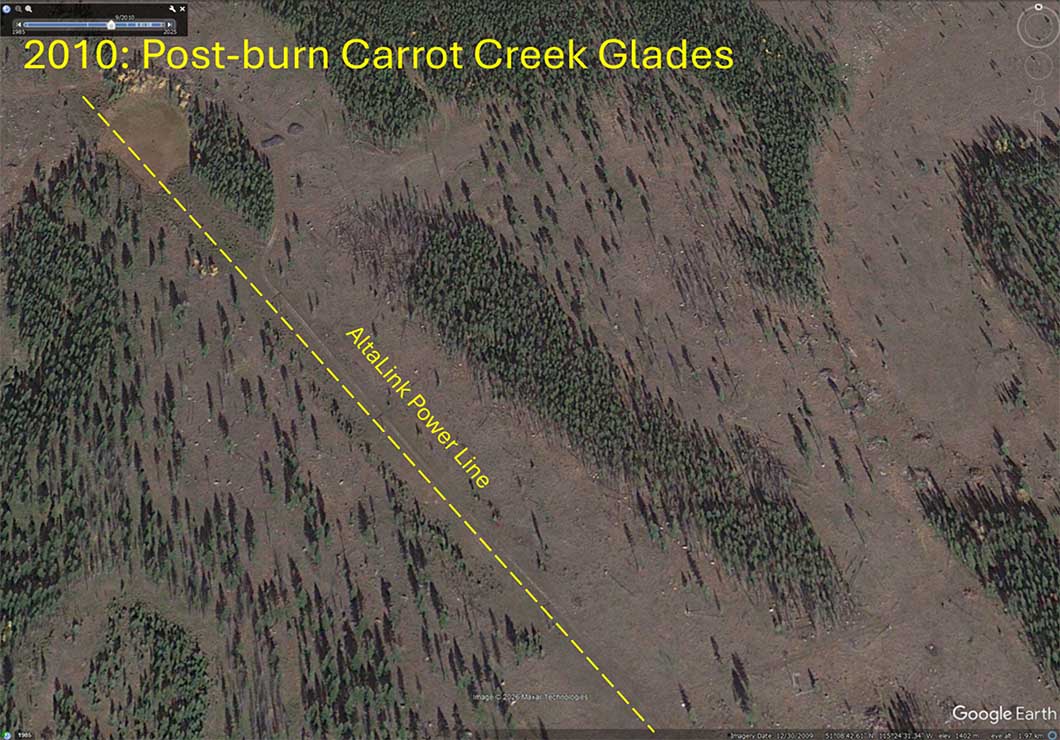
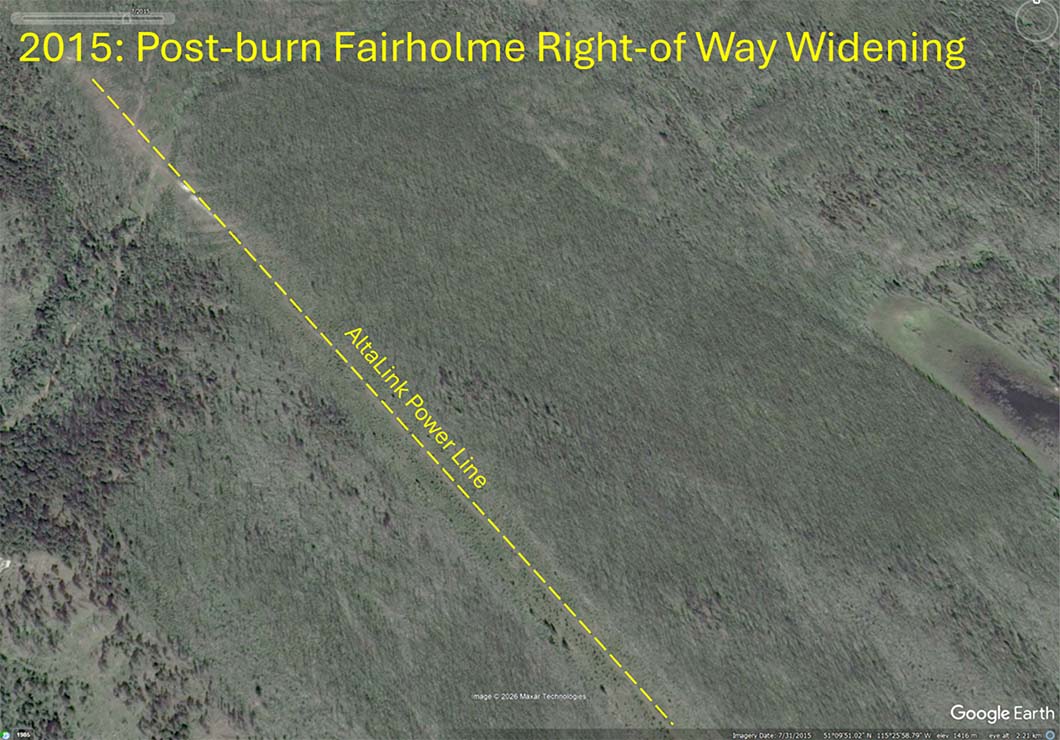
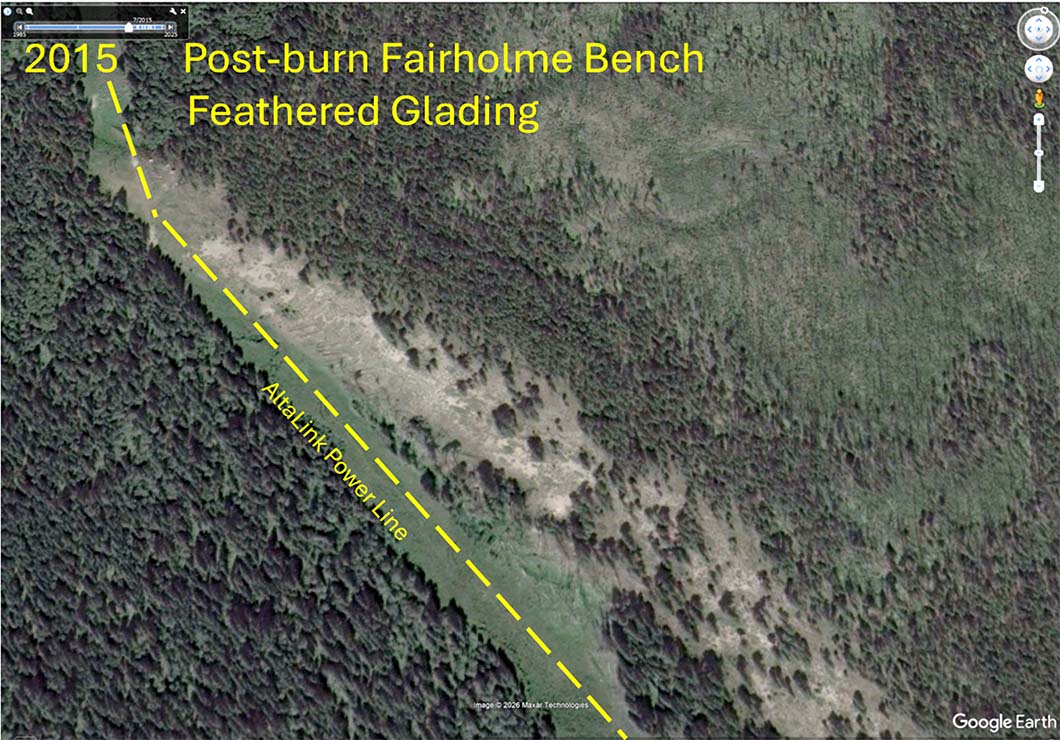
Three experimental treatments used along the powerline in the Carrot Creek Fuelbreak and the Fairholme Prescribed Burn Unit to reduce fire risk to the line from the 2003 burns (press arrows to scroll the 3 treatments). These were all broad area options using forest clearing combined with early or late season, low intensity prescribed fire to reduce risk from potential high intensity fires in mid-summer. Post-burn photographs show the magnitude and intensity of the 2003 fire which in many areas were less would be expected by a wildfire.
“Feathered glading” would likely be the preferred method over time for the least impact method to maintaining relatively safe vegetation cover conditions along the line. The foliage on trees felled during the summer can be burned the following fall, or if the area is contained by fuelbreaks, under higher predicted fire behavior the following spring.
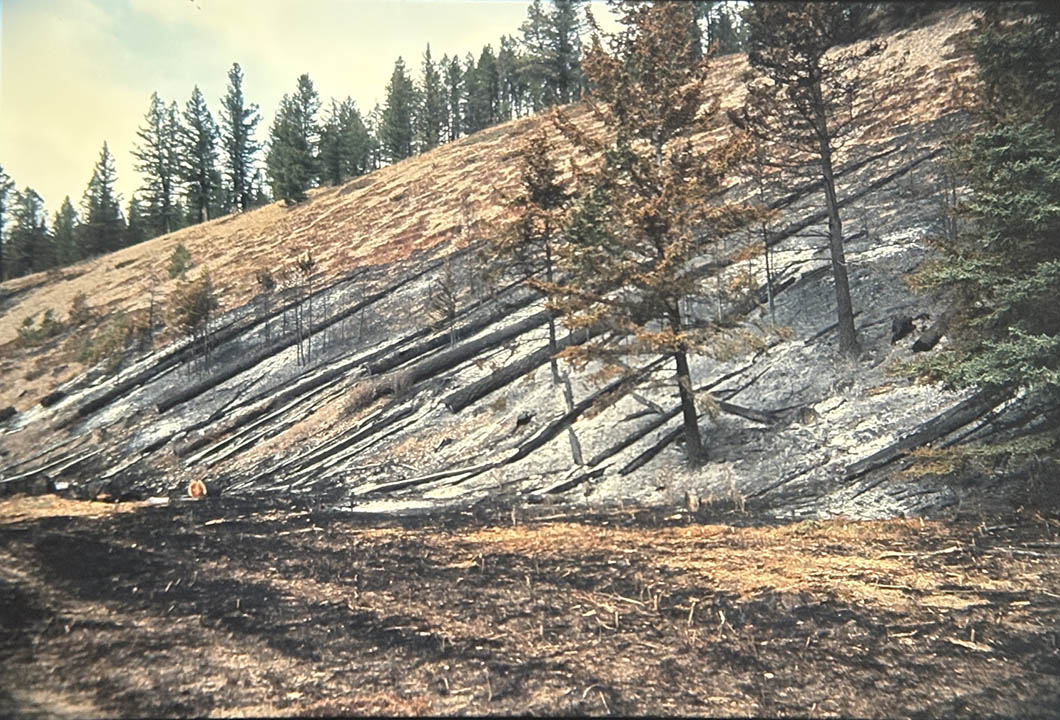
“Feathered glades” along the AltaLink powerline in the Duthill valley in the fall of 2002 prior to the spring, 2003 Fairholm prescribed fire.
In the 5- year period following the burn, many of the the gladed areas near the power line in Carrot Creek Fuel Break were 1-3 times again to remove pine seedlings and enhance meadows. Although Parks Canada has routinely scheduled the larger Fairholm Bench for reburning during the period 2010 to 2026 this has not been done. Like in all 2000-2003 treatments, due to lack of ongoing vegetation management, wildfire risks to the powerline are now high.
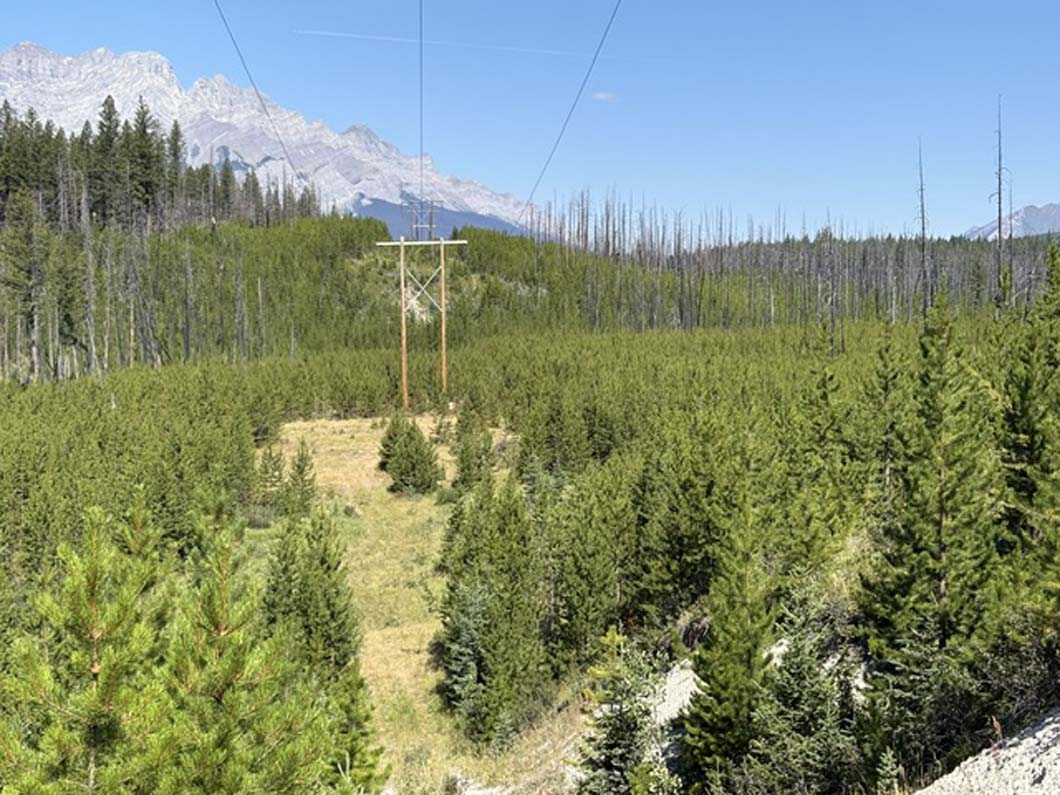
Current condition of the 54L Transmission Line in the Widened Right-of Way treatment zone. Lodgepole pine regeneration could have been easily removed if a low intensity prescribed fire maintenance program would have been implemented after the initial 2003 right-of-way widening and prescribed burn.
Unfortunately, after 2010 Parks Canada’s policy changed away from “glading” to “shading” and screening powerlines from visibility in the Bow Valley (Avens 2015, 2025). Moreover, the 54L line and surrounding landscape has not been managed to reduce fire danger since that time. In the understory >30 meters from the line are large areas with >100 tons/ha of downed wood that could have been reduced with low intensity prescribed fire in the 20 year period post-burn—but this was not done. A mid-summer wildfire consuming dense lodgepole pine and downed wood would now have very high intensities and rates-of-spread.
Pathway Forward: Integrating Power Lines into Bow Valley Intensive Forest Zone and Community Forest Management
The Carrot Creek Fuelbreak and Fairholm Prescribed Fire treatments were progressive ideas linking fire management and ecological restoration with powerline management. Inexplicably, these results of the last 20-30 years fire and forest management along the 54L line are only given passing mention in the environmental evaluations for the 54L upgrade. The current detailed assessment refers to wildfire risk 10 times whereas the terms “visibility” or “vegetation screening” occur greater than 50 times, and individual “danger trees” hundreds of times in the Appendix. All this simply misses the “elephant in the room” of fire risk damage related to ongoing growth of of millions of trees across the Fairholm Bench, high rates of biomass accumulation, a fine-scale map predicting of high fire wildfire frequency in the area, potential for extreme fire behaviour and the importance of the 54L as the single line for electrical service to Banff National Park, and shows a failure to document and evaluate past efforts to manage these complexities.
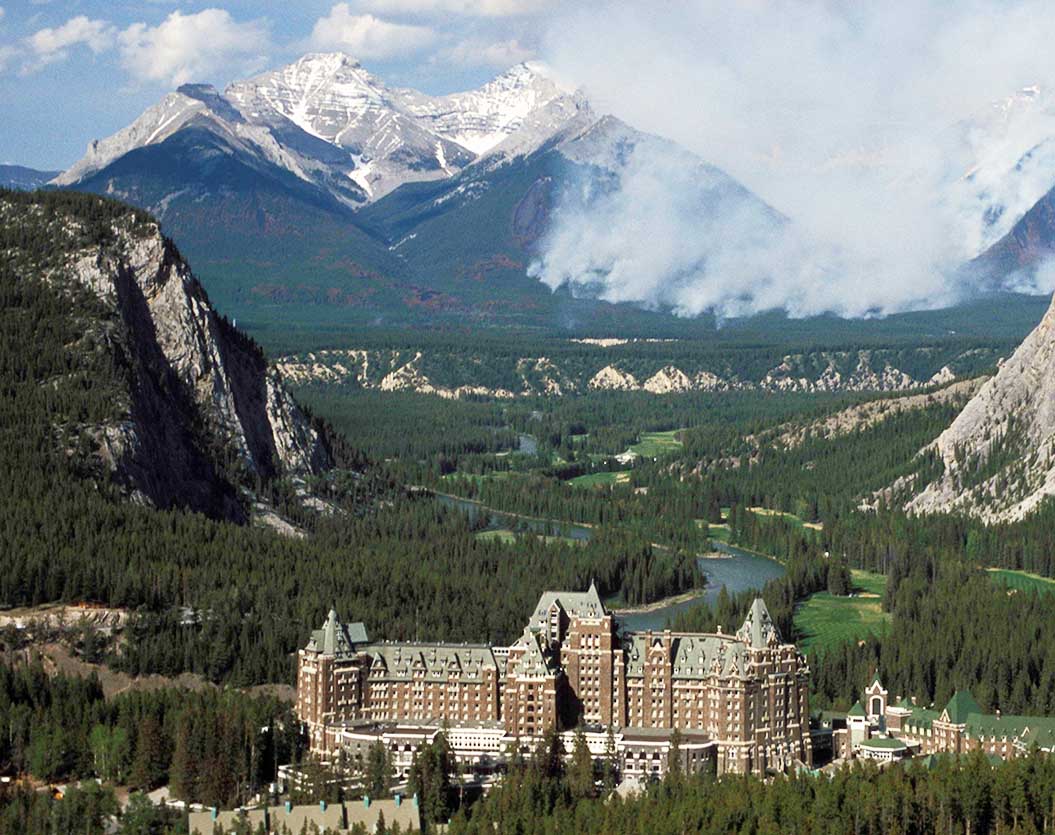
Banff Springs Hotel (foreground) and early season, low intensity burning in May 2003 on the Fairholm Bench along the 54L AltaLink Power Line in preparation for the main prescribed fire in June. This “burn early, burn often, burn light” strategy can restore native vegetation and reduce fire risk to power lines and other infrastructure.
One of the greatest weaknesses of the current Parks Canada 2020 Banff, Yoho, and Kootenay Wildland Fire Management Plans is the failure to comprehend the magnitude and solutions to the wildfire risk problem in the Bow Valley, and especially to the power lines. This resulted in faulty guidance from the federal government to AltaLink, the electrical utility provider on how these risks might be reduced in a park environment.
Prior to decision-maker review, an addendum to the AltaLink 54L Rebuild proposal is required that:
- Provides an overview of potential wildfire risk damage vs power line vegetation management based upon current North American experiences and research;
- Reviews extensive scientific and management knowledge described above gained from previous fire ecology/history/behavior/risk research in Banff National Park that would be relevant to this project;
- Provides a fine scale, specific analysis of the past and current prescribed fire and fuel management treatments along the 54L power line in the Carrot Creek Fuelbreak and on the Fairholm Bench and assesses ongoing forest growth and increasing fire risk in the area.
- Provides specific details on options that will reduce current and future fire risk along the 54L power line, and interest group management and funding systems to achieve these.
Additional 54L rebuild mitigations and maintenance measures will be required. For managing forest cover along the right-of-way, park managers must make a fundamental decisions on either reducing fire risk by glading or general right-of-way widening, or to favour a policy of vegetation screening to reduce visibility as has been recently followed along the powerline sections west of Banff (Avens 2015). This should be informed by ecologists and fire behaviour experts, and visual landscape analysts to evaluate trade-offs between ecosystem management, aesthetics, and infrastructure risk.
The three forest and fire management treatments along the 54L show that the power line can be protected from wildland fire—but only if maintained over time. Moreover, in glading treatments where the right-of-way is greatly widened, the right-of-way itself can be used to contain fires, especially if burn outs occur during lower fire danger conditions (e.g., at night, or during a period of moister weather). The main requirement is that there are no large piles of remaining unburned debris or risk trees near the line after treatments. Banff’s main powerlines lie mostly in warm/dry montane and lower subalpine forests historically dominated by young lodgepole pine. When these forests are managed both for reduction of wildfire risk and restoration/maintenance of ecological integrity such as on the Fairholme Bench, only infrequently will trees reach heights that overtop the powerline, or biomass levels where fire intensity or smoke would threaten structures.
Establish Community Forest to Reduce Wildfire Risk to Power Lines
The 54L transmission line’s current condition and upgrade assessment document is clear evidence that Banff National Park cannot sustain the capacity (funding, staffing, experience, knowledge) to use an ecological integrity approach to reduce wildfire risk along the high visitor use area of the Bow Valley. Parks Canada’s fire program is partially a victim of its own success. Banff staff are now routinely called for interagency assistance to manage difficult wildfires across the country. Meanwhile, fuels are accumulating to a crisis level across the the park.
The Bow Valley’s capacity to reduce wildfire risk could be rapidly increased if AltaLink, local communities and businesses, and the federal and provincial governments work together to revise fire management and power line upgrade options to maximize long-term electric power security to Banff National Park and Bow Valley residents, visitors and infrastructure. This will likely result in the powerline eventually being included in an intensive forest management zone. Ultimately, AltaLink could be a key member in any future Bow Valley Community Forest organization that has the knowledge, will and capacity to both maintain ecological integrity and reduce wildfire risk in this zone.
Public Review
As of July 2026, AltaLink was requesting public review of the 54L line rebuild with meetings scheduled at the Canmore Recreation Center from 5 pm to 8pm on Thursday Aug 13, and Tuesday August 18. Perhaps not coincidentally, during the period prior to the scheduled meetings much of the northwest was blanketed dense wildfire smoke and several communities had recently suffered severe damage (Spokane, Clinton, Summerland, villages near Vernon along Okanagan Lake). The upper Columbia Valley from Canal Flats to Golden had just experienced a sustained power outage due to a fire near Kimberly.
Learn more at www.altalink.ca/projects/54L
Contact Alta Link at 1-877-267-1453
or stakeholderrelations@altalin.ca
Go back to Bow Valley Wildfire Risk Reduction: Progress Problems Prospects
Go to further information on Banff Powerlines and Fire Risk
References
Avens Consulting Inc. 2008. Strategic Environmental Assessment of the Fire and Fuel Management Program in the Contiguous Mountain Parks. Final Report. Canmore, AB.
Avens Consulting Inc. 2015. Maintenance Rebuild of the AltaLink 551L Transmission Line Between Banff and Lake Louise: Detailed Environmental Impact Assessment. Canmore, AB.
Avens Consulting Inc. 2025. AltaLink 54L Transmission Line Rebuild in Banff National Park: Detailed Environmental Assessment. Canmore, AB. https://www.altalink.ca/project/54l/
Coogan, Sean C. P., Lori D. Daniels, Den Boychuk, et al. 2021. “Fifty Years of Wildland Fire Science in Canada.” Canadian Journal of Forest Research 51 (2): 283–302. https://doi.org/10.1139/cjfr-2020-0314.
Dezan, Alexandrie. 2010. Controlling the Burn of Banff. NiCHE– Network in Canadian History & Environment. July. https://niche-canada.org/2010/07/29/controlling-the-burn-of-banff/
Parks Canada. 2001. Environmental Assessment of Fire Management in the Cascade/Bow Ecological Management Area. Banff, AB. 299 pages.
Pengelly, Ian. 2002. Addendum to the Environmental Assessment of Fire Management in the Cascade/Bow Ecological Management Area (BNP-417): Tree Removal Along the Minnewanka Secondary Transmission Line. Parks Canada, Banff Warden Service, Banff, AB.