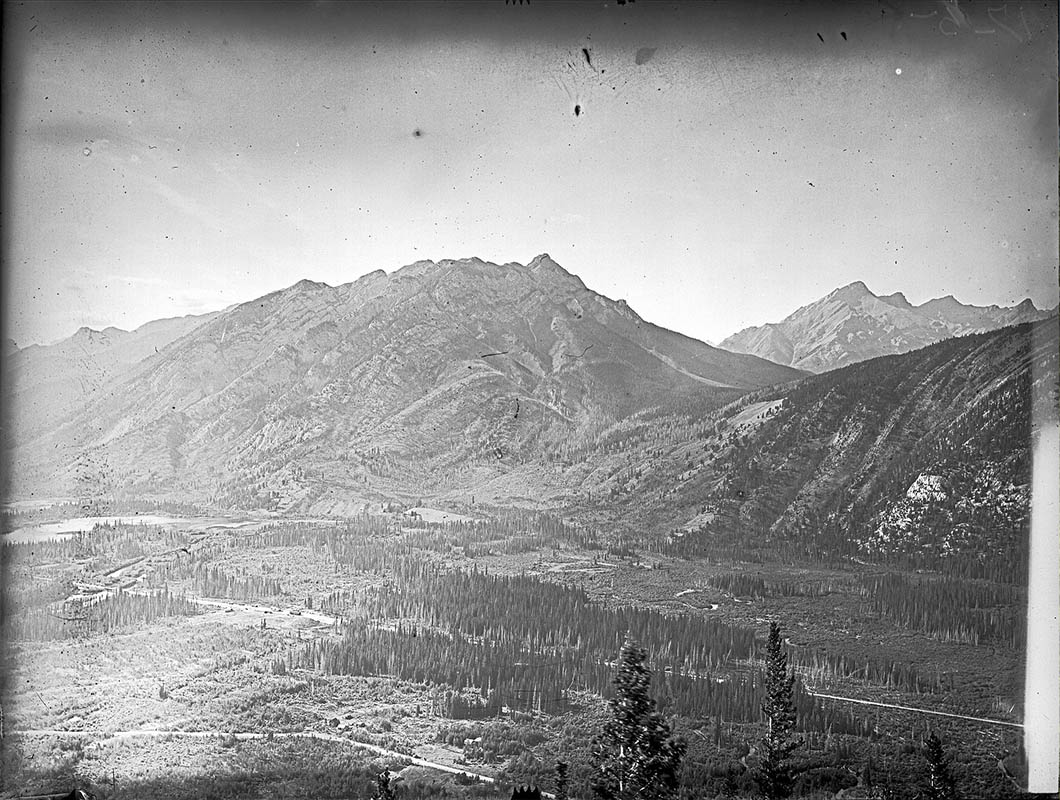
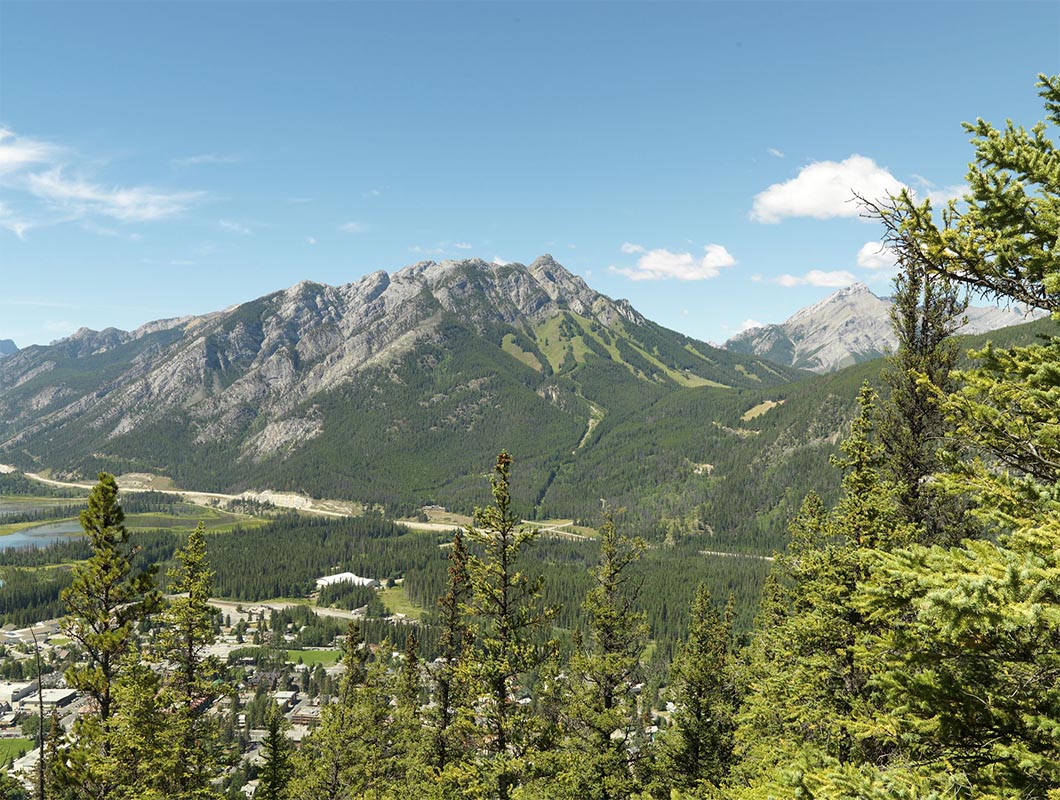
View of Mount Norquay and the Town of Banff in 1888 and in 2008. Prevailing SW winds and ecological and cultural conditions at the convergence of the Bow and Spray watersheds created historical high fire frequencies and open forests, shrublands and grasslands that burned with low to moderate intensity. The modern landscape, dominated by dense conifer forests will burn will burn with high intensity. (Photo credits: McArthur, J.J. MLP-e002506995-v6, MLP-B0002604).
Mount Norquay rises downwind and upslope of the Vermilion Lakes and meadows along the Bow Valley now occupied by Banff townsite. Indigenous people commonly used this area—it lay at the convergence of several valleys with abundant vegetation and wildlife resources. These people frequently used fire, most often in the spring, to lightly burn the landscape and maintain these habitats. This is the “burn early, burn often, burn light” universally used by humans for ecological restoration and maintenance. This fire regime creates a positive feedback loop of vegetation types that in turn favor continued use of low intensity fire in the spring or fall when leaves are cured.
The historic vegetation types can be classified into several broad groups shown on the historic image below (click picture to enlarge).
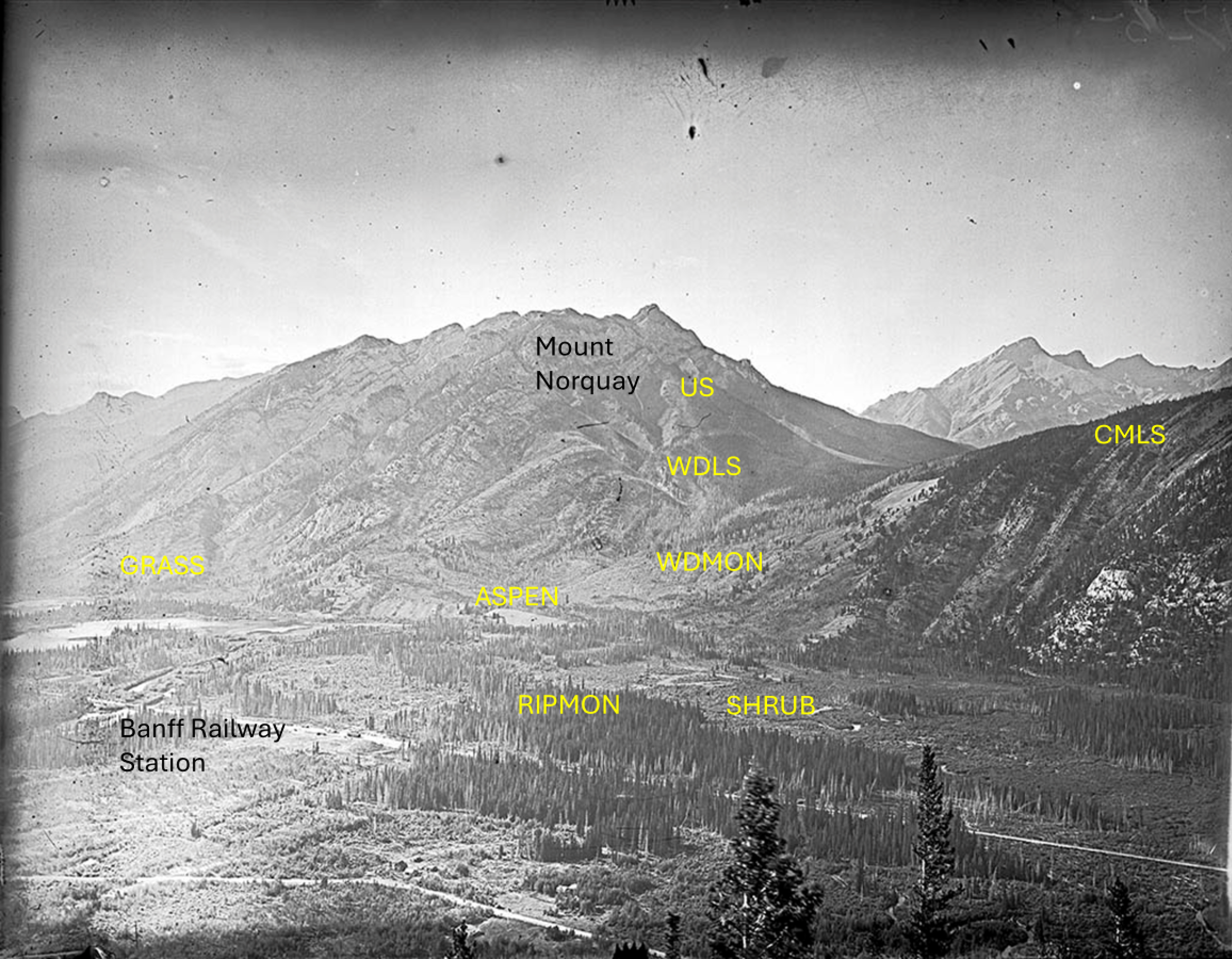
Three of these vegetation groups labelled above are predominantly deciduous:
• grass– These areas dry out early each spring, and historically likely had a fire frequency of less than 20 years.
• aspen– found as groves on moist slopes or alluvial fans, with fire cycle of about 20 years.
• shrublands– Riparian shrublands of willow, birch, dogwood and balsam poplar were historically common along valley bottom streams in the Bow Valley. They likely burned every 20 to 50 years, restricting the growth and cover of white spruce.
Five of the vegetation groups are predominantly conifers, and these tended to burn with intensities reflecting the time-since-fire of the last burn (interval shown with red boxes) as shown below:
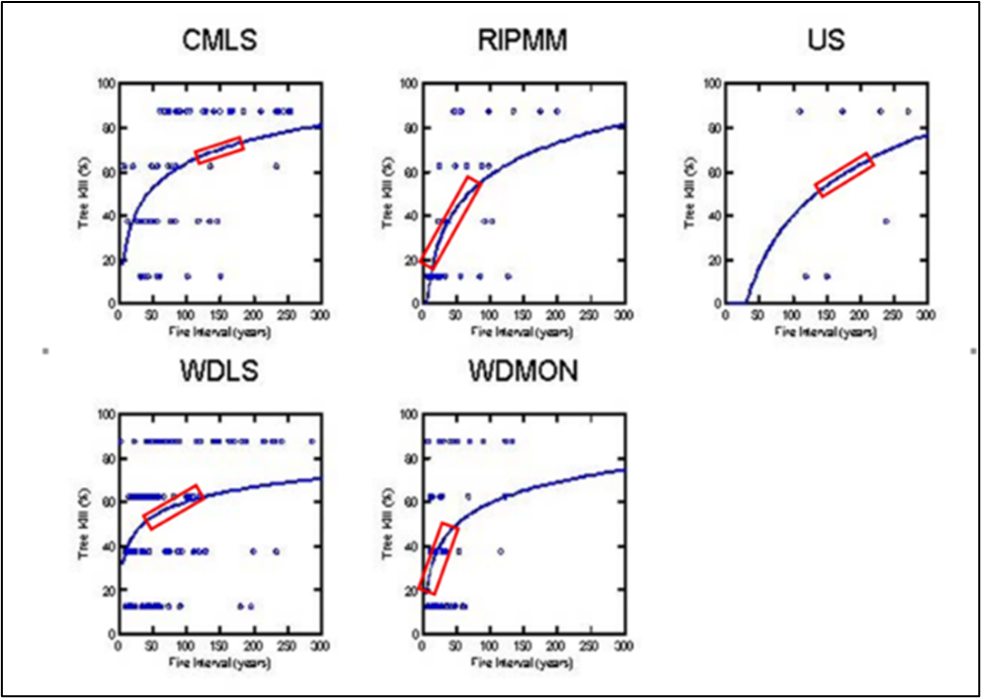
- cool/moist lower subalpine (CMLS)- north-facing slopes at middle elevations are dominated by lodgepole pine transitioning to subalpine fir and Engelmann spruce. at younger age classes transition. Mean fire cycles of about 120 to 140 years create intensities that kill about 60-80% of trees.
- riparian mesic montane (RIPMM)- riparian shrublands that escape burning can transition to white spruce that may burn less frequently (e.g. 20 to 80 years) but will burn with high intensities and return to shrublands with higher fire frequencies.
- upper subalpine (US)- forests near treeline are dominated by Engelmann spruce and subalpine fir. Due to cool moist conditions and long periods of snow cover fire intervals are long (150 to 200) years, but with higher tree mortality due to very dry conditions during burns.
- warm/dry lower subalpine (WDLS)- middle elevation forests on warm dry slopes had a historic fire frequency (50 to 80 years), with moderate intensities that killed 40 to 60% of trees, generally in a gladed pattern.
- warm/dry montane (WDMON)– lowest elevation conifer forest were dominated by lodgepole pine interspersed with Douglas-fir, and small groves of aspen. Historically frequent fires (20 to 40 years) maintained small meadows, shrublands of young pine and aspen, and open groves of old growth lodgepole pine.
The general pattern with all Banff’s conifer forest groups is that with shorter fire intervals, fire intensity declines rapidly. In many cases the Indigenous people’s “burn early, burn often, burn light” management strategy converted many landscapes to grasslands, shrublands and aspen forests with low fire intensities that maintained a stable flow of plant and animal resources.
Avoiding An Explosive and Destructive Future
The forest tree-kill curves above show that for current stand ages, the next wildfire in this region will be of extreme intensity in all the cover types. For most of Banff National Park ecological restoration can still be done with careful use prescribed fire. However, due to high levels of human use and infrastructure, much the Mt. Norquay area shown in the historic and modern images will have to be initially mechanically restored prior to any use of prescribed fire, and even then mechanical maintenance (mowing etc.) will be preferred near facilities. This will be costly and require innovative funding and forest management techniques. The alternate future is the Jasper 2024 scenario.
Return to main “Ecological and Cultural Restoration” overview page
References
White, C. A., I. R. Pengelly, D. Zell, and M. P. Rogeau. 2003. Landscape Fire Regimes and Vegetation Restoration in Banff National Park, Alberta. Occasional Paper BNP-2003-1. Parks Canada.
White, C. A., I. R. Pengelly, D. Zell, and M. P. Rogeau. 2005. “Restoring Heterogeneous Fire Regimes in Banff National Park.” In Mixed Severity Fire Regimes: Ecology and Management, edited by J. Zelnik Taylor, S. Cadwallader, and B. Hughes. Washington State University Extension.