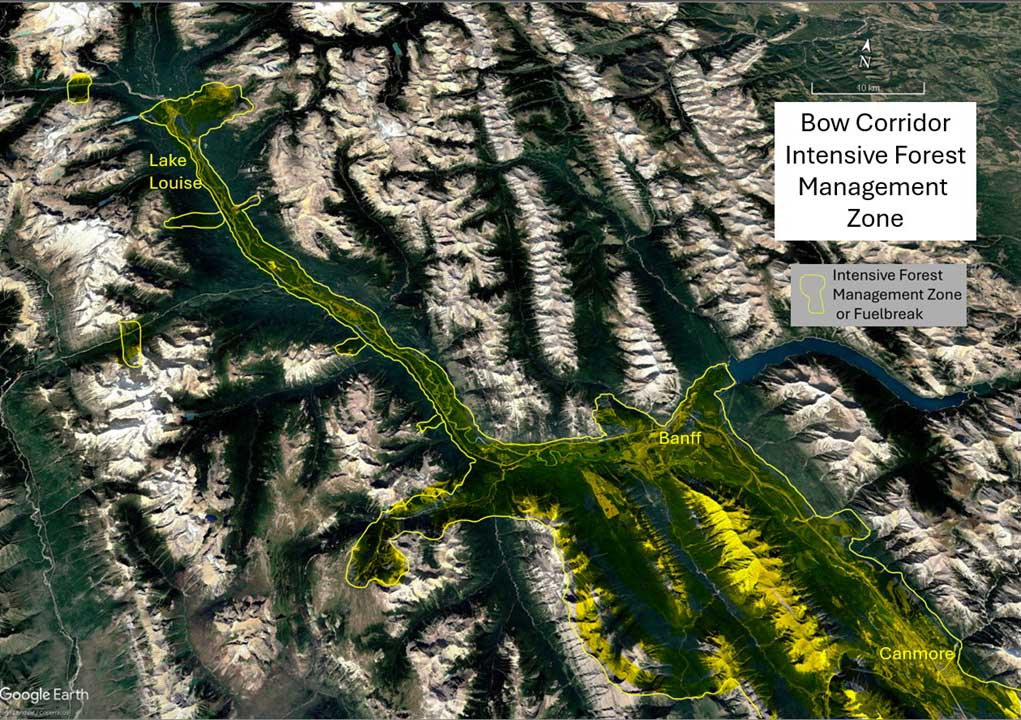
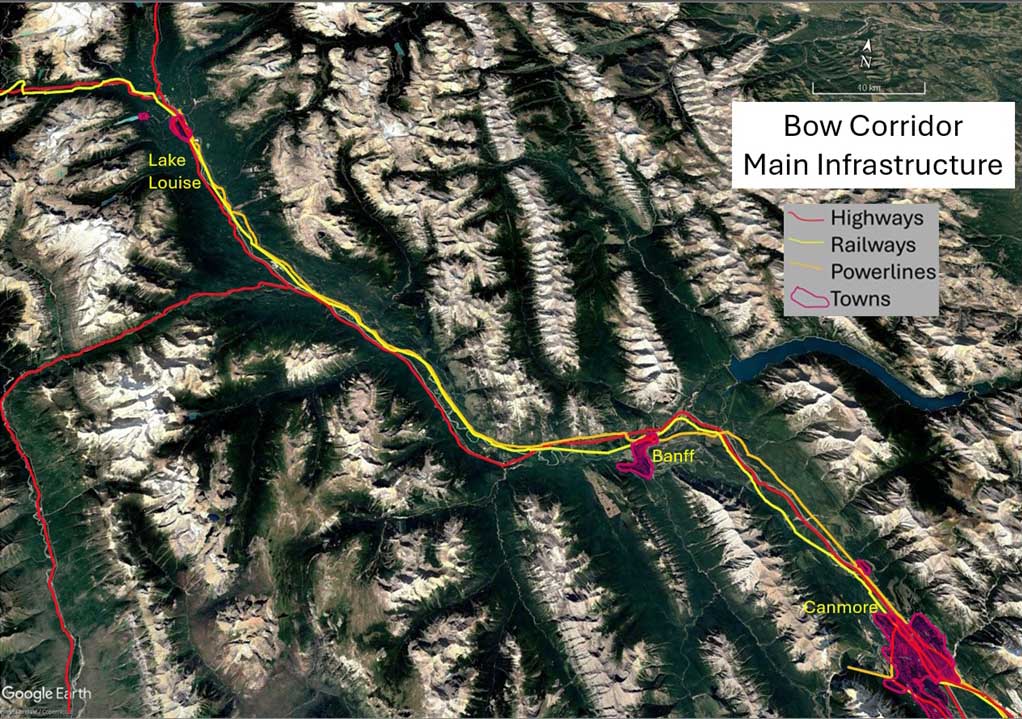
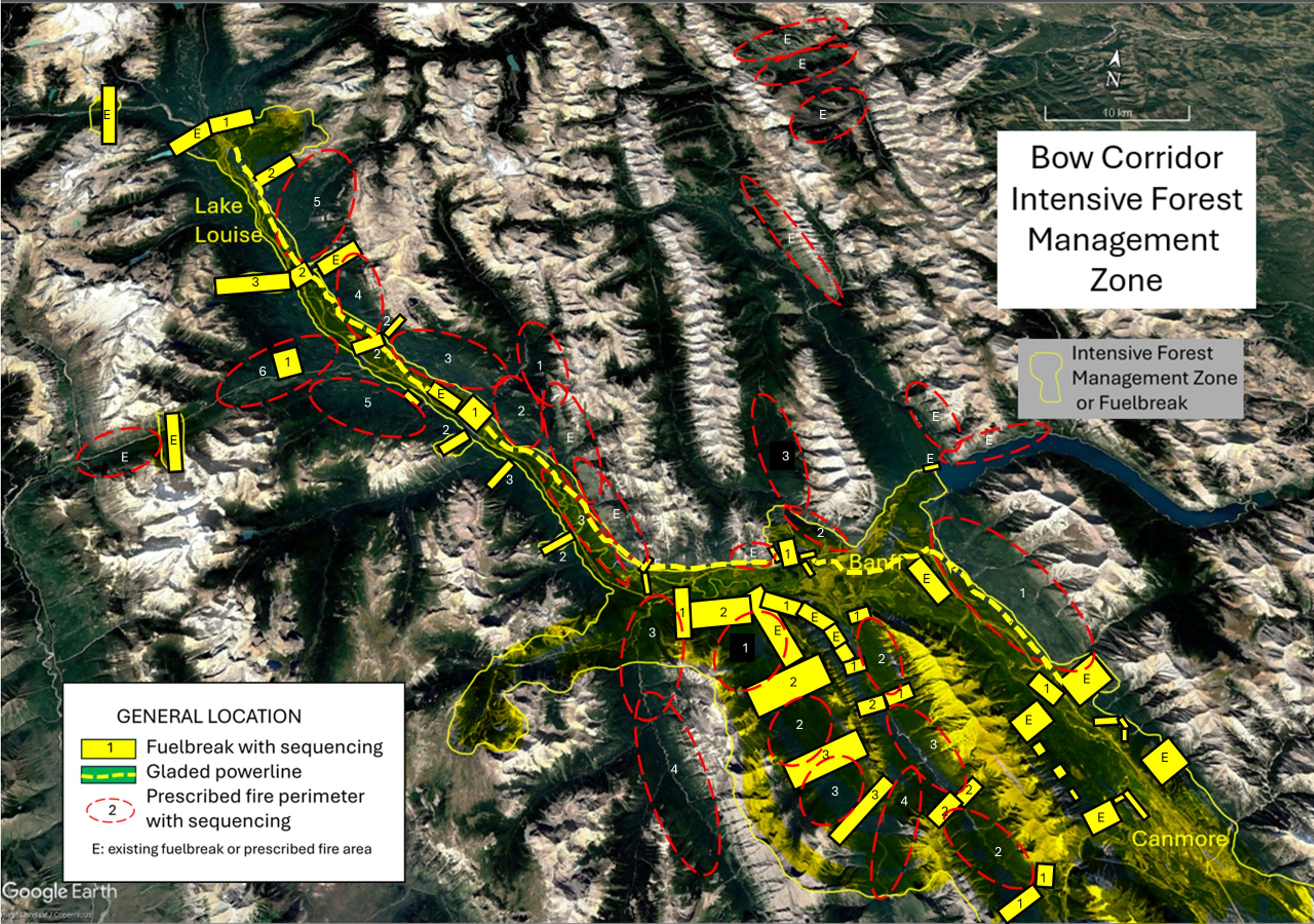
Images of main Bow Corridor infrastructure, an Intensive Forest Management Zone, and potential fuelbreaks and prescribed fires with sequencing (Base Image: Google Earth).
A systematic and holistic approach to zoning and forest management is required to reduce fire risk in the narrow corridor containing the Trans Canada Highway, CPKC Railway, Alta Link Powerline, Bow Valley Parkway, Telus Communications Line near the parkway, and numerous park visitor facilities.
Overview
The proximity of important, high-risk infrastructure along the floor of the Bow Valley is of obvious concern for public safety and national transportation. But consider several advantages to this situation:
- Historically frequent Indigenous burning maintained much of this corridor in relatively low flammability vegetation types (e.g., grasslands, aspen groves, willow-birch shrublands, and young pine glades).These vegetation types can be restored and maintained by prescribed burning or mechanically clearing the current high flammability forests of spruce and over-mature pine (see Section 30).
- Various types of fuelbreaks, partial felling and burning along the Bow River and existing infrastructure (e.g., twinned Trans Canada Highway, Alta Link Powerline) can be relatively easily linked to form a broad band (> 3 km wide) of low intensity type fuels the cumulatively protects all infrastructure and facilitates fire containment and evacuation during a wildfire event.
- Vehicle access exists along most areas and sections of infrastructure allows for both removal of commercial wood and operations to contain wild and prescribed fires.
- The low elevations of the Bow Valley corridor are important habitats for numerous native species. Careful ecological restoration and maintenance in this corridor can thus provide ecological, economic, and social benefits.
- Although the Parks Canada (2020) BYK Wildland Fire Plan did not take a systematic approach to reducing fire risk in the whole corridor, operational fire managers have continued to complete several projects that cumulatively begin to take this direction including the Protection Mountain and Moose Meadows fuelbreaks.
- When intensive forest management is completed, wildfires can either be contained by fuelbreaks that cross the zone from the river to upper mountain slopes, or be allowed to burn through the zone. With prevailing westerly winds these burns will be contained by mountain ridges to the northeast.
- Unlike a more traditional approach of using fuelbreaks to minimize area burned (e.g., Yemanshov et al. 2021, 2025), the geography and wind patterns in the Bow Valley could favour the use fuelbreaks and sequential prescribed burns to contain both escaped prescribed fire and wildfires to maximize the area that can be safely burned at low cost.
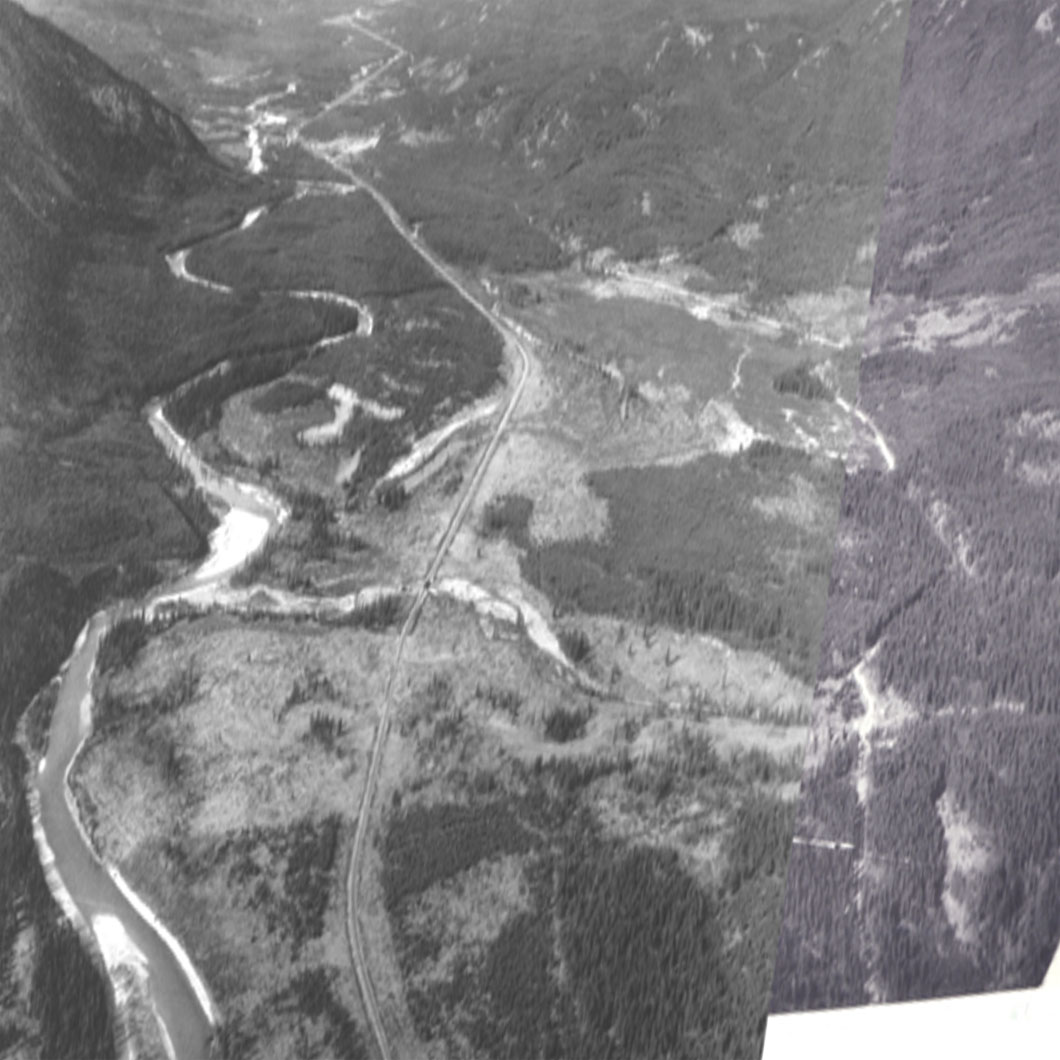
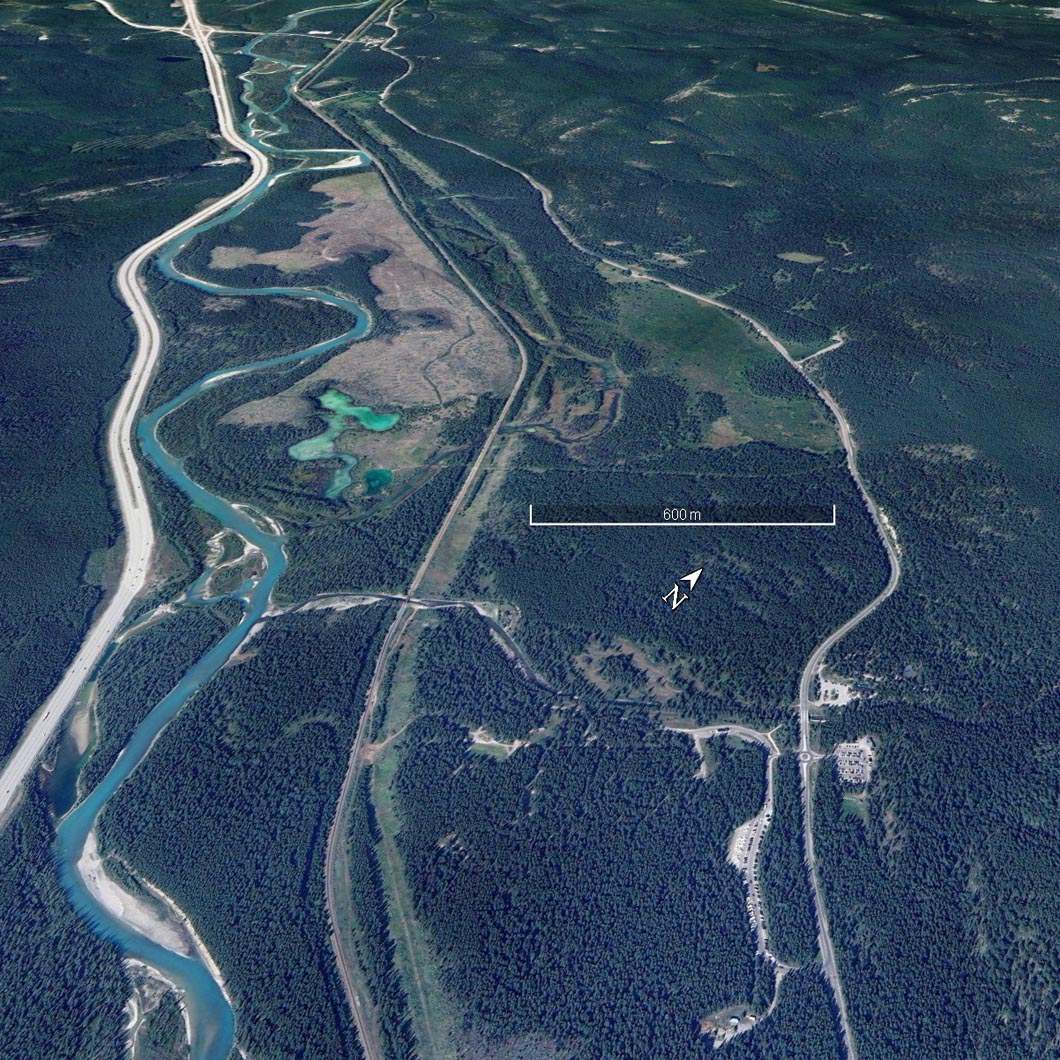
View of the proposed intensive forest management zone near Johnson Canyon in 1922 and 2025 (Images: National Air Photograph Library and Google Earth).
The intensive forest management zone here would extend from southwest of the Trans Canada Highway across the Bow River, CPKC Railway, Alta-Link Powerline, Johnson Canyon high visitor use area and the Bow Valley Parkway. Restoration of long-term vegetation within the zone will reduce wildfire risk. As described below the general strategy here would be to use fuel breaks and sequential prescribed burns to reduce conifer forest biomass and restore vegetation types to conditions more similar to 1922. Substantial work has already been done in this area. A large recently cleared fuelbreak exists between the rail line and the Bow River in the background.
Conceptual Locations/Sequential Scheduling for Fuelbreaks and Prescribed Fires
The existing Parks Canada (2020) fire plan for the region schedules minimal planned disturbance in the Bow Valley. The eventual outcomes will be massive mountain pine beetle mortality and a high probability of large, high intensity fires. The alternative approach is to manage disturbance type and scheduling to achieve an optimal outcome of costs, risk, and ecological integrity. The conceptual model below shows one option for this management direction within and adjacent to the intensive forest management zone. Many other options are possible, and their risk and ecological outcomes for probabilility of burning by additional unplanned wildfires over time could be cumulatively evaluated with a fire behavior simulation models such as Burn P3+.
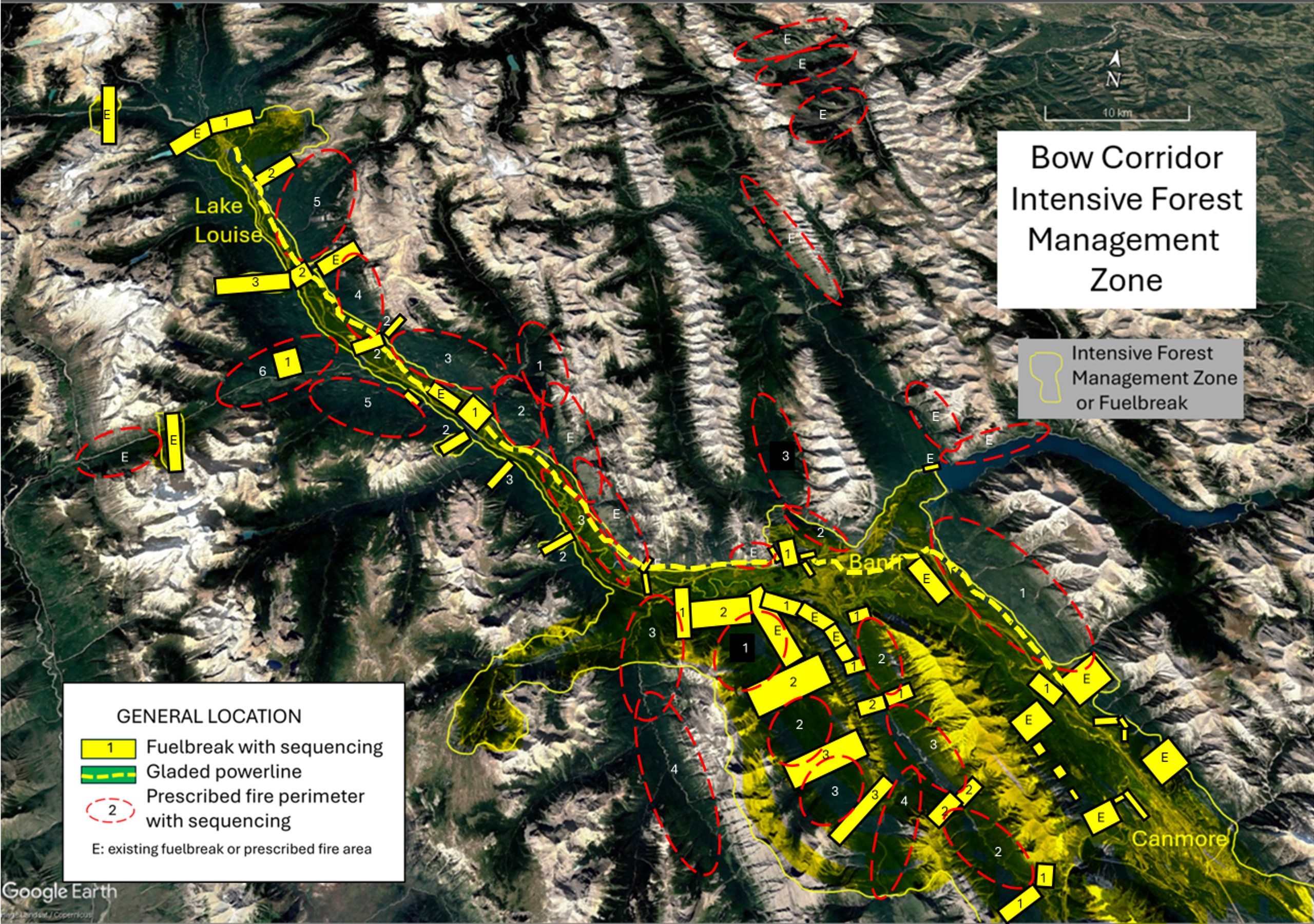
A conceptual model of potential locations and timing for fuelbreak clearing and prescribed fires in the Bow Valley (2025-2045). Click image to enlarge.
From an ecological and costs effective perspective, options such as these also need to carefully evaluated with the types of fuelbreaks that could be used under various conditions. From least to most potential ecological and social (e.g. visual) impacts these are:
- Late/early season patch burns– Warm/dry slopes or ridges with differential flammability can be burned early or late in the season with minimal spread into adjacent areas before going out due to winter or large precipitation events. These will block wildfire spread during high fire danger.
- Select tree-felling and burning– Differential flammability can also be achieved by felling trees, letting the foliage cure, and burning in low fire danger. Variable fire intensities and forest clearing can be achieved by the number and configuration of trees felled, slash treatment type and fire weather conditions. This method is particularly useful along powerlines to remove “danger trees” that over-top the line. These are simply felled into the adjacent forest, and when cured burned under conditions that kills some adjacent trees to glade-out the line with minimal impacts. Select falling followed by burning near streams may be useful to remove flammable white spruce and restore poplar, aspen, and shrubfields.
- Shaded fuel break with slash treatment– Where post-cutting windfall is unlikely, partial removals of overstory and understory trees and pruning can create conditions reduced fire spread rates and intensity. Retaining overstory trees reduces surface winds and dry flashy fuels. Treatment is often done with manual crews, but can also be done with smaller machinery. Slash can be burned or chipped. With road access, logs and chips can be removed. Impacts vary with degree of access and treatment.
- Glades or larger cutblocks– In areas where windfall is likely, the preferred treatment is larger cutblocks. Standard forest harvesting techniques with road access is usually required. Impacts vary with size of cutblocks, harvesting/skidding techniques, and type of road access (e.g. narrow winter snow/wood chip road versus standard logging road). Commercial timber is taken to a sawmill. Slash is collected and burned by various techniques, or in smoke-sensitive areas can be chipped and hauled.
All these fuelbreak types require an operations and maintenance plan for each location. This should give specifics of the “who, when, how” the fuelbreak will be used, and how it will be maintained over time. Routine maintenance work (e.g. low intensity burning) can be used to train fire crews on operation of the fuelbreak during a wildfire event. To fund maintenance, parks agencies or other entities harvesting forests could earmark a percentage of returns from commericial wood sales be retained in a non-profit society for this essential work.
Initial Cost Estimates
Even with these proximity and ecological advantages, existing and ongoing forest clearing, establishing and maintaining an intensive forest management zone will be expensive for the zone itself. Some basic costing is as follows for forest clearing and maintenance. First, let’s assume the the forest “fireshed” area in the Bow and adjacent watersheds is about 2000 km2 (200,000 ha), and for fire protection no more than 2.5-5% or a range of 50 to 100 square kilometers (5,000 to 10,000 ha) is intensively managed in the zone as fuel breaks (shaded or gladed) or recently burned (<20 years) area. Maintenance of fuelbreaks is presumed to be mostly by low intensity prescribed fire and smaller areas of mechanical cutting of regenerating trees. One initial maintenance cycle of less than 10 years may be required to reduce conifer forest regeneration and increase deciduous woody plant sprouting. After one or two cycles of maintenance costs should decline as fuelbreaks are integrated within broader, low-intensity prescribed fires.
| Potential square km of forest thinning or glading in zone | hectares | % total Bow Valley watershed | Range of unit and total zone cost of initial mechanical forest clearing in zone | Range of unit and total zone annual cost of maintenance (20 year maintenance cycle done largely with low intensity prescribed fire) | ||
| $1000/ha | $5000/ha | $100/ha | $500/ha | |||
| 50 | 5,000 | 2.5 | $5M | $25M | $.25M | $1M |
| 100 | 10,000 | 5 | $10M | $50M | $.5M | $2M |
These rough initial and annual costs may seem high, but it is important to recognize that if the intensive forest zone is functional in reducing risks to infrastructure and providing public safety huge benefits will accrue. Consider the following simple statistics:
- Loss of power, communications or highway human evacuation capacity result in almost incalculable costs to human welfare.
- Replacing infrastructure such as housing or commercial accommodation destroyed by wildfire can exceed $.5B/ha.
- Loss of power and communication lines will result in long-term costs to tourism and transportation during the extended period required for replacement. Intensive forest management will reduce this cost.
- Wildfire suppression operations in a landscape with minimal intensive forest management can be extremely costly. Well planned fuelbreaks cleared within the intensive forest management zone will reduce these costs.
- Intensive forest management should allow a larger area to be burned not only in prescribed fires, but also in contained wildfires. Ultimately, more burned area in the Bow Valley reducing overall forest biomass and fuels is the most effective way to reduce the risk of mega-fires with extensive risk to humans, infrastructure, and park ecosystems.
Return to “Reducing Bow Valley Wildfire Risk” overview page
References
British Columbia Wildfire Service. 2024. Wildland Urban Interface Wildfire Risk Reduction Plan. Victoria, BC.
Parks Canada. 2009. Banff Field Unit Fire Management Strategy. Banff National Park.
Parks Canada. 2020. Fire Management Plan 2020 Banff, Yoho and Kootenay National Parks. Resource Conservation Fire Management Section.
Yemshanov, Denys, Ning Liu, Eric W. Neilson, Frank H. Koch, and Marc-André Parisien. 2025. “Evaluating Fuelbreak Strategies for Compartmentalizing a Fire-Prone Forest Landscape in Alberta, Canada.” PLOS One 20 (5): e0321722. https://doi.org/10.1371/journal.pone.0321722.
Yemshanov, Denys, Ning Liu, Daniel K. Thompson, et al. 2021. “Detecting Critical Nodes in Forest Landscape Networks to Reduce Wildfire Spread.” PLOS ONE 16 (10): e0258060. https://doi.org/10.1371/journal.pone.0258060.