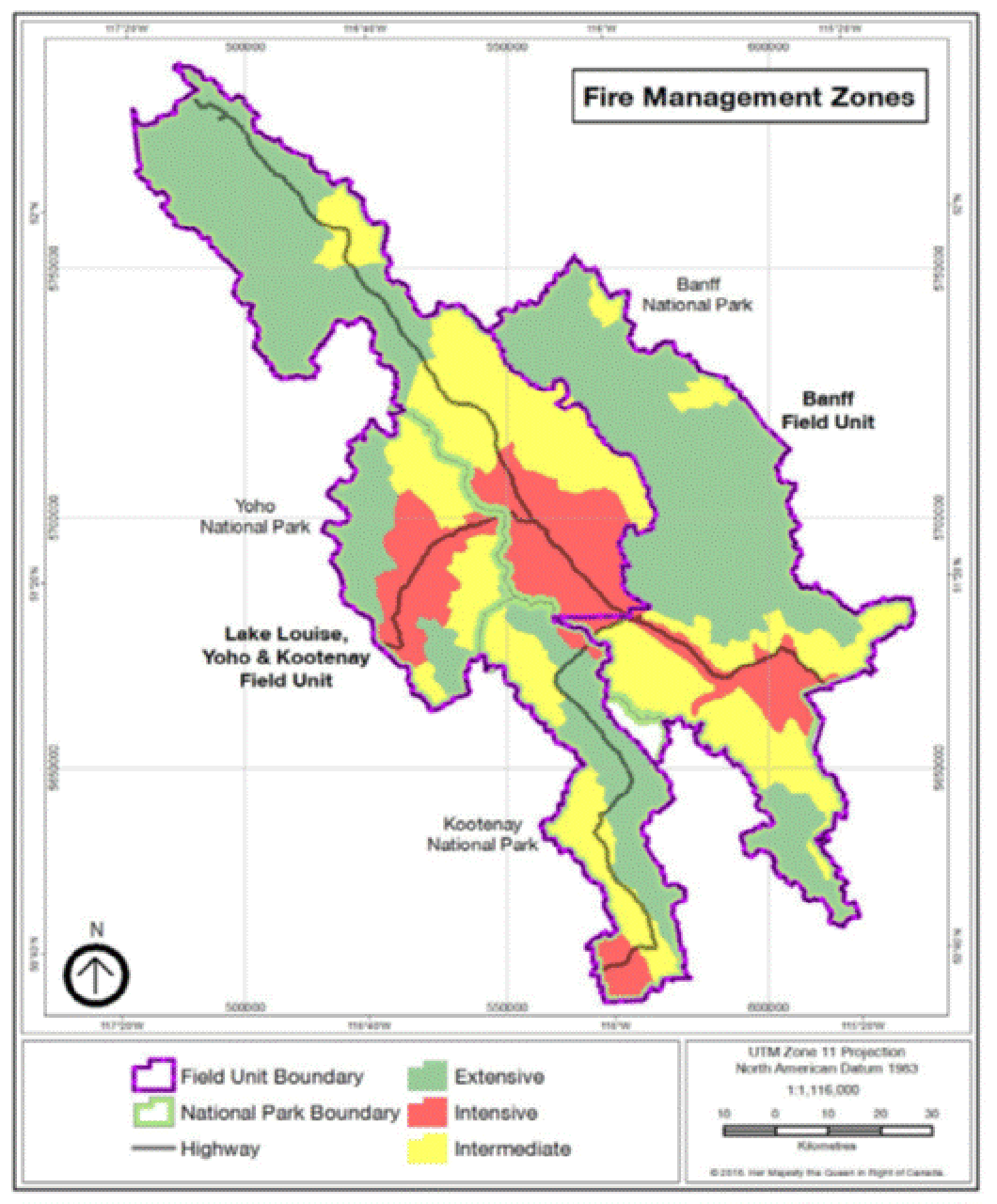
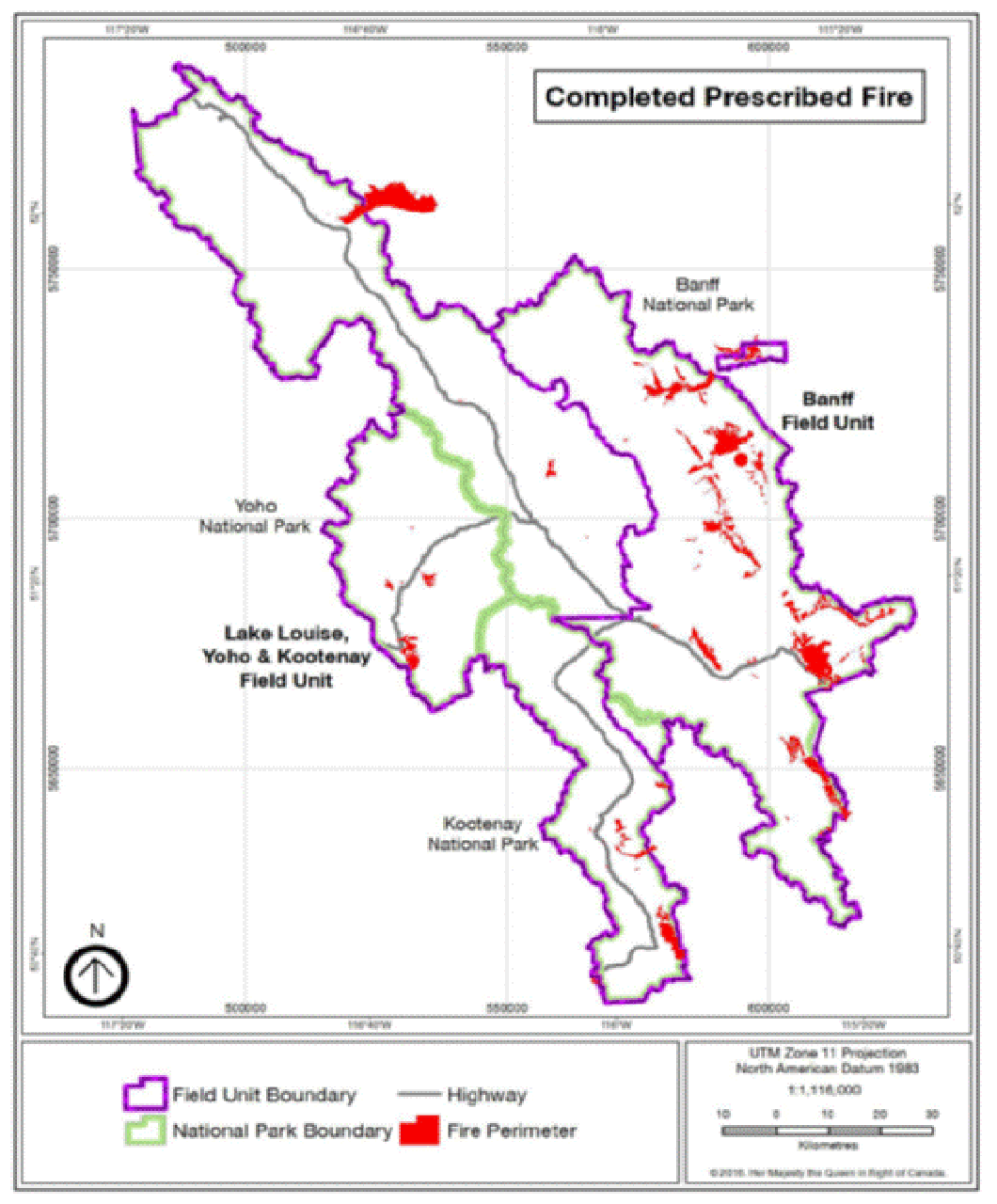
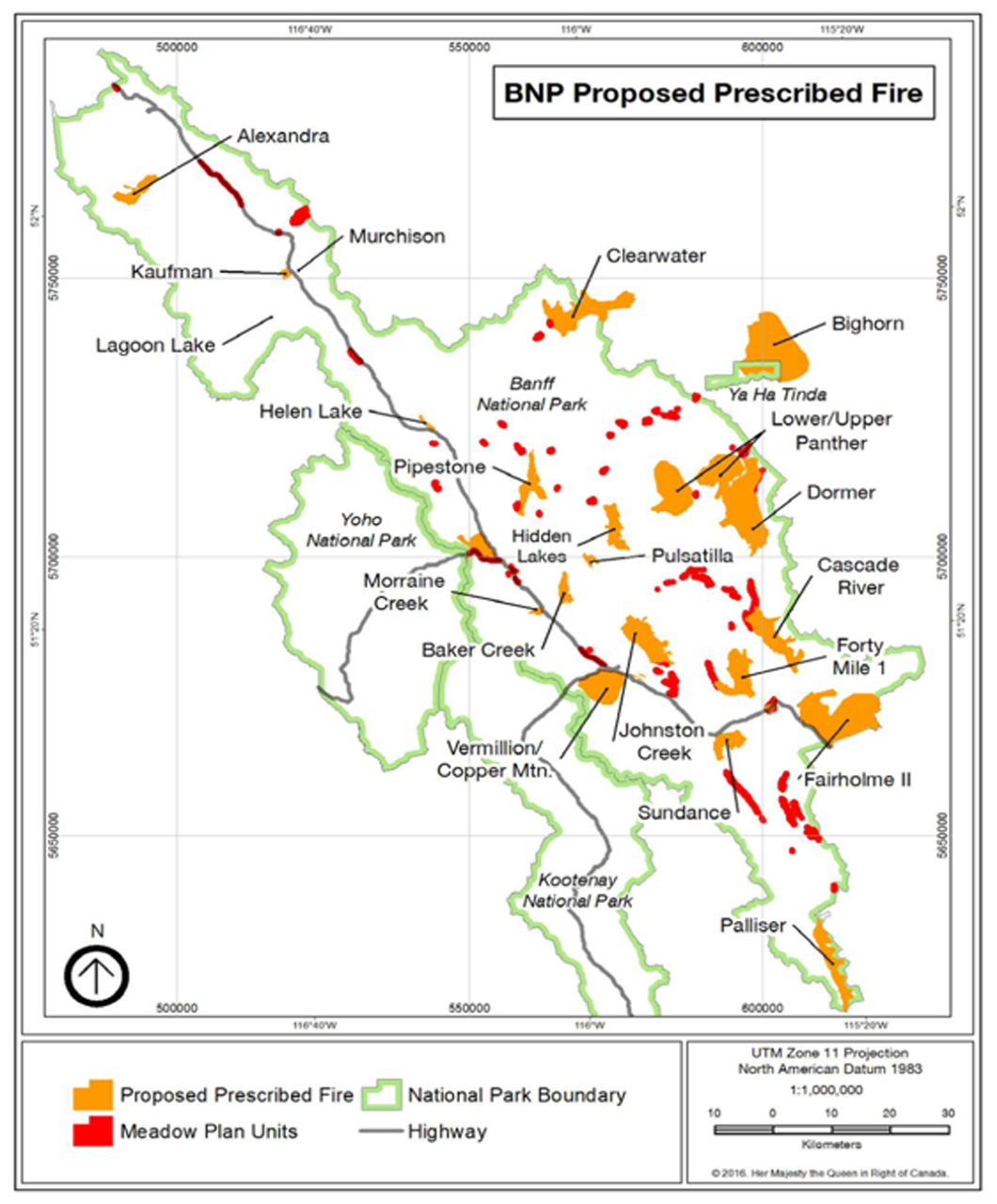
Images from the Banff, Yoho and Kootenay (BYK) 2020 Fire Plan: Prescribed fires completed (1983- 2016), BYK fire management zones, and proposed Banff prescribed fires. The plan describes continued large, prescribed fires in the eastern slopes of the park. It recognizes a broad are of high risk in the middle Bow Valley and near Banff townsite. However, for the Bow Valley, the plan provided no urgent, logical, or systematic approach to sharply reduce the risk of mountain pine beetle attack, ongoing fuel accumulations or the risk of a major conflagration. Through planned inaction, the 2020 plan was in essence a blueprint for increasing the probability of a disastrous mega-fire in the main Bow Valley.
Old-time park wardens, usually antsy to get out-the-door during a tedious meeting might remark: “Well you know, a camel is a horse designed by consensus.” And so it was with Parks Canada 2020 Banff National Park Fire Management Plan (“2020 Fire Plan”). Trying to amalgamate fire direction for parks on different sides of the continental divide with different fire regimes, vastly different human use levels, and different politics could only result in a tough, bumpy ride into the future.
Park managers had to find a compromise between east-slope prescribed burners moving westwards with complex sequential planned fires contained by large machine-cut fuelbreaks. In contrast the west-slope managers favoured mid-summer lightning strikes, and then the icefields and peaks of the Great Divide to contain large-area burns. Upward-bound park bureaucrats wisely tended to choose the lightning burns that by default be blamed on the whims of weather. In contrast, fuelbreak cutting followed by prescribed burns clearly required definitive objectives, an intrusive approach on the landscape, a high degree of public engagement, and culpability if things “went south” (or with prevailing winds, more often to the northeast). This violated the standard rules of bureaucratic survival: “Don’t do anything, and you won’t do anything wrong” or as they say: “Nobody moves, nobody get’s hurt.”
As a result, national park managers rejected direction developed for the Banff’s eastern slopes and the Bow Valley during the period 2000 to 2010 Parks Canada 2009 Banff Fire Management Strategy. Instead, they eventually approved the 2020 fire plan—a bureaucratic compromise that can only be an eventual default to future catastrophic mega-fires in the Bow Valley.
Flaws in the 2020 Fire Plan
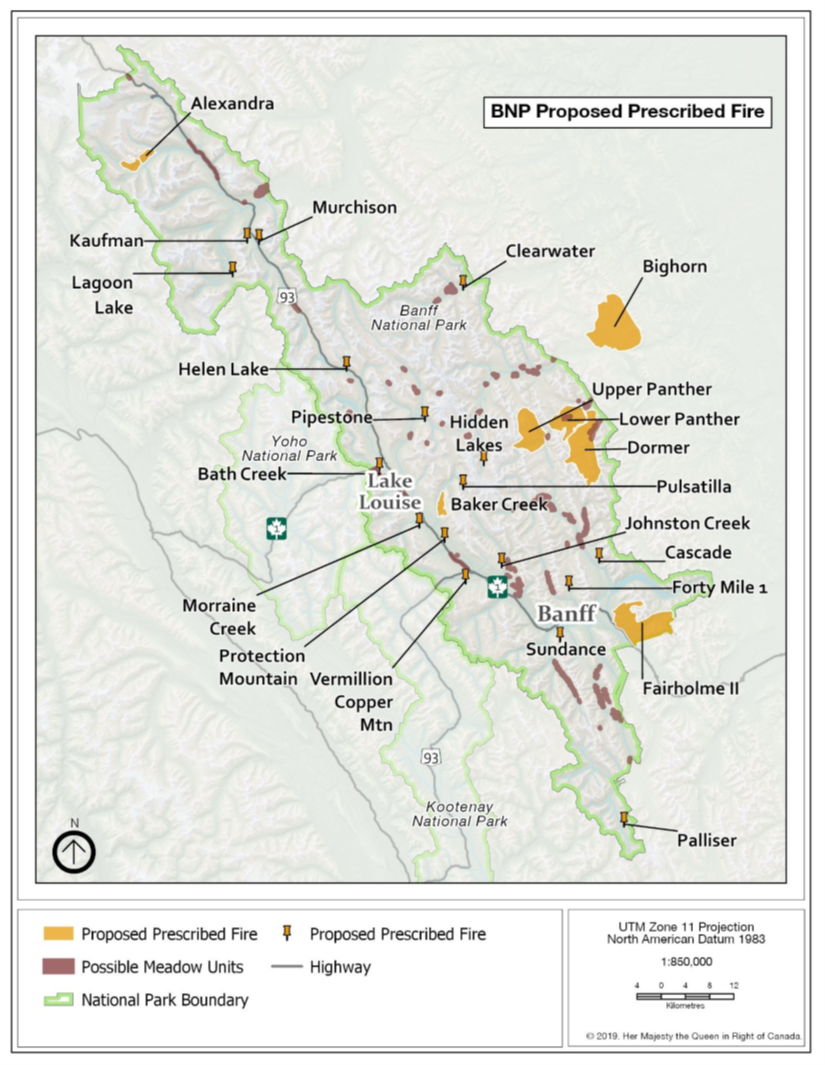
Planned fire management actions in the Banff, Yoho, Kootenay Wildland Fire Plan (“2020 Fire Plan”) showing no specific sequential use of fuelbreaks or large area prescribed fires in the Bow Valley, continued high rates of burning on the eastern slopes, and dozens of small red dots referred in the text as “meadow burns”. Click on image to enlarge.
Sadly, for reducing wildfire risk in the Banff-Canmore Bow Valley, the 2020 Fire Plan failed on several critical factors:
- Banff is not Kootenay or Yoho—These parks use up valley spread and the continental divide and Banff as their backstop for using lightning ignitions and minimal forest management (e.g. 2003 and 2017 fires). Banff has no backstop– down valley it just gets warmer, dryer, and windier. Banff needs fuel breaks and active management to reduce forest biomass (e.g. fuelbreaks and prescribed burning on the Fairholme Range or other eastern slope areas). Moreover, Banff contains significantly more infrastructure (mountain resorts, powerlines, larger towns). The Bow Valley is the only major highway artery directly west of Calgary, whereas travellers can, during fire emergencies use the alternate routes through Yoho or Kootenay.
- Failure to evaluate fire management by ecological management areas– Banff is a vast landscape (6600 square kilometers). Previous fire plans had divided the park into smaller areas and monitored the ecological forest health and burned area targets within the smaller areas (Parks Canada 2009). By amalgamating the park into one large area, the 2020 plan allowed senior managers and their media relations staff to claim the park was meeting management plan burning targets. What wasn’t said was this was achieved by comparatively high rates of burning in more remote areas but only doing minimal burning in the politically more complex Bow Valley. This is disingenuous and could only eventually create high forest biomass, and megafires with unfortunate ecological and economic consequences.
- No planned sequential fuelbreak and prescribed fire use– Most the successful area of prescribed burns in the previous decades had been achieved through a combination of designating large containment units, creating fuelbreaks at their boundaries, and then using prevailing winds upwind of the breaks to burn larger areas under more extreme burning conditions. The 2020 plan does not specifically recognize or expand upon this innovative strategy.
- No fuelbreak maintenance strategy– Essential and expensive existing fuelbreaks at Carrot Creek, Sulphur Mountain and other locations are transitioning into being high risk areas of wind-exposed dense young lodgepole pine. Although the 2020 plan recognizes that more fuelbreak clearings would be required, it provides no consistent provisions for either methods or funding to maintain the existing projects.
- Failure to assess implications of the upcoming major mountain pine beetle mortality event– Banff’s Bow Valley is currently in unique situation of large areas of still-living lodgepole pine. For the next few years fuelbreaks within this forest could be commercially harvested to partially offset costs. This fortuitous situation will soon end, sharply increasing the cost of constructing fuelbreaks and ability to fund mitigations to reduce environmental and social impacts.
- Use of “meadow burns”– The 2020 plan proposes to achieve much of the area burned and ecological restoration through numerous valley bottom “meadow burns”. These are fraught with logistical and fire holding issues and may have little historical or ecological precedent. Early or late season burns that in Indigenous times were just “overachievements” that spread broadly downwind and upslope can– with today’s human use and infrastructure—result in traumatic events for both Indigenous and modern agency prescribed fire practitioners. “Mother Nature doesn’t care who lights the fire” (Van Wagner 1985).
- In sum: a default to ongoing broad area fire suppression followed by mega-fire in the critical Bow Valley corridor– The 2020 plan assigns a broad area in the Bow Valley to intensive fire suppression with few prescribed burns, several questionable meadow burns, and no strategic containment unit planning. In other words, most forests in this area would continue to age with increasing mountain pine beetle mortality until a prescribed meadow fire or wildfire escapes to burn a large area (e.g., Kootenay Parkway 2003, Jasper 2024). This will eventually be a disaster for highway traffic movement, powerlines, towns and other infrastructure in the Bow Valley.
Fortunately, even before it was signed off, field-level fire practitioners recognized that although Banff’s 2020 Fire plan might have Parks Canada’s upper administration’s blessing, it wasn’t a useful blueprint for the future. Deviations from the plan started immediately. In the upper valley, even prior to the 2024 Jasper Fire, fire staff began build broad valley wide fuel breaks at Ross Lake and Protection Mountain that were not described in the 2020 plan. With these recent prototypes, the Banff and Canmore area fire managers could rapidly respond to the political awareness created by the 2024 Jasper disaster, and are moving on to more innovative solutions.
Return to overview Bow Valley Wildfire risk reduction section
References
Alberta.
Parks Canada. 2009. Parks Canada 2009 Banff Fire Management StrategyBanff National Park.
Parks Canada. 2020. Parks Canada 2020 Banff National Park Fire Management Plan. Resource Conservation Fire Management Section. Banff, AB.